Worldwide attack on fundamental civic freedoms laid bare by new online tool that rates civic space and documents rights violations
24/10/2016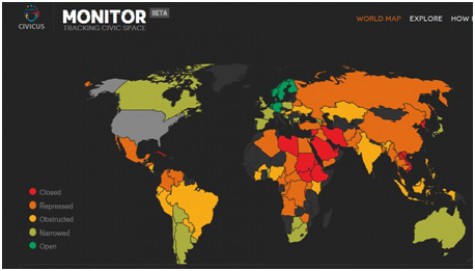
More than three billion people live in countries where the rights to protest, organize and speak out are currently being violated according to the CIVICUS Monitor, the first-ever online tool to track and compare civic freedoms on a global scale.
The new tool, launched in beta today by the global civil society alliance CIVICUS, rates countries based on how well they uphold the three fundamental rights that enable people to act collectively and make change: freedom of association, freedom of peaceful assembly, and freedom of expression. The Gulf Centre for Human Rights (GCHR) is a partner in this initiative, for which it monitors Bahrain, Kuwait, Oman, Saudi Arabia, Qatar, the United Arab Emirates, Syria, Iran, Iraq and Yemen. In the countries covered by GCHR, these fundamental rights are regularly violated by States.
Of the 104 countries currently rated, it finds that civic space in 16 countries – Bahrain, Burundi, Cuba, Equatorial Guinea, Eritrea, Ethiopia, Iran, Laos, Libya, North Korea, Saudi Arabia, South Sudan, Sudan, Syria, UAE and Vietnam – is closed, a rating characterised by an atmosphere of fear and violence, and severe punishment for those who dare to disagree with authorities. A further 32 countries are rated repressed, meaning that 3.2 billion people live in countries where civic space is either repressed or closed.
Twenty-one countries are rated obstructed and 26 narrowed. Just nine countries were rated as open, meaning the state safeguards space for civil society and provides platforms for dialogue. There were violations of civic freedoms in every region of the world, but these are more concentrated in Africa, the Middle East and the Americas.
“The CIVICUS Monitor shows that far from valuing citizen action, states are cracking down on protesters, shutting down organisations on the flimsiest of pretexts, and brutally silencing dissent,” said Dr. Dhananjayan Sriskandarajah, Secretary-General of CIVICUS. Governments should not fear people power, they should be harnessing its potential.”
“In the countries monitored by GCHR, journalists, human rights defenders and activists are killed, disappeared, arbitrarily detained, threatened, harassed and subject to reprisals rather than being protected and supported to carry out their legitimate work in defence of human rights,” said Kristina Stockwood, chair of GCHR’s Advisory Board.
The CIVICUS Monitor also documents attacks on civil society with updates every weekday. Analysis of more than 200 updates to the CIVICUS Monitor over the past four months has found:
● Detention of activists (68 cases), use of excessive force against protesters (62 cases) and attacks on journalists (37 cases) were the three most common violations of civic freedoms
● Activists were most likely to be detained over criticism of authorities (37%), human rights monitoring (29%) or political divisions or conflict (16%)
● Excessive force was most likely to be used against protesters who criticise government decisions or corruption (29%), call for action on human rights abuses (20%) or call for basic social or economic freedoms (20%)
● Journalists were most likely to be attacked covering protests (26%) or conflicts (19%), or because of their ethnicity, religious or political affiliation (14%)
● In the vast majority of cases, the state is the perpetrator of violations
“Attacks on those who speak out against their leaders are becoming increasingly brazen – and it’s because governments know their actions will go unpunished,” said lead researcher Cathal Gilbert. “By collating these attacks, we hope the CIVICUS Monitor will serve as a wake-up call to the international community. We are inspired by the innovative ways that local civil society is resisting this assault, but it is imperative that global leaders do not stand by silently as their allies and trade partners crush domestic dissent.”
“For human rights defenders in the region, this new tool will provide additional evidence for international advocacy and is a call to action to the international community. Governments in the region need to be held accountable for their direct targeting and repression of human rights defenders and violations of the rights to freedom of expression, assembly and association,” said Khalid Ibrahim, Co-Director of GCHR.
Ratings are based on a combination of inputs from local civil society activists, regional civil society experts and research partners, existing assessments by national and international civil society organisations, user-generated input and media-monitoring. Local views are prioritised. At launch the CIVICUS Monitor will offers ratings of civic space in 104 countries and updates for most countries in the world. The number of countries rated will increase over time, with ratings for all countries available in 2017.
Unique amongst global measures of freedom, democracy and governance, the CIVICUS Monitor will be updated each weekday, and users are invited to contribute in order to improve accuracy.
CIVICUS hopes the CIVICUS Monitor will be an invaluable tool allowing activists, journalists, civil society organisations, academic institutions and the general public to assess how well their governments are enabling civic freedoms, as enshrined in national constitutions and guaranteed in international law, as well as through intergovernmental commitments such as the Sustainable Development Goals, Open Government Partnership and the Busan Partnership for Effective Development Cooperation.
The CIVICUS Monitor is available at https://monitor.civicus.org