GCHR Co-Director and Staff Participate in Three Side Events during First Week of the 29th session of the HRC in Geneva
21/06/2015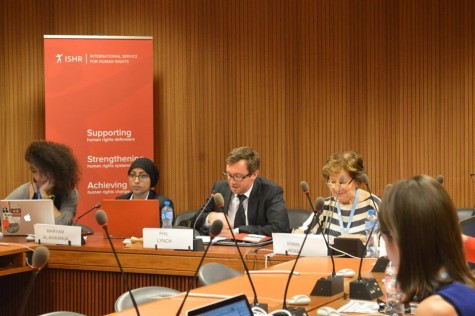
Overcoming Restrictions on Women Human Rights Defenders in the MENA Region
Co- director of the GCHR, Maryam Al-Khawaja, and GCHR researcher, Elsa Saade, took part in an side event on the 18th of June 2015. The side event was co-sponsored by CIVICUS, ISHR and GCHR. During the event moderated by ISHR Director, Philip Lynch; Chair of the Working Group on Discrimination against Women in Law and Practice, Emna Aouij, started the panel by talking about the restrictions faced by WHRDs in the region, including attacks, shortage of funding and discrimination. Al-Khawaja then spoke about the crackdown on WHRDs in the region, mentioning specific cases from different countries including Iran, Iraq, Syria and Egypt. She reiterated the importance of having stronger mechanisms of accountability for reprisals. Following her, Sara Brandt, the International Advocacy Advisor at the Center for Egyptian Women’s Legal Assistance, spoke about the attack against WHRD, Azza Soleiman, due to her witnessing the killing of Shaima AlSabbagh. The final speaker of the event was Elsa Saade, who focused on the situation of WHRDs in Saudi Arabia, raising several specific cases that the GCHR covered.
Among the recommendations made by the panel were:
– Essential that rights of WHRDs are entrenched in law to progress;
– To not wait until convictions to act on cases of WHRDs;
– Gender Equality must be entrenched in constitutions;
– Eliminate all discriminatory laws;
– Follow up mechanisms on attacks on WHRDs;
– Stronger mechanisms of accountability against reprisals.
Right to Protest
GCHR Co-Director Maryam Al-Khawaja was invited to join a panel sponsored by Article 19 on the right to protest. Moderator Thomas Hughes, Executive Director of Article 19, introduced the panel, moving to Al-Khawaja as the first speaker. Al-Khawaja spoke about the crackdown on protests in the Gulf region, and the shrinking space for peaceful assembly. Long Kimheang spoke about the attack on the movement for land rights and Marek Tyszynski spoke about how Tactical Tech works to promote digital security tools, and address the restrictions on digital technologies in regards to protest movements. He was then followed by Paula Martins, who spoke about the crackdown on protests in Brazil, and the tactics used by police against protesters. Finally, the UN Special Rapporteur on extrajudicial, summary or arbitrary killings, Christof Heyns, discussed the inter-connectivity of his mandate on police violence with protecting peaceful protesters; adding that all issues addressed by the UN Human Rights Council, in many ways, were brought to attention through protest.
Using information and communication technologies to protect human rights
UN Special Rapporteur on extrajudicial, summary or arbitrary executions, Christof Heynes, invited GCHR co-director Maryam Alkhawaja to join the panel sponsored by the United Nations Office of the High Commissioner and International Service for Human Rights. Heynes started off the panel speaking about the importance of technology, and how it has increased the number of people in the “human rights project”. He added that digital documentation and digital security must be essential tools in the human rights defender toolkit. Al-Khawaja then spoke about the importance of social media to HRDs in the region as a tool for documentation, and the responsibility of companies to ensure their ICTs are being used to protect, not to violate rights. She also spoke of how the Internet is a double edged sword, and governments have learned how to use it to target dissidents and HRDs. Next on the panel was Amnesty’s Advisor to the Technology and Human Rights Team Tanya O’Carroll who spoke about how mobile phones can be a potential lifeline for HRDs at risk and explained how Amnesty’s panic button on phones works. Kelly Matheson, Senior Programme Manager at WITNESS, went on to speak about the importance of training HRDs on how to collect information and evidence that is admissible in courts. Josh Lyons, Satellite Imagery Analyst at Human Rights Watch, shared examples of how his team analyzes video and picture evidences sent to them from places like Syria to verify authenticity. Finally, Felim McMahon, Digital Investigator at the Office of the Prosecutor at the International Criminal Court, said that ultimately, video and other evidence will never substitute for brave witnesses standing in court and giving vital testimonies.