Cybersecurity Highlights and Digital Protection for Human Rights Defenders and Journalists
30/10/2020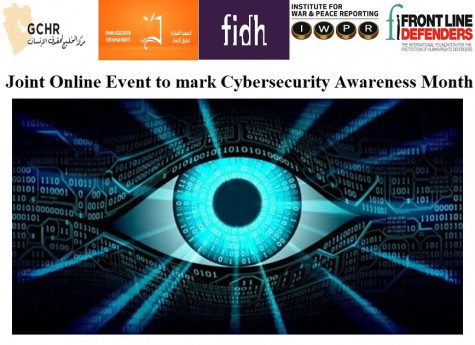
On 26 October 2020, the Gulf Centre for Human Rights (GCHR) held an online event for Cybersecurity Awareness Month. Relying on digital communication and devices to stay connected in the physically-distanced COVID-19 time primes the importance of cybersecurity for human rights defenders (HRDs) in the Gulf and Neighbouring countries. GCHR was joined by Zaina Erhaim from the Institute for War and Peace Reporting (IWPR), Habiba Al-Hinai from the Omani Association for Human Rights (OAHR), Mohammed Al-Maskati from Front Line Defenders, and Vincent Fargeas from the International Federation for Human Rights (FIDH).
In this event, Al-Hinai and Erhaim explained the types and impact of cyberattacks on HRDs, including women human rights defenders (WHRDs), and journalists. Al-Maskati highlighted that mitigating cyberattacks and cybersecurity breaches is not easy since they are multi-layered and originating from different sources. On that Fargeas highlighted that limited public knowledge of cybersecurity motivates the development of guides such as FIDH’s Cyber Survival Kit which balance specialised and accessible knowledge of cybersecurity.
Problems of cybersecurity and digital protection are aggravating the closure of the Internet as an open space for activism, noted both Erhaim and Al-Hinai. In Oman, Al-Hinai spoke of the combination of repressive laws and prosecution, direct intimidation from security services, and cyberattacks targeting online accounts of HRDs in closing the Internet, which she said is “the only space for the people of Oman to represent themselves.”
Across the region, cyberattacks and the growing conservatism in society which motivate the censorship of free speech and activism have taken a toll on WHRDs, Erhaim explained. As such, WHRDs have to distance their identities from their activism and lessen the risks by remaining anonymous. Fargeas added that targeting HRDs and WHRDs is a global trend that need to be addressed at both technical and human rights levels, such as smear campaigns. On this note, Al-Maskati highlighted that the LGBTQI community and WHRDs were the most targeted in the region before COVID-19 and transferring life online increases the risks of these attacks.
Other challenges to address are related to expanding analysis into the “bot” activity in the region, the sale of surveillance technologies and malware, and censorship on commercial platforms such as social media.
To strengthen advocacy efforts and the international community’s commitment to protection of HRDs, GCHR invited the speakers to highlight advances for cybersecurity. Recommendations involved establishing international mechanism for regulating sale of dual-use technology to governments, urging social media platforms such as Facebook and Zoom to be transparent about their content moderation decisions, and strengthening solidarity networks and support campaigns on behalf of targeted WHRDs and HRDs.
For more information or inquires, contact us at: info [@] gc4hr.org or visit our website https://www.gc4hr.org/
###
The Gulf Centre for Human Rights (GCHR) is an independent, non-profit and non-governmental organisation that provides support and protection to human rights defenders in the Gulf region and neighbouring countries in order to promote human rights, including but not limited to freedom of expression, association and peaceful assembly. GCHR is based in Lebanon and documents the environment for human rights defenders in the Gulf region and neighbouring countries, specifically Bahrain, Kuwait, Iran, Iraq, Jordan, Oman, Qatar, Saudi Arabia, Syria, the United Arab Emirates and Yemen.