This is the story of two families from different countries who share the same pursuit of human rights despite immense personal costs. The first comes from Bahrain, while the second hails from Egypt. Human rights defense has passed from one generation to another in these families of courageous men and women, some of whom are in jail on lengthy sentences for standing up for their beliefs.
Khalid Ibrahim
Second part in Egypt:
Seif Family
Ahmad Seif:
Let’s start with the first man of the family, the human rights activist, champion of the poor, and a man humble by nature, the man with the greatest of accomplishments, whose name is Ahmad Seif Al-Islam Abdel Fattah. His picture below has deep meaning and it can summarize all that he has done in his life, taking a humanitarian stand and defending prisoners of conscience. He has faced successive authoritarian governments in Egypt which have tried by all means to suppress his strength and perseverance. Despite their efforts to bring him down, he conquered them.
 Ahmad Seif at court during one of his defense cases
On 4 September 2012, Ahmad Seif wrote in his diary (known as “Kharbashat”) about his loyalty to the principles of human rights and his big dream of freedom for Egypt, which he believed to be possible. He wrote: “I promise to work hard in order to stay loyal to the standards of international human rights. Help me fulfill this promise. I might be a dreamer but why not dream? Wasn’t our revolution a dream that we thought was far-fetched?” https://ahmedseif.wordpress.com/
On 9 December that year he also talked about the close tie between human rights and human dignity to Amnesty International. He said, “Of course when I became more involved in human rights, I found it has a much wider scope than torture, though all of it arises from the original basic rule, which the UDHR also upholds, and that is respect for human dignity. All that violates human dignity is an abuse to human rights.” http://www.amnesty.org/en/news-and-updates/feature-stories/human-rights-defender-egypt-ahmed-seif-el-islam-20081209
Many stands taken by this amazing man in his lifetime can be highlighted. Foremost of which would be his choice to live in prison for five years rather than run away from his country despite the chances he had to do so. He also would not accept any governmental job; instead he would prioritize his work as a civil activist. Ahmad Seif had also participated in founding the Hisham Mubarak Law Center in 1999 and took a lead in its administration since its inception as the center worked to address human rights violations and to provide support to victims of these violations, who otherwise had nobody to stand up for them.
And after having lived a lifetime full of challenges and difficulties, as well as achievements, he died on 27 August 2014 after having fought sickness, while his son Alaa and his daughter Sanaa were jailed in Egyptian prisons. You can hear him on this video apologizing to his son Alaa saying: “I am sorry Alaa that you did not inherit democracy, instead you inherited prison.” https://www.youtube.com/watch?v=3C0uQ_I68sU
Dr Leila Soueif:
This lawyer would not have been able to pursue his mission if it weren’t for the presence of his wife and life partner, activist and doctor Leila Soueif, by his side. She supported him with a strong will that could not be diminished and always participated in his human rights activities. At the same time, she was a human rights defender in her own right, founding both the Assemblies that work for the Independence of Universities (Movement of March 9th) as well as the Egyptian Organization Against Torture. Dr Leila was a friend and champion to her husband, as well as the mother of three children Alaa, Mona and Sanaa who chose the same hard path to freedom their parents did.
 Dr Leila and Alaa, who is holding his son Khalid, and behind him stands his wife Manal
Alaa Seif:
Alaa Abdel Fattah is a well-known Egyptian blogger. He is a firm human rights defender who has founded, along with his wife Manal Baheyeddin Hassan, the blog “Manal and Alaa’s bit bucket” which during 2005 was awarded the best Arabic blog by Reporters Without Borders”. http://manalaa.net/node/22139
Alaa was arrested and imprisoned several times because of his human rights activities in support of freedom of expression, freedom of opinion as well as freedom of assembly and because of his desire to build state institutions that protect the rights of citizens without exception. On 11 June 2014, a court in Egypt sentenced him, along with 24 others to 15 years in jail and a fine of 100,000 pounds (US$14,000) on trumped up charges related to participating in a peaceful protest held on 26 November 2013 in Cairo. Police used force to disband the demonstration that was organized by the group “No to military trials for civilians” two days after the government issued a law restricting the right to peaceful assembly.
http://www.hrw.org/news/2014/06/11/egypt-15-year-sentences-25-peaceful-protesters
On 23 February 2015, during a re-trial of the case, Alaa was sentenced to five years in prison for violating a law banning unauthorized protests. See: http://www.theguardian.com/world/2015/feb/23/egyptian-activist-alaa-abd-el-fattah-sentenced-five-years-jail
Manal Baheyeddin Hassan:
Meeting Manal Baheyeddin Hassan recently in Beirut, I found her full of excitement and prepared to support a human rights movement and the protection of activists digitally. Despite the fact that her husband Alaa is still behind bars, she would not hide her optimism concerning a future of freedom and prosperity, clearly projected by the smile on her face in this picture below which the blogger and activist Hamzoz caught on camera.

And here is another paradox in the life of this family of fighters which Ahmed Seif mentioned before he passed away: “My daughter Mona was born while I was in jail, which is exactly what happened with Alaa, my son, whose son Khalid was born while he was in jail, as though history is repeating itself.”
Mona Seif:
Which leads us to Mona Seif, the human rights activist who is characterized by her infinite love for her family members and her ferocious defense of them as well as her constant participation in the Egyptian revolution, which succeeded in ousting Hosni Mubarak from power in 2011. She has also been a prominent social networking figure and keeps actively working on increasing public awareness of civilians tried by the military.
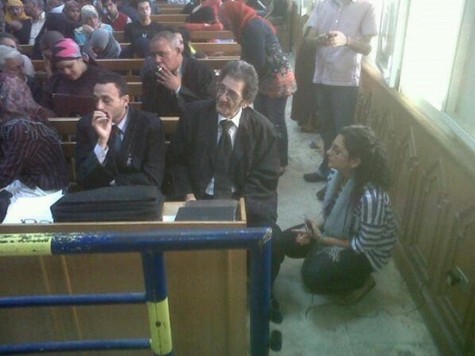
In this picture here, Mona is beside her father in an Egyptian courtroom where Ahmed Seif was pleading in defense of a group of prisoners of conscience, sitting beside him and looking at him with love and tenderness that transcends time and space to meld with the dreams and goals for which he died.

On 30 June 2014, Mona wrote on her Facebook page about her younger imprisoned sister Sanaa. Mona has affectionately described Sanaa as the last of the successive line:
“Sanaa is with me every moment of every day
I talk about her to all the people around me
I talk to her, I apologize to her when I’m weak,
And in my mind I let my guards down with her.”
Sanaa Seif:
And we get to the youngest, Sanaa Seif, who worked with all the means she had available for the sake of her imprisoned brother Alaa. In the picture below she is alone in front of Kobba palace, before she was arrested, asking for freedom for her brother Alaa Abdel Fattah and 23 others sentenced to 15 years in jail.

On 26 October 2014, the misdemeanor court in Cairo issued a sentence of three years in jail for 23 human rights activists, Sanaa included, and it also imposed on the 23 activists an additional three-year period of security inspection as well as a 10,000 Egyptian pound fine (around US$1,398) plus an imposed payment compensating for the damage caused by the uproar. http://english.ahram.org.eg/NewsContent/1/64/113998/Egypt/Politics-/BREAKING-Activist-Sanaa-Seif,–others-sentenced-to.aspx
A New Generation that Gives Hope:
Finally, after having introduced all members of the two families who are activists, it would only be fair to end the story with the new generation that gives hope.
Let us first share what Mona wrote to her nephew, whose name is Khalid and who was born while his father was still in jail. It’s a very short sentence but it provides hope for a warm and bright future to everyone:
“And with Khalid, a new journey begins… It carries so much love that it can feed us all and more.”

The reality, there is big hope in Bahrain as well as in Egypt for the new generations of Jude and Abdulhadi junior – the grandchildren of Abdulhadi Senior and the children of Zainab – as well as the grandchildren of Seif and the children their age who would hopefully not have to live under the current oppression ruling their countries. Instead, they should find free and prosperous societies that respect humans and their rights to generous and fruitful lives, in part because of their grandparents’ sacrifices.