UN side event highlights need for protection in the face of ongoing attacks on human rights defenders and journalists
27/06/2015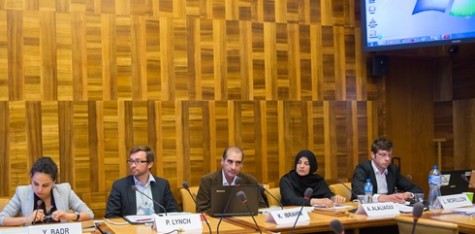
On 25 June 2015, the Gulf Centre for Human Rights (GCHR) organised a side event in Geneva at the 29th Session of the United Nations Human Rights Council on the situation of human rights defenders (HRDs) and journalists in Syria and Iraq. The event was co-sponsored by the Cairo Institute for Human Rights Studies (CIHRS), CIVICUS World Alliance for Citizen participation, Euro-Mediterranean Human Rights Network (EMHRN), International Media Support (IMS), International Service for Human Rights (ISHR), Metro Centre to Defend Journalists in Iraqi Kurdistan, Syrian Center for Media and Freedom of Expression (SCM) and Reporters Without Borders (RSF). GCHR co-director and moderator Khalid Ibrahim opened the session by introducing the panelists and providing a general background on the issues in both Syria and Iraq.
SCM Director Yara Bader, wife of detained human rights defender Mazen Darwish, provided a legal background for the current situation of human rights defenders and specifically journalists in Syria. She called for continuous support for Darwish and many other human rights defenders in Syria. Bader highlighted the legal issues surrounding the case of the SCM detainees, and how the arrest and court case lack the basic standards of due process and fair trials. She continued to explain the ambiguous definition of the terrorism law in Syria that tends to shape charges of terrorism and extremism against human rights defenders for practicing human rights activities. She then stated the importance of upholding support for Syrian human rights defenders and specified: “You cannot have a free society without free media, which is why we need people like Mazen Darwish.” She continued: “The youth in Syria broke the iron wall of information, but tens of thousands of them lost their lives as a result. We will make it hard to forget all human rights defenders fighting for human rights for the sake of our survival.”
The audience then heard from Angela Alaliaoui, independent human rights activist and wife of Ammar Al-Shahbander, an Iraqi human rights defender killed in a terrorist attack on 2 May 2015 (see: https://www.gc4hr.org/news/view/994). Alaliaoui stated that Shahbander’s dream was to establish a media sector to amplify the voices of the Iraqi people and added that she has now taken on the responsibility to continue in his footsteps.
Paul Coppin, representative of RSF, referred to the number of journalists arbitrarily detained, disappeared, or killed in the last year in both Syria and Iraq. He then highlighted the importance of establishing mechanisms to ensure the compliance of states with the obligations of international law i.e. creating a mandate on the protection of journalists capable of verifying state compliance of Security Council resolutions and capable also of recommending actions.
Finally, the director of ISHR, Philip Lynch spoke about the situation of women human rights defenders (WHRDs) on the ground and reiterated the importance of international pressure for further inclusion of WHRD language in resolutions within the Human Rights Council. He stated: “The Human Rights Council does call for action on Iraq and Syria, however it’s not enough to make an effective change. There should be further focus on the region and particularly on women human rights defenders.” He noted that WHRDs not only face threats and risks from governments and non-state actors, but also need to face the pressures within their communities. Lynch then concluded that “the vital role of journalists and HRDs should be highlighted in resolutions and we should lobby for that language inclusion.”
The panel ended with concluding remarks highlighting the importance of creating awareness of all enforced disappearances, unfair trials, deaths and torture of HRDs in Syria and Iraq. In addition, participants expressed the need to guarantee accountability for the perpetrators as well as the protection of HRDs and their valuable input to push for respect of human rights and media freedom. Finally, the panelists reiterated the need for further UN mechanisms to protect and support HRDs through a legal framework.

-
Latest News
Defenders Affected