UNHRC Side Event examines crackdown on cyberactivism and repression of digital rights in the Gulf and Neighbouring Countries
27/06/2018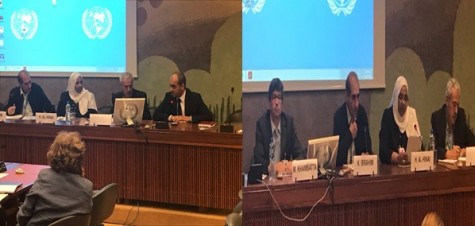
At a side event on “Digital Rights Across the Gulf and Neighbouring Countries”, held at the 38th Session of the United Nations Human Rights Council (UNHRC) in Geneva on 26 June 2018, the Gulf Centre for Human Rights (GCHR) and partners examined the “Crackdown on Cyberactivism, Repression of Digital Rights and Freedoms, and the Role of International Human Rights Mechanisms.” The event was co-sponsored by the Martin Ennals Award (MEA), the Omani Association for Human Rights (OAHR), Index on Censorship, CIVICUS, FIDH and the World Organisation Against Torture (OMCT).
The event examined recent cases of human rights defenders imprisoned for their online advocacy including GCHR Board member Ahmed Mansoor in the United Arab Emirates (UAE), online activists Hassan Al-Basham and Abdulla Habib in Oman, and Saudi women’s rights defenders Loujain Al-Hathloul, Dr. Eman Al-Nafjan, and Aziza Al-Yousef, among others jailed in the recent crackdown. Speakers at the event also examined new legislation used to stifle freedom on-line in Oman and Palestine, among other countries.
The Moderator, GCHR Executive Director Khalid Ibrahim, opened the event by discussing how traditional media is mostly owned or controlled by governments in the Middle East and North Africa (MENA) and after citizens, including online activists, began to use social media to express their views on public affairs, governments across the region created cybercrimes law to imprison them. GCHR recently published an article on the lack of network neutrality and the human rights crisis in MENA region and its contribution to the ongoing extensive violations.
At the event, GCHR also simultaneously launched a lengthy research report on the topic of digital rights. See: GCHR report maps cybercrime laws and violations of digital rights in the Gulf and Neighbouring Countries.
Habiba Al-Hinai, head of the Omani Association for Human Rights (OAHR), described how difficult it is to promote human rights on-line, and to discuss violations, including about the Arab Spring in 2011, an oil workers’ strike in 2012, or Female Genital Mutilation (FGM) in Oman. “Due to my internet human rights activism, I was subject to dozens of interrogations and threats from the security services,” she said. In May 2012, Al-Hinai founded the Omani Group for Human Rights, which remains banned in Oman. Four co-founders of the group (out of the five) were brought to prison in obscure circumstances, she said, and the group’s social media accounts were continuously hacked and deleted.
Al-Hinai criticises provisions of the new penal code signed into law in January 2018 which target activists and public freedoms. The new Penal Code, published as Royal Decree No. 7/2018, “contains several vaguely-defined articles that could easily be used by the Internal Security Service (ISS), known for its history of human rights violations, to target human rights defenders and Internet activists, and to suffocate public freedoms,” she said.
The ISS in Oman uses “different kinds of tools as punishment for Internet activists, such as judicial, religious, social pressure and even family members. Sadly many activists end up in prison or banned from traveling and are not permitted to work,” said Al-Hinai. Internet activist Hassan Al-Basham died in prison on 28 April 2018 while serving a three-year sentence, due to lack of treatment for poor health. On 13 June 2018, writer and Internet activist Abdulla Habib was released from Samail Central Prison after he was pardoned while serving a six-month prison sentence. Habib was charged with violating Article 19 of the Information Technology Crimes Act for “using the Internet in what would prejudice the state public order” in addition to “contempt of religions.”
Michael Khambatta, MEA Director, presented the case of Mansoor, a laureate of the Martin Ennals Award for Human Rights Defenders in 2015. Mansoor, who was arrested on 20 March 2017, was sent to trial in April 2018, where he faced an unfair trail that lacked the minimum international standards of a fair trial.
On 29 May 2018, Mansoor was sentenced to 10 years in prison, one million Dirhams (USD $272,294.00), and three years of surveillance following his release. Khambatta also mentioned the two lawyers who went to UAE to find the whereabouts of Mansoor but were told by the authorities “we don’t know anything about him”, which is surprising for a government that spent millions of dollars to digitally monitor Mansoor and other activists.
Mousa Rimawi, Co-founder and Director of the Palestinian Center for Development and Media Freedoms (MADA), talked about the co-operation between Israel and Facebook to monitor activities, which he described as “a threat to freedom of expression on the Internet.” Rimawi said that Palestinian journalists face many risks, including incitement provoked by the Occupation Authority, and imprisonment by the Palestinian Authorities, who have arrested many journalists due their work. MADA has been carrying out advocacy against a recent draft Cybercrimes Law, which includes possible imprisonment of five years for journalists and online activists. MADA has been organising demonstrations to make sure that this law won’t be passed before changes are made to the section which threaten freedom of expression on and off-line.
Ali Al-Dubaisi, Director of the European Saudi Organisation for Human Rights (ESOHR), highlighted the contradictions of the policies of the Saudi authorities. He said the arrests of many women’s rights defenders “is a message to other groups to stop their peaceful human rights activities, otherwise they will get the same fate.” He said that while the authorities are now giving women the right to drive a car, “they put all the leading campaigners behind bars in order not to give them the opportunity to get publicity for their hard work,” hence the focus will be on the King and the Crown Prince as the ones who made the change. He concluded by saying that these courageous women’s rights defenders (both women and men) have been branded as traitors and accused of terrorism by the government which eliminates any remaining vestiges of its credibility.
The side event concluded with an important question about what can be done to address the widespread human rights violations and attacks on digital rights and the panel united in a call to continue their human rights work to make a peaceful change in the MENA region, including the release of all the detained human rights defenders and Internet activists.