World Press Freedom Day event in Beirut calls for supporting journalists and protecting freedom of expression in the MENA region
3/05/2018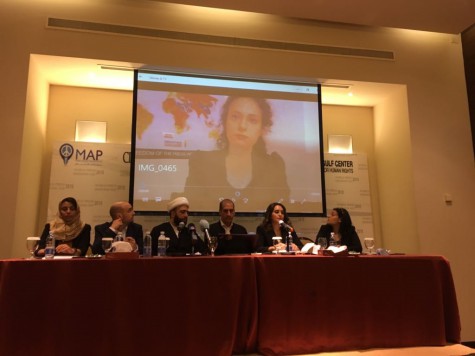
(Beirut) – The Gulf Centre for Human Rights (GCHR) in cooperation with Media Association for Peace (MAP), Reporters Without Borders (RSF), the Bahrain Center for Human Rights (BCHR), the Committee to Protect Journalists (CPJ), and the Arabic Network for Human Rights Information (ANHRI), organised on World Press Freedom Day, a press conference to demand the release of journalists, bloggers, and internet activists, in addition to protecting press freedom in the Middle East and North Africa (MENA) region.
Khalid Ibrahim, Executive Director of GCHR, opened the press conference by calling for the immediate release of journalists from the region who are detained solely for their journalistic work, protecting freedom of the press and conducting independent investigation into all crimes against journalists and bringing the perpetrators to justice. He also called on governments to work hard to support journalism and not to target journalists. He stressed that the partner groups are defending all journalists without exception and do everything possible to stop violations in all countries in the region.
The head of MAP, Vanessa Bassil, stressed that there is no real and positive peace without respect for freedom of opinion and freedom of expression, stressing the importance of the media’s role in building community awareness among all people. She said that the infringement of journalists’ rights is a violation of the rights of the entire society, indicating that the freedom of the press cannot be safeguarded if there are armed conflicts capable of curbing those freedoms with ease. She called on the United Nations in particular to exert international pressure on governments to immediately release journalists and prisoners of conscience. Then she read a number of recommendations made by MAP at one of its recent conferences on the subject.
For his part, BCHR Special Advisor Maytham Al-Salman pointed to the deteriorating situation of freedoms of press, opinion and expression in Bahrain, stressing that it is the worst in the region and that Bahrain accounts for the highest percentage of detainees in the Middle East. He drew attention to the recent practices of the authorities to muzzle voices and the latest closure of the only independent media in the country, “Al-Wasat” newspaper.
At the meeting RSF Middle East coordinator Sophie Anmuth spoke about the obstacles facing journalism and putting journalists at risk in different countries of the MENA region. She cited several examples of targeting journalists and preventing them from doing their jobs.
CPJ MENA correspondent in Beirut, Ignacio Delgado Culebras, spoke about the press situation in the region and common patterns of targeting, such as harassing and preventing journalists from performing their work, defaming them and accusing them of spreading false news. He stressed the need for governments to protect journalists and to respect their right to work freely and without fear of retaliation.
The deputy director of ANHRI in Egypt, Rawda Ahmed, spoke about the reality of freedom of expression which is suffering in Egypt today, pointing to the practices of the authorities to curb freedom of expression, and to prevent rights defenders from appearing on local and other television channels. She also mentioned the case of Egyptian photojournalist Mahmoud Abu Zaid, known as Shawkan, who won the 2018 UNESCO/Guillermo Cano World Press Freedom Prize and is still behind bars. She also pointed out that Egyptian citizens are risking arrest under the charge of “joining the Muslim Brotherhood”, unless proven otherwise.
Journalist Halah Mohammed Al-Aulaqi from Yemen spoke extensively about the current crisis and the violations committed against journalists by all parties, stressing that Yemen’s serious humanitarian catastrophe today is affecting journalists and activists who have been targeted, in particular with the lack of an appropriate environment for them to do their journalistic work.
All speakers called for lobbying in order to call for the release of all detainees, holding officials accountable, and giving journalists and activists more space to express their opinions.
At the end of the conference, Khalid Ibrahim also congratulated Egyptian photojournalist Shawkan on winning the 2018 UNESCO/Guillermo Cano World Press Freedom Prize and called on all governments to respect freedom of the press and freedom of expression, saying that no creativity can exist without respect for public freedoms.