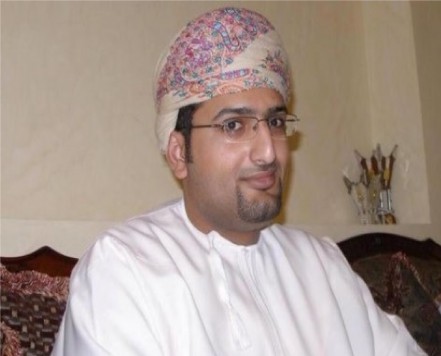
On 14 March 2016, State Security Court at the UAE Federal Supreme Court found him not guilty and subsequently he was released then deported to Oman on 20 March 2016.
2016-01-31
On 31 January 2016, the Federal Supreme Court in the United Arab Emirates (UAE) decided to postpone the trial of detained Omani blogger Muawiya Al-Rawahi to 15 February 2016 in order for the Medical Tribunal to give their testimony.
On 24 February 2015, Al-Rawahi, was stopped by UAE security intelligence agents at the border and was not allowed to return back to Oman. On 09 November 2015, he appeared before the Federal Supreme Court, which decided to refer him to a hospital. He has been sent to Sheikh Khalifa Medical City hospital to be examined by a medical committee composed of three doctors. Reports confirm that he was medically examined and returned to the notorious Al-Wathba prison.
The Gulf Centre for Human Rights (GCHR) is concerned that the trial has been adjourned five times so far. The last two postponements were to hear the testimony of the Medical Tribunal, who failed to show up at the court hearing.
On 09 November 2015, Al-Rawahi published a recording on social media sites where he said that has not received “fair treatment” from the UAE State Security Apparatus. State Security previously prevented him from receiving his medication for two months, thus forcing him to stay in the hospital for one week to get treatment. He said he had spent four months in solitary confinement and threatened harm to himself by saying, “If I cannot find fair treatment I will start a hunger strike or commit suicide.”
The GCHR believes that the ongoing detention, ill-treatment and the repeated trial postponement of Muawiya Al-Rawahi are directly related to the exercise of his right to freedom of opinion and expression. The authorities in UAE should understand that he needs proper medical care and not detention on fabricated charge.
The GCHR urges the authorities in the UAE to:
- Immediately and unconditionally release Muawiya Al-Rawahi and revoke all the charges directed against him, as his arrest is solely related to his peaceful on-line activities;
- Immediately grant him unfettered access to proper medical care;
- Guarantee the physical and psychological integrity and security of Muawiya Al-Rawahi; and
- Guarantee in all circumstances that on-line activists and all human rights defenders in Oman and the UAE are able to carry out their legitimate human rights activities without fear of reprisals and free of all restrictions including judicial harassment.
The GCHR respectfully reminds you that the United Nations Declaration on the Right and Responsibility of Individuals, Groups and Organs of Society to Promote and Protect Universally Recognised Human Rights and Fundamental Freedoms, adopted by consensus by the UN General Assembly on 9 December 1998, recognises the legitimacy of the activities of human rights defenders, their right to freedom of association and to carry out their activities without fear of reprisals. We would particularly draw your attention to Article 6 (b and c): “Everyone has the right, individually and in association with others: (b) As provided for in human rights and other applicable international instruments, freely to publish, impart or disseminate to others views, information and knowledge on all human rights and fundamental freedoms; (c) To study, discuss, form and hold opinions on the observance, both in law and in practice, of all human rights and fundamental freedoms and, through these and other appropriate means, to draw public attention to those matters”, and to Article 12 (1 and 2): “(1) Everyone has the right, individually and in association with others, to participate in peaceful activities against violations of human rights and fundamental freedoms. (2) The State shall take all necessary measures to ensure the protection by the competent authorities of everyone, individually and in association with others, against any violence, threats, retaliation, de facto or de jure adverse discrimination, pressure or any other arbitrary action as a consequence of his or her legitimate exercise of the rights referred to in the present Declaration.”

-
Latest News
Defenders Affected