GCHR’s activities during the 62nd session of the UN Human Rights Council
17/07/2026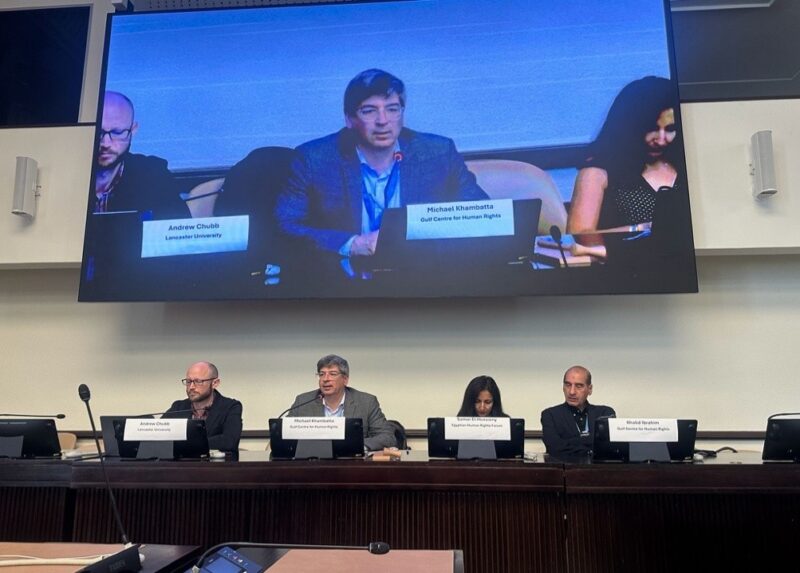
The Gulf Centre for Human Rights (GCHR) carried out advocacy on behalf of human rights defenders (HRDs) at the 62nd session of the United Nations Human Rights Council (UNHRC) in Geneva, which was held from 15 June to 08 July 2026.
The various activities were designed to get support from UN member states to help free detained human rights defenders and enhance the protection of public freedoms across the Middle East and North Africa (MENA). They also highlighted the need to address shrinking civic space, transnational repression, restrictions on freedom of expression, the use of the death penalty, torture and arbitrary executions, and to end impunity and ensure accountability across the region.
Resolutions
The only resolution partially followed was on Freedom of Expression. Initial attempts to follow the resolution were constrained by scheduling conflicts caused by the compression of the schedule due to budget cuts. This very ambitious resolution added stronger language on transnational repression, digital surveillance, internet restriction, among others.
Statements at the HRC
On 18 June 2026, GCHR delivered a statement at the interactive dialogue with the Special Rapporteur on the promotion and protection of the right to freedom of opinion and expression. The statement warned that governments across the MENA region criminalise criticism of rulers, state policy, or matters deemed to affect national security, often under terrorism-related charges and through special courts, and cited the use of Pegasus spyware against Emirati human rights defender Ahmed Mansoor as an example of widespread digital surveillance. It asked what measures the Human Rights Council should prioritise to protect human rights defenders engaged in peaceful online advocacy.
On 18 June 2026, GCHR delivered a joint statement in cooperation with ALQST for Human Rights and MENA Rights Group at the interactive dialogue with the Special Rapporteur on extrajudicial, summary or arbitrary executions. The statement welcomed the report’s conclusion that the severe physical and psychological suffering caused by capital punishment is inherent throughout the “death penalty trajectory”, and noted its relevance to the Gulf region, Iran and Iraq, where the death penalty is frequently imposed amid allegations of torture, coerced confessions, unfair trials, secrecy and denial of effective safeguards. It asked what legal obligations retentionist states have to move beyond procedural reforms and adopt abolition as the only means of ensuring compliance with the absolute prohibition of torture and the protection of human dignity.
On 30 June 2026, GCHR delivered a statement during the adoption of Lebanon’s Universal Periodic Review outcome. The statement noted Lebanon’s acceptance of recommendations on freedom of expression, media freedom, the protection of journalists and human rights defenders, and safeguarding civic space, but raised concern over its rejection of recommendations on international accountability, the full decriminalisation of defamation, removing civilians from military court jurisdiction, and women’s nationality rights. GCHR urged Lebanon to reconsider rejected recommendations, implement accepted recommendations in consultation with independent civil society, and ensure that journalists, human rights defenders and civil society actors can work freely and safely.
On 01 July 2026, GCHR delivered a statement during the adoption of Oman’s Universal Periodic Review outcome. The statement raised concern that, despite acceding to the International Covenant on Civil and Political Rights (ICCPR) in 2025, Oman rejected recommendations to ratify other key instruments, including the Second Optional Protocol (OPCAT) to the ICCPR, and the Rome Statute. It noted that Oman accepted some recommendations on freedom of expression, association and peaceful assembly, but rejected key recommendations to amend restrictive laws affecting expression and civic space, including the Nationality Law, the Penal Code, the Media Law and relevant royal decrees, and warned that the new Cybercrime Law 61/2026 is more repressive than its predecessor. GCHR urged Oman to reconsider rejected recommendations, amend restrictive laws, end the use of the judicial system against those peacefully exercising their rights, release anyone detained for doing so, and allow a vibrant civil society that can freely criticise the government.
Side Events
On 19 June 2026, GCHR, in cooperation with the Egyptian Human Rights Forum and FIDH, organised a side event entitled “Transnational Repression: Impact on MENA Human Rights Defenders”. The event was moderated by Michael Khambatta, GCHR’s Geneva Representative, and featured speakers Andrew Chubb of Lancaster University; Samer El-Hussieny of the Egyptian Human Rights Forum; and Khalid Ibrahim, GCHR’s Executive Director.
Speakers discussed transnational repression as a cross-border human rights violation, rather than only as a matter of national security or foreign interference, and highlighted the obligations of host states under international human rights law to protect individuals within their territory, regardless of the origin of the threat. The Egyptian Human Rights Forum presented findings on key patterns used against defenders, journalists and activists in exile, including the denial of consular and identity documents, misuse of counter-terrorism laws, and punishment by proxy against family members.
Speakers also raised concerns over extradition practices, the role of the Arab Interior Ministers’ Council in facilitating cross-border transfers without accountability, and the use of digital surveillance and social media geo-blocking by governments in the region against critics abroad. Khalid Ibrahim presented GCHR’s newly published report, “Pursued Beyond Borders: Patterns of Transnational Repression Linked to States in the Middle East and North Africa”, referring to documented cases to illustrate patterns of transnational repression affecting human rights defenders from the region. Speaking also from his own experience as a target of transnational repression, he highlighted the closure of civic space in the Gulf region and other countries in the MENA region, in addition to the reality that many human rights defenders and organisations now operate in exile.
GCHR co-sponsored a side event on 25 June 2026, entitled “The Death Penalty in Saudi Arabia: Torture, Arbitrary Executions and the Erosion of International Law“, organised by MENA Rights Group in cooperation with Reprieve, ALQST for Human Rights, European Saudi Organisation for Human Rights (ESOHR) and Amnesty International, and moderated by Michael Khambatta, GCHR’s Geneva Representative. The discussion examined the use of capital punishment in Saudi Arabia, including torture, arbitrary executions, enforced disappearance, unfair trials and discrimination, amid record levels of executions in 2024 and 2025 and a continued alarming rate in 2026.
GCHR participated in a side event at the Swiss Press Club on 26 June 2026, entitled “The Role of the Universal Periodic Review (UPR) in Promoting Human Rights and Combating Torture in Lebanon”, organised by the Cedar Centre for Legal Studies with the support of the Heinrich-Böll-Stiftung Beirut. Michael Khambatta, GCHR’s Geneva Representative, discussed the outcomes of Lebanon’s fourth UPR cycle, torture-related recommendations, and the role of UN mechanisms and States in supporting follow-up, implementation and accountability.
GCHR participated in a side event on 26 June 2026, on “Human Rights in Bahrain” organised by the Bahrain Center for Human Rights, in cooperation with FIDH, GCHR, and Amnesty International. Michael Khambatta, GCHR’s Geneva Representative, spoke about the disappointing lack of follow up to the releases of hundreds of detainees in 2024, which left hundreds of prisoners of conscience detained, including Abdulhadi Al-Khawaja; the tightening of already severely limited civic space due to the current hostilities; transnational repression including digital surveillance; and the impact of nationality stripping and consequent deportations with almost no notice.