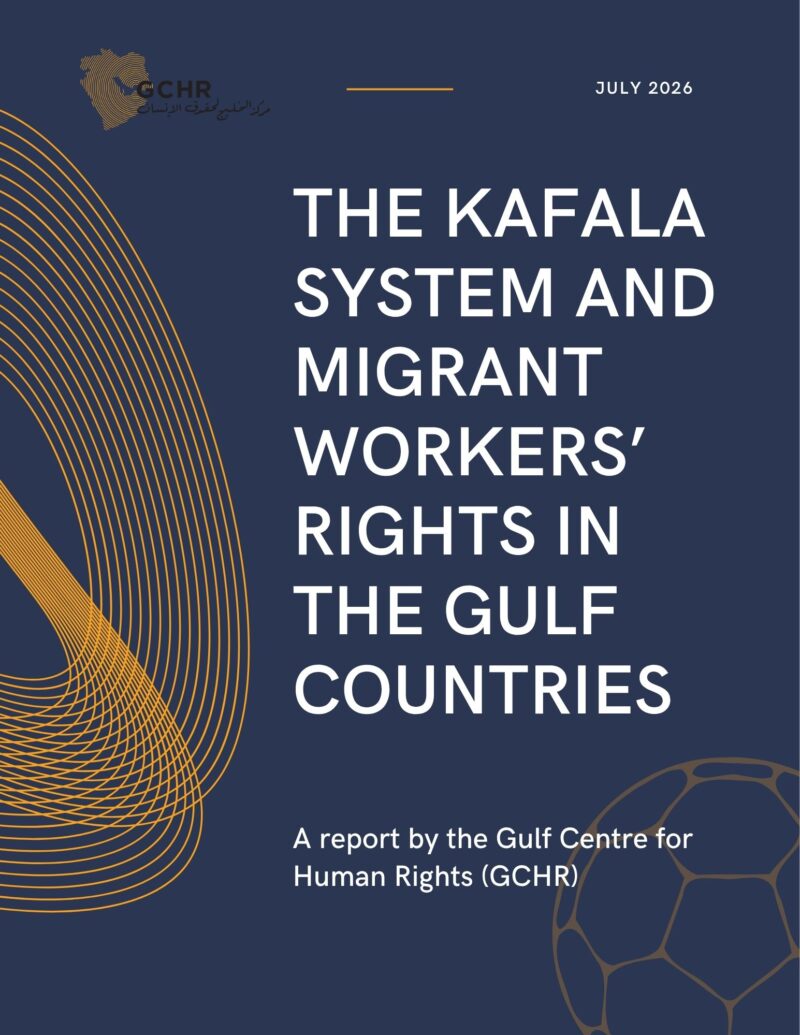
A report by the Gulf Centre for Human Rights (GCHR)
Introduction
The awarding of the 2034 FIFA World Cup to Saudi Arabia has reignited concerns that had already emerged during the preparation and organisation of the 2022 FIFA World Cup in Qatar. While the Qatari tournament was presented by both FIFA and Qatari authorities as an opportunity to improve labour standards and modernise the treatment of migrant workers, numerous human rights organisations have argued that many of the structural factors enabling exploitation remained largely intact despite a series of widely publicised reforms. The decision to award another World Cup to a Gulf State where migrant labour continues to play a central role in ambitious development projects has therefore raised fears that the lessons of Qatar have not been fully learned.
These concerns extend beyond the field of sport. Across the Gulf region, governments are currently investing billions of dollars in large-scale infrastructure and urban development projects. Saudi Arabia’s Vision 2030 programme, including the NEOM megacity project and the expansion of transport infrastructure, relies heavily on migrant labour. Similarly, Qatar continues to pursue major economic projects, notably through the North Field gas expansion programme, which remains dependent upon a large migrant workforce. In this context, the treatment of migrant workers during the preparation of the 2022 World Cup cannot be understood as an isolated issue. Rather, it raises broader questions regarding the sustainability of labour exploitation patterns within Gulf economies and the ability of international actors to prevent their recurrence.
This report by the Gulf Centre for Human Rights (GCHR) aims to address the issue of the migrant rights and the continued abuses faced by migrant workers in the Gulf states, particularly Saudi Arabia and Qatar – despite new legal reforms introduced since the 2022 FIFA World Cup in Qatar and the partial dismantling of key components of the kafala system. Many of the human rights violations documented before the tournament – including passport confiscation, recruitment debt, restrictions on freedom of association, barriers to justice, inadequate living conditions and failures to investigate worker deaths – continue to be reported, in conditions that amount to forced labour.
Background
The centrality of migrant labour within the Gulf Cooperation Council (GCC) states is not a recent phenomenon. Since the oil boom of the second half of the twentieth century, Gulf economies have relied extensively on foreign workers originating primarily from South Asia, Southeast Asia and parts of Africa. To regulate this migration, most Gulf countries developed sponsorship systems commonly known as kafala. Although the practical implementation of the system varies from one country to another, its defining characteristic is the dependency of migrant workers upon a sponsor, usually their employer, for their legal residence and employment status. This dependence has long been criticised for facilitating labour exploitation, restricting labour mobility and creating conditions conducive to forced labour and other serious human rights violations.
International scrutiny intensified following Qatar’s selection as host of the 2022 FIFA World Cup in December 2010. Investigations by journalists, trade unions and human rights organisations documented widespread abuses affecting migrant workers employed on construction sites and in related sectors, including passport confiscation, recruitment debt, wage theft, restrictions on freedom of movement, excessive working hours and unsafe working conditions. Particular attention was also drawn to the issue of worker deaths and the repeated failure of Qatari authorities to conduct adequate investigations into fatalities frequently classified as resulting from “natural causes” or “cardiac arrest” without further examination.
Within the framework of this report, several concepts require clarification. The term migrant worker refers to a person who migrates from one State to another for the purpose of employment, regardless of migration status, in accordance with internationally-recognised definitions contained in the International Convention on the Protection of the Rights of All Migrant Workers and Members of Their Families and related international instruments. The kafala system refers to sponsorship arrangements linking a migrant worker’s legal residence and employment status to a specific employer or sponsor, thereby restricting labour mobility and increasing vulnerability to abuse.
The concept of forced labour will be understood according to Article 2 of ILO Convention No. 29 as work or service exacted from a person under the menace of any penalty and for which that person has not offered himself or herself voluntarily. Similarly, the notion of trafficking in persons will be understood according to the Palermo Protocol and subsequent UNODC and United States State Department definitions, encompassing the recruitment, transportation or harbouring of persons through force, coercion, deception or abuse of vulnerability for the purpose of exploitation.
This report deliberately focuses on the Gulf region, and particularly on Qatar and Saudi Arabia. While labour exploitation affecting migrant workers is a global phenomenon, the Gulf States present specific characteristics that justify a dedicated analysis. Their economies remain heavily dependent on foreign labour, sponsorship systems have historically structured labour migration across the region, and several of the world’s largest ongoing infrastructure projects are concentrated within these countries. Furthermore, the transition from the Qatar 2022 World Cup to the Saudi Arabian 2034 World Cup provides a unique opportunity to assess whether structural problems identified during one mega-event have been effectively addressed or merely transferred to another context.
The relevance of this report extends beyond questions of labour law. At stake are issues relating to the protection of fundamental rights, including the rights to life, health, decent working conditions and access to effective remedies. The subject also intersects with broader debates concerning corporate accountability, state responsibility and the governance of global sporting events. As Gulf countries continue to attract migrant labour on a massive scale while simultaneously pursuing ambitious environmental, urban and economic transformation projects, the consequences of regulatory failures may affect millions of workers and their families. Moreover, the continued awarding of prestigious international events to countries where such concerns remain unresolved raises questions regarding the legitimacy and credibility of global governance actors, particularly FIFA.
Several theoretical approaches have sought to explain these dynamics. The concept of mega-event exceptionalism suggests that major sporting events often generate extraordinary political and economic pressures that justify exceptional governance arrangements and weaken ordinary accountability mechanisms. Similarly, the literature on the mega-event syndrome highlights recurring patterns whereby large-scale events produce cost overruns, governance failures and social harms while benefiting powerful political and economic actors. These approaches can be combined with the notions of governance gap and accountability gap, which describe situations where existing legal and institutional frameworks fail to effectively regulate corporate and state conduct or provide remedies for victims of abuse.
Against this background, this report seeks to answer the following question: To what extent did the 2022 FIFA World Cup in Qatar reinforce rather than dismantle the structural mechanisms of migrant worker exploitation associated with the kafala system, and what precedent does this set for future mega-events and infrastructure projects in the Gulf region? To answer this question, the report will first examine the extent to which the reforms introduced in Qatar before and during the World Cup period altered – or failed to alter – the structural conditions enabling labour exploitation. It will then analyse how the limited accountability of state authorities, international institutions and private actors has contributed to the persistence and possible reproduction of these dynamics in future Gulf mega-projects and sporting events.
Read the full report here:
-
Related Publications
Latest Urgent Action
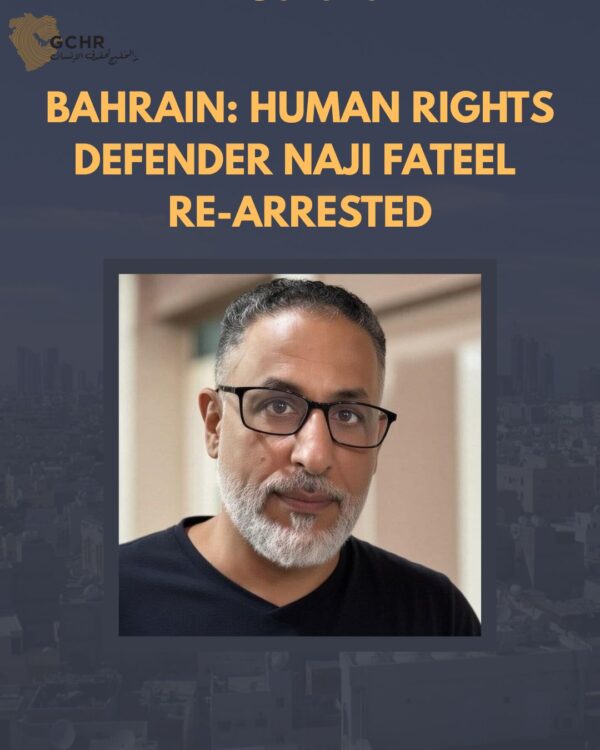 Bahrain
Human rights defender Naji Fateel re-arrested