Protests were held in Syria in which demonstrators condemned the enforced disappearance of two journalists and the prevention of a large number of students from taking their exams.
A protest against enforced disappearances
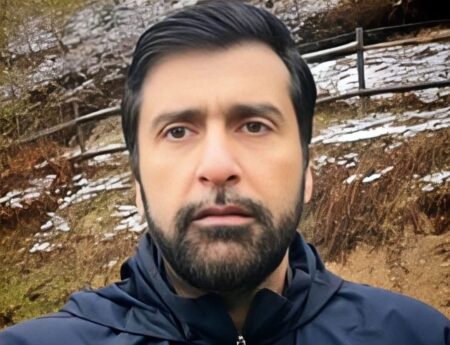
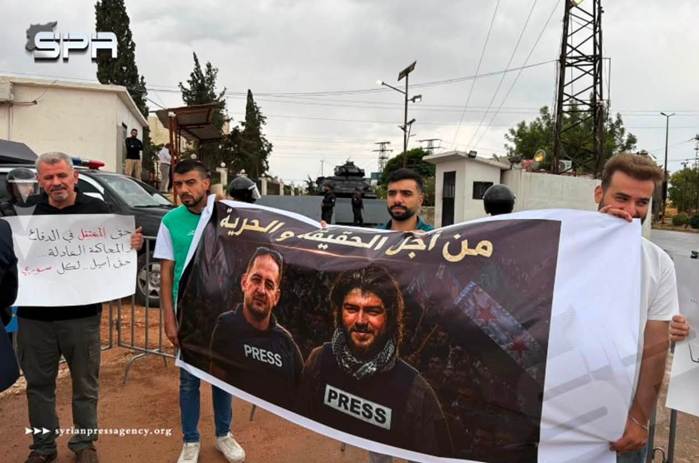
On 29 August 2026, a number of journalists, along with other activists and citizens, held a protest in front of the Internal Security Directorate in Aleppo, demanding information on the fate of journalists Mahmoud Al-Khatib, who has been missing for more than 567 days, and Murad Mahli, who has been detained in Ministry of Interior prisons for more than 247 days without specific charges being brought against him or his case being referred to the judiciary (main photo).
The protesters also demanded a comprehensive and transparent investigation into the two cases and that those responsible for their enforced disappearance be held accountable.
Al-Khatib was abducted by military leaders in the city of Marea, north of Aleppo, at the beginning of February 2025. He has remained forcibly disappeared ever since. Mahli, who is from the city of Jarabulus in the eastern Aleppo countryside and worked as the director of the Jarabulus Media Office, has been held in one of the Ministry of Interior’s prisons in Aleppo since his arrest and enforced disappearance by security forces on 27 December 2026.
Students’ Sit-in in Suwayda
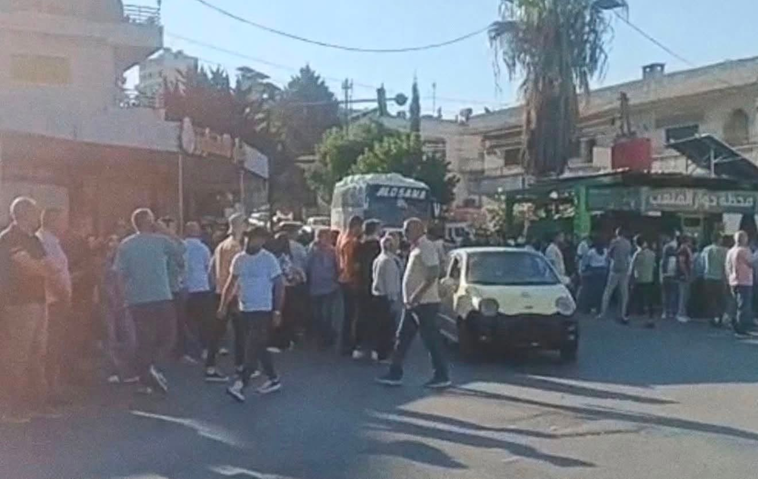
Dozens of students and their families staged a sit-in at the Stadium Roundabout in Suwayda on 29 August 2026, to protest being prevented by the National Guard militias from traveling to examination centres in the northern Suwayda countryside to take their supplementary exams. Reliable local sources confirmed that buses transporting students were forced to turn back from areas such as the Anqoud Roundabout.
The Gulf Centre for Human Rights (GCHR) received credible testimony from a mother who was with her 14-year-old daughter, a student. She described how the militia attacked the bus, terrorising and intimidating all the passengers, assaulting the driver, attempting to force open the door, and smashing the car windows. She confirmed that the passengers, most of whom were young students, were subjected to intimidation, harassment, and mistreatment. They threatened one of the parents by saying they would throw a bomb at the bus. The mother, describing her feelings, said, “I am truly heartbroken for my daughter, who is only 14 years old and has aspirations to study and learn, to have to go through this experience.”
This disruption led the Education Directorate in Suwayda to postpone the start of exams several times that day to allow students to reach the centres. Despite this, only a few hundred students were able to reach the exam centres due to being prevented by these militias.
In a statement regarding the exams in Suwayda Governorate, the UN Resident and Humanitarian Coordinator for Syria, Marianne Ward, expressed the UN’s concern at “developments in Suwayda Governorate, including reports that students are being prevented from reaching examination centres and face other restrictions of movement.” She added, “The UN reaffirms that every child has the right to education and must be able to learn, develop, and sit for examinations in a safe, secure, and supportive environment.” The statement concluded with the UN calling on “all relevant stakeholders to ensure that children with the support of their caregivers can exercise their right to education without pressure or disruption of movement.”
Recommendations
GCHR urges the Syrian authorities to take immediate action to secure the release of journalists Mahmoud Al-Khatib and Murad Mahli, compensate them for the harm caused by their prolonged enforced disappearance, and bring those responsible to justice. There should be no place for enforced disappearances or human rights violations of any kind in the new Syria.
The Syrian government must strive earnestly to build a state based on institutions and genuine citizenship. Support must always be provided to the education sector, protection must be ensured for all students, and full attention must be given to defending the rights of marginalised groups, including women and children.