Authorities continue systematically targeting influential citizens, human rights defenders, journalists and Internet activists
3/09/2021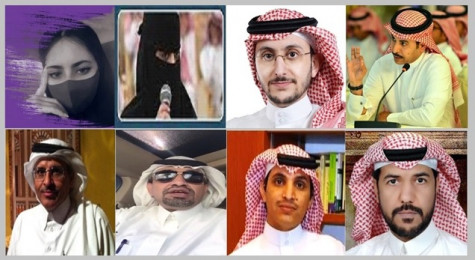
Authorities continue their systematic policies to target talented and influential citizens, prominent journalists, and Internet activists who believe in reform and advocate for it and for the civil and human rights of citizens. Human rights defenders who have received heavy prison sentences also suffer from targeting and ill-treatment in prison, in addition to the absence of any local mechanism that has the ability to consider their cases and bring perpetrators who have violated their rights to face justice.
Internet activists arrested

On 01 June 2021, a force affiliated with the Presidency of State Security raided the home of 22-year-old university student and human rights defender Asmaa Al-Subaie, confiscating her personal electronic devices and taking her to an unknown destination.
Local reports confirmed that the reason for her arrest was that she posted tweets in which she expressed her views defending women’s rights and supporting women who are subjected to domestic violence, as well as defending detainees, calling for their trials to be public and criticising the harsh sentences issued against them because of their peaceful expression on the Internet.
A group of her colleagues created a Twitter account in the name of friends of the detainee Asmaa, in which they called for her immediate release, using the hashtag: #Release_Asmaa

Journalist and online activist Maha Al-Rafidi, 30 years old, has a Bachelor’s degree in media and communication and used to work as a trained journalist for Al-Watan newspaper. Her Twitter account, which is followed by more than 4,000 followers, topped with the following two hashtags: #Freedom_for_prisoners_of_opinion and #Normalisation_betrayal
Her last tweet was on 24 September 2019, which included the following:
“On the other side of the world
I am the diamond among a pile of rocks”.
She was then arrested on 28 September 2019, after her home was raided and her electronic equipment were confiscated. Local reports confirmed that she was beaten and ill-treated after being kept in solitary confinement for two months after her arrest before being transferred to a general ward.
There is no doubt that the reason for targeting her lies in her defense of the prisoners of conscience, her rejection of normalisation and her support for the Palestinian cause.
Influential and creative people imprisoned for promoting reform

The case of the prominent economic researcher and expert Essam Al-Zamel, born in Dammam in 1979, represents a clear example of the higher authorities’ targeting of scientific experts who enjoy wide popularity and acceptance in society. On 05 October 2020, the Specialised Criminal Court (Terrorism Court) issued a ruling against him for 15 years in prison and a travel ban for the same period after the end of his sentence.
Several charges were brought against him, including allegedly belonging to a terrorist organisation, meeting foreign diplomats, belonging to the banned Muslim Brotherhood, contacting Qatar and inciting protests in Saudi Arabia.
Al-Zamel was arrested on 12 September 2017 at the same time as many other rights defenders and reformists, and was being held in solitary confinement, according to “The Independent” newspaper, which also reported in October 2018 that he was in bad shape. For more information on the arrest in 2017, see: https://www.gc4hr.org/news/view/1729
He is an efficient and creative young man who always tried to provide solutions to the chronic economic problems that plague the country’s economy, including by posting a series of tweets in 2011 calling for a solution to the unemployment problem, as well as his criticism in the past of plans to offer shares from Saudi Aramco for public subscription.
Al-Zamel founded the Saudi Rimal Company, a leading company in the field of information technology, in addition to many websites, programs, applications and services on the Internet. He obtained his Bachelor’s degree in Chemical Engineering from Tulane University in the United States in 2002, and worked for Saudi Aramco as an engineer and contributed to its development, and two years later he founded his own company called “Al-Rimal”. He was also a member of the Young Entrepreneurs Executive Committee.
Al-Zamel paid a heavy price just for being a creative young man who is keen on his homeland and loves it and defends the rights of citizens.

On 09 September 2017, prominent journalist Khaled Al-Alkami posted the following tweet: “The call of the Emir of Qatar to the Saudi Crown Prince and the Emir’s welcome to the dialogue is a positive step that we hope will lead to a solution to the crisis. I hope it will be followed by a cessation of exchanges and media escalation.” Reliable local sources stated that his arrest was related to this and other tweets, in addition to his bold opinions in his television interviews, which dealt with sensitive topics such as eliminating corruption. He called for the participation of citizens and civil society organisations in ending corruption. He was arrested on 16 September 2017, after posting his last tweet the day before, stating, “Facing daily challenges in your life? Think again.”
His Twitter account has more than 350,000 followers and the following phrase is written in the header: “Liberating minds before liberating homelands.”
His account is pinned with a tweet, posted on 22 October 2016, which included his views on “Vision 2030” and “austerity”, under the title “So that the ship does not sink,” in which he explained the importance of releasing all prisoners of opinion who demanded reform and national reconciliation.
Al-Alkami is another example of the targeting of national experts by the Saudi authorities as a result of their call for comprehensive reform and their defense of prisoners of conscience.
Detained human rights defenders on hunger strike

On 15 August 2021, Dr. Mohammed Al-Qahtani began a new hunger strike due to the prison administration’s failure to implement his demands, which include ending the ill-treatment of prisoners, returning his books that are still in the possession of the prison administration after nearly a year, and transferring a number of inmates who suffer from mental illnesses to a hospital for treatment, due to the danger that their presence poses to the other inmates, especially since one of them started a fire, which indicates the seriousness of the situation.
He was joined in his hunger strike by human rights defenders Issa Al-Nukhaifi and Fawzan Al-Harbi, in addition to a number of prisoners of conscience, who are languishing in ward A8 of Al-Ha’ir Reformatory Prison in the capital, Riyadh. Reliable reports confirmed that news about what is currently happening in this ward has been blocked due to the strict monitoring by the authorities of the phone calls that take place with the families and their prevention from discussing matters related to the hunger strike or their demands. For more information, see: https://www.gc4hr.org/news/view/2806
Lack of local mechanisms to achieve justice

In a country like Saudi Arabia, where gross violations of human rights occur on a daily basis, there is no doubt that their systematic continuation, with the participation and support of senior officials, has led to the spread of impunity and the absence of any local mechanisms to activate accountability.
The case of prominent human rights defender Khaled Al-Omair is a prime example of the failure of the Saudi judicial system to provide citizens with legal protection and justice when their rights are flagrantly violated.
On 16 August 2021, the Court of Appeal decided to add two years to Al-Omair’s previous sentence of seven years in prison, bringing the sentence against him to nine years in prison, and a travel ban for a similar period after completing his sentence. On 30 July 2021, he was subjected to an attempted murder by another prisoner who disappeared after this attempt, which clearly shows the failure of the authorities to provide the necessary protection even in prisons, although there are existing fears that all of this may be deliberate on their part.
Al-Omair has been detained without charge since 06 July 2018, after he filed a complaint with the Saudi Royal Court (the Office of the King) against an officer of the General Investigations Department, who allegedly tortured him during his imprisonment from December 2008 to April 2017.
Al-Omair tried to use fundamental legal methods in order to obtain justice, and his punishment was that he was hidden in the darkness of prisons. The authorities were not satisfied with that, but rather worked to deprive him of his rights as a prisoner. The authorities did not allow him to see his sick father and prevented him from attending his funeral after his death on 20 March 2019, as well as preventing him from visiting his sick mother in the hospital. This confirms once again that the Saudi authorities do not apply most of the United Nations Standard Minimum Rules for the Treatment of Prisoners (Nelson Mandela Rules), including Rule 5, which states, “The prison regime should seek to minimise the differences between prison life and life at liberty.”
For more information on his case, see: https://www.gc4hr.org/news/view/2725
Once again, the Gulf Centre for Human Rights (GCHR) urges the Saudi authorities to:
- Immediately and unconditionally release all detained human rights defenders, including journalists and all Internet activists, as well as any citizens who express themselves in public, and drop all charges against them;
- Pending the release of all human rights defenders and prisoners of conscience, full implementation of all the United Nations Standard Minimum Rules for the Treatment of Prisoners (Nelson Mandela Rules);
- Protect public freedoms including the right to freedom of expression both online and offline; and
- Ensure that, in all circumstances, all human rights defenders and journalists in Saudi Arabia are able to carry out their legitimate human rights work without fear of reprisals and without restrictions, including judicial harassment.

-
Latest News
Defenders Affected