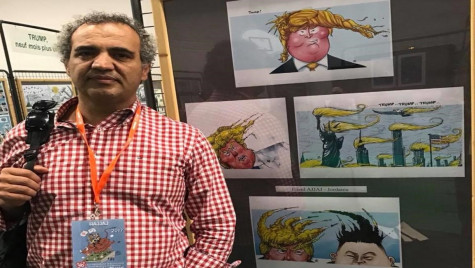
On 26 August 2020, the Public Prosecutor of Amman, the capital of Jordan, issued an order to arrest prominent cartoonist Emad Hajjaj (Abu Mahjoub) pending investigation after he published a cartoon that was deemed offensive. Local sources confirmed that he was arrested under the Cyber Crimes Law.
The latest reports received by the Gulf Centre for Human Rights (GCHR) stated that on 27 August 2020, the Public Prosecutor of Amman decided not to have jurisdiction in the case. The case was referred to the State Security Court’s Public Prosecutor, who ordered Hajjaj to be detained for 14 days pending investigation and charged him with disturbing relations with a friendly country.
The arrest came hours after Hajjaj published a cartoon on the website of Al-Araby Al-Jadeed (The New Arab), expressing his rejection of the normalisation of ties between the United Arab Emirates and Israel, after the announcement on 13 August 2020, of an agreement to fully normalise relations between them. This declaration has met widespread popular opposition in view of the grave violations suffered by the Palestinian people at the hands of the Israeli occupation authorities.
Hajjaj, one of the most prominent cartoonists in Jordan, works for Al-Araby Al-Jadeed newspaper and website, and he is known for his sarcastic character Abu Mahjoub. He is the president of the Jordanian Cartoonists Association. Hajjaj also publishes his caricatures on his Facebook page and Twitter account. After his arrest, the hashtag #Emad_Hajjaj was trending as the most popular topic related to Jordan taken up by Twitter users.
GCHR strongly condemns the arrest and detention of Hajjaj, which is a flagrant violation of Paragraph (1) of Article (15) of the Jordanian Constitution, that states: “The State shall guarantee freedom of opinion. Every Jordanian shall be free to express his opinion by speech, in writing, or by means of photographic representation and other forms of expression, provided that such does not violate the law.” The Jordanian government should release Hajjaj and all other activists who are prisoners of opinion, and respect and protect the general freedoms of citizens, in particular freedom of opinion and expression, freedom of the press, freedom of peaceful assembly, freedom of association, and all other freedoms.