A report by the Gulf Centre for Human Rights (GCHR), with the support of Maharat Foundation and IFEX
December 2025
Introduction
Media workers, lawyers and other Human Rights Defenders (HRDs) in Lebanon report a situation of constant crisis during 2025, with multiple threats challenging their work. “We are caught in an ongoing, cyclical crisis of war and economic depression,” said one veteran journalist.
Although a ceasefire with Israel was agreed in late 2024 to end the 13-month conflict, extensive violations of the truce were reported within days, and since then there have been regular Israeli missile and other attacks on Lebanon. At the end of November 2025 Israel bombed the capital Beirut, killing five people and injuring dozens more. In the 12 months following the November 2024 agreement, more than 270 people have reportedly been killed and more than 850 injured killed in Israeli attacks on Lebanon.
In October 2025, UN experts noted that “Despite the ceasefire, Israel continues to strike Lebanese territory almost daily.” The experts said, “These attacks have resulted in a mounting toll of civilian deaths and injuries and destruction and damage of infrastructure, housing, the environment and agricultural zones vital to civilian livelihoods.”
They said Israel’s repeated strikes and partial occupation of territory in Lebanon had left schools, health centres, and places of worship inaccessible, preventing the resumption of essential civilian life and services. “Israel’s conduct is seriously undermining efforts by Lebanese authorities to implement effective disarmament as required by the cessation of hostilities agreement and Security Council resolution 1701 [passed in 2006 calling for full cessation of hostilities],” the experts said.
Local journalists and other activists fear the agreement is so fragile it risks breaking down completely and suddenly, which will send the country back into a large-scale conflict. Many assume that such a conflict is coming, either imminently or very soon. Many noted that in the event of full-scale conflict with Israel, much of their work will again revert to emergency service provision and crisis response.
They also report that a worsening economic situation threatens Lebanon, and drastic cuts in international funding of human rights organisations has severely damaged their work.
Many report a lack of protection from international mechanisms supposed to support them, and cite damage to their physical and mental health. They also report ongoing frustrations in accessing information which should be publicly available.
Many media workers and other HRDs continue to face chronic financial difficulties, and a lack of insurance and protective equipment. There are hopes that a new proposed media law, long in development and whose progress was halted by the war, could bring some necessary clarity and progress to the media landscape.
Activists and other international agencies report that the new Lebanese government, formed in February 2025, is hampered by a lack of resources, and some question its political will to make significant progress on human rights. The deepening economic crisis is damaging various human rights, including the right to a clean environment, where activists say dirty water is being pumped into the sea, and most garbage is now just being burned.
Despite these formidable challenges, media workers and other human rights defenders in Lebanon continue to provide vital services, whether during full-scale conflict or through economic crises.
In January 2026 Lebanon’s human rights record is due to be scrutinised at the United Nations Human Rights Council, as it is the country’s turn to be examined by the Universal Periodic Review (UPR) mechanism. Various civil societies based in, and working on, Lebanon, have submitted information to the review, including the Gulf Centre for Human Rights (GCHR) and Maharat Foundation in partnership with IFEX and OMCT. Many expressed frustration at the lack of accountability for attacks on media workers and other civilians.
Parliamentary elections scheduled for May 2026 also offer some prospects for change, and possibly progress, although local human rights activists note that election campaigns are often periods when hate speech and disinformation peak.
Methodology
This report is based on in-country research by Brian Dooley, an Advisory Board member of the Gulf Centre for Human Rights (GCHR), a regional human rights organisation based in Lebanon. The report was prepared with support from Maharat Foundation, a freedom of expression organisation based in Beirut, and IFEX, the international freedom of expression network. GCHR and Maharat Foundation are both members of IFEX.
GCHR’s researcher conducted interviews with human rights lawyers, journalists, humanitarian workers, UN officials and media organisations in Lebanon in November 2025. The report, Constant Crisis, aims to provide an analysis of the dangers facing local and international journalists and other Human Rights Defenders (HRDs) in Lebanon, assesses the realities of their exercising their rights of freedom of expression under Article 19 of the Universal Declaration of Human Rights, and offers recommendations to enhance their protection.
The report also cites the Universal Periodic Review (UPR) submission on Lebanon made in 2025 by the Gulf Centre for Human Rights (GCHR), Maharat Foundation, IFEX and OMCT, and several reports by Maharat Foundation on access to information, and misinformation and disinformation.
The report was prepared as part of a project on Crisis Prevention, Stabilisation, and Peacebuilding in Lebanon through Freedom of Expression Rights, implemented in partnership with IFEX and Maharat Foundation, and supported with German Federal Foreign Office’s funds by ifa (Institut für Auslandsbeziehungen), zivik Funding Programme.
Click to download the full report in English:
-
Related Publications
Latest Urgent Action
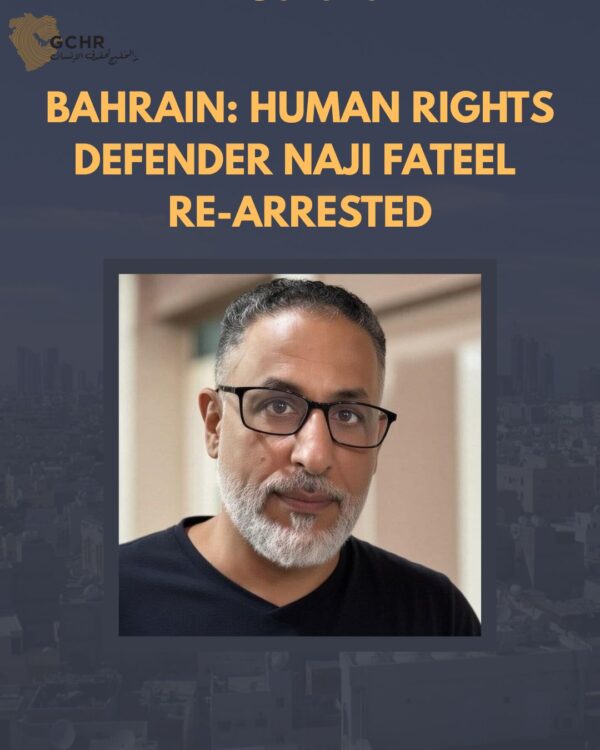 Bahrain
Human rights defender Naji Fateel re-arrested