Court announced the verdict of “Azamn” journalists; two journalists face prison sentences and one acquitted
26/12/2016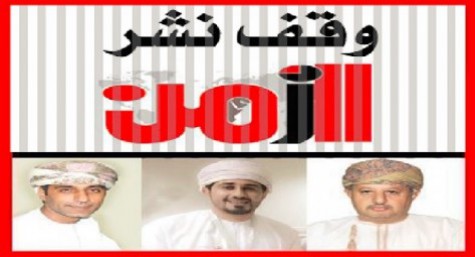
At a hearing held on 26 December 2016, the Court of Appeal announced its verdict related to the case of “Azamn” three journalists.
The Court of Appeal acquitted Zaher Al-Abri while sentencing both Yousef Al-Haj to one year in prison and Ibrahim Al-Maamari to 6 months in prison, to include the time they have spent in detention to date. The court also revoked the decision to shut down “Azamn” newspaper which was issued by the Ministry of Information.
Reports received by the Gulf Centre for Human Rights (GCHR) confirm that the two journalists, Ibrahim Al-Maamari and Yousef Al-Haj are still free. Their human rights lawyer, Yaqoob Al-Harthi will appeal the verdict to the Supreme Court in Oman.
The case of the three journalists has been postponed on many occasions. Furthermore an independent human rights lawyer, who was present at a previous hearing in the case, found that the proceedings fell below international standards for a fair trial.
For more information about the case of the closure of “Azamn” newspaper and the targeting of its journalists, please see: https://www.gc4hr.org/news/index/country/6
While the GHCR welcomes the revocation of the decision to shut down “Azamn”, it believes that the targeting of the three “Azamn” journalists is a serious threat to freedom of the press in Oman and should be brought to an immediate and unconditional end.
GCHR urges the authorities in Oman to:
- Revoke the latest sentences against the two “Azamn” journalists, Ibrahim Al-Maamari and Yousef Al-Haj;
- Provide a secure environment for “Azamn” newspaper to do its journalistic work;
- Protect freedom of the press in the country; and
- Guarantee in all circumstances that all human rights defenders including journalists, writers and on-line activists in Oman are able to carry out their legitimate human rights activities without fear of reprisals and free of all restrictions including judicial harassment.
GCHR respectfully reminds you that the United Nations Declaration on the Right and Responsibility of Individuals, Groups and Organs of Society to Promote and Protect Universally Recognized Human Rights and Fundamental Freedoms, adopted by consensus by the UN General Assembly on 9 December 1998, recognises the legitimacy of the activities of human rights defenders, their right to freedom of association and to carry out their activities without fear of reprisals. We would particularly draw your attention to Article 6 (c) “Everyone has the right, individually and in association with others: (c) To study, discuss, form and hold opinions on the observance, both in law and in practice, of all human rights and fundamental freedoms and, through these and other appropriate means, to draw public attention to those matters” and to Article 12.2, which provides that “the State shall take all necessary measures to ensure the protection by the competent authorities of everyone, individually and in association with others, against any violence, threats, retaliation, de facto or de jure adverse discrimination, pressure or any other arbitrary action as a consequence of his or her legitimate exercise of the rights referred to in the present Declaration.”