Despite the measures taken to limit the spread of the Coronavirus (COVID-19) in Iraq, which resulted in a large number of people being forced to stay in their homes, a few dozen demonstrators continued to remain in the sit-in squares in order to ensure the continuity of the popular movement. Their goal is to put more pressure on the authorities, while expressing their aspirations for a prosperous and bright future for all people, without exception.
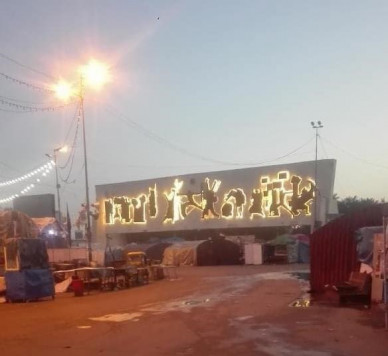
Protesters in Al-Tahrir Square, located in the centre of the capital, Baghdad (pictured above), which is the icon of the Iraqi sit-ins, observed the health protection requirements and worked to keep a few of the protesters in the sit-in tents, as did protesters in the sit-in squares of other Governorates. This is the fifth monthly report of the Gulf Centre for Human Rights (GCHR) for 2020, which documents continued violations in Iraq during popular demonstrations.
Targeted killing of human rights defenders
Human rights defenders and activists continue to be killed by unidentified gunmen, as the authorities fail to protect people from targeted killings.

On the evening of 09 May 2020, unidentified gunmen opened fire on prominent human rights defender Azhar Al-Shammari (picture on the left), near his house in the Sumer neighborhood in the center of Nasiriyah. He was hit with three bullets that seriously wounded him, especially in the abdomen, and led to his death in hospital the next day, on 10 May. Thousands participated in his funeral from Al-Haboubi Square in Nasiriyah.
He had predicted his own death hours before the assassination, when he posted on his Facebook page several photos (picture on the right) of protesters in Al-Tahrir Square in Baghdad, writing their wills, filled with sadness, who are being killed only because they want to restore their homeland. Above these pictures is written the hashtag #We_know_we_will_die.

Al-Shammari, 28 years old, was married with a six-month-old baby boy. He lived with his wife, in his parent’s house with eight members of his family, and owns a clothing store. He was at the forefront of the protesters who did not leave Al-Haboubi Square from the start of the popular movement, and did everything possible to serve his city, defend its rights, fight corruption, and urge that demonstrations remain peaceful. He also devoted his time to improving the streets and painting the sidewalks (picture on the left). After the Covid-19 pandemic began, he carried out relief campaigns for the city’s needy people in addition to providing food in Al-Haboubi Square during the month of Ramadan (picture on the right).
Violent attacks on protesters
Protesters have been violently attacked and assaulted in May in various locations.

On 13 May 2020, members of the riot forces arrested three peaceful protesters, all young men under the age of twenty, who were on their way to the sit-in at Al-Tahrir Square. They violently beat them as well as sexually assaulted them. The above two photos illustrate the cruelty with which they were treated. Reliable local sources confirmed that they are in very poor psychological condition.

On 10 May 2020, crowds of demonstrators set out in the streets of most of the central and southern governorates, including Baghdad, to emphasise that the popular movement will continue until protesters achieve the comprehensive reform that they were still seeking.

In Basra, a militia attacked protesters and killed one of them on 10 May 2020. Civil society activist Moamel Osama Khalaf (pictured above), born in 1990, who used to live in one of the poor neighborhoods in the Shatt Al-Arab district, had just eaten the iftar meal after a day fasting, before joining the peaceful solidarity march in Basra. As the march passed in front of the headquarters of one of the militias, the demonstrators came under heavy weapons fire, and five protesters were wounded: Ahmed Ali Khadim, born in 1996, Khadim Waad Saad Obaid, born in 1995, Ali Khadim Salman Nassar, born in 1994, Haidar Ahmed Khadim Maaraj, born in 1994, and Hussain Majed Hassan, born in 2020. Khalaf was killed after being shot shot in the head several times, causing many injuries and scattering his brains on the street. He died at dawn the next day. A symbolic funeral for him took place on 12 May 2012 in the central sit-in square in the city of Basra, in which a large number of protestors participated.
Basra Police Command has announced the closure of the headquarters of this armed militia and the arrest of the occupants. A statement of Basra Police Command released on 11 May 2020 said that, on 10 May, a police force immediately went to the headquarters of the armed militia’s office, and closed it down. Also those responsible for the shooting were arrested. The statement said the police were “seizing various weapons and ammunition,” and indicated that these measures has been taken after protesters were targeted with gunfire from the militia’s office.

On 06 May 2020, Al-Muthanna Police Directorate, by order of the Commander of the Al-Muthanna Emergency Regiment, arrested 16 graduates of the College of Administration and Economy for demonstrating in front of the Al-Muthanna Governorate building in the city of Al-Samawa (picture on the left). They were protesting to demand job opportunities. The female students were assaulted and their mobile phones were broken. The 16 graduates then were also detained in bad conditions in an inappropriate place used as a bicycle park (picture in the middle). They were released later on the same day on bail after being charged with “assaulting a government employee while he was on duty.” The Al-Muthanna Police Directorate detained activist Haider Al-Khashan (picture on the right), a coordinator of the postgraduate degree sit-ins, without a warrant during the sit-in, and soon released him.

On 21 April 2020, three protesters were wounded and a fourth lost his life due to a heavy armed attack (picture 1) by armed men who used machine guns against the protesters and their tents in Al-Tahrir Square. They started from the direction of Al-Khilani Square towards the Al-Tahrir Tunnel, in central Baghdad. The attack was carried out by men wearing civilian clothes, with their faces uncovered. The security forces, including anti-riot forces, did not intervene to prevent the attack nor to arrest the perpetrators.
Among the injured was demonstrator Ayser Hashim (picture 3) who now needs several surgeries due to the wounds he sustained. Demonstrator Mahdi Al Saadi (picture 4) lost his life as a result of this attack. This attack was documented with photos and videos, showing one person in civilian clothes shooting a Kalashnikov machine gun towards the Tahrir Square protesters (picture 2).
Arrests and kidnappings of human rights defenders and activists
Human rights defenders, activists and protesters have been kidnapped by armed groups and arrested by various security forces, both from their homes or the streets of Iraq, including near protest squares.

On the night of 09 May 2020, civil society activist Sheikh Ali Madkour Al-Lami was kidnapped by armed militia while he was heading to Al-Tahrir Square in Baghdad. Al-Lami participated in the popular movement since its inception and opened a tent he called a “tent of the will of the people” to support the demonstrators. He was released on 10 May 2020 and returned to Al-Tahrir Square.

On the night of 05 May 2020, an armed group kidnapped civil society activist Mortada Al-Safi from Al-Tahrir Square and took him to an unknown destination. He was only released on 09 May 2020 after his captors tortured him and shaved his hair and beard (picture on the right). He nonetheless confirmed that he would return to the sit-in at Al-Tahrir Square because he said, “Iraq deserves everything.” This is not the first time an activist has been kidnapped and shaved.

On 03 May 2020, civil society activist Heba Al-Mousawi (picture 1) was kidnapped as she left the central sit-in square in Al-Hilla city, the capital of Babel Governorate, by two people who forced her into a car and covered her eyes. They drove her for a few minutes to an abandoned house and severely beat her. When she woke up, she did not find her bag or her veil. She ran out of the abandoned house and some locals helped her to contact her family to come and bring her back home. The kidnappers asked her to appear in a recording to reject the popular movement, but she refused, thinking to herself, “I will die so let me die with my principles.” She suffered from various bruises and wounds, and she received a medical report which filed with a complaint to the relevant authorities. Al-Mousawi has participated in the demonstrations in her city since 25 October 2019 and supported the protesters in the sit-ins by organising direct broadcasts as well as transporting supplies for them during the month of Ramadan.
On 20 April 2020, security forces arrested human rights defender Ali Hassan Al- Ibrahimi (picture 2), one of the coordinators of the demonstrations, in the centre of Nasiriyah. Al-Ibrahimi is known for his loyalty in his work and his national stance, and his fate remains unknown.
On 19 April 2020, the National Security Agency in Al-Diwaniyah city, the centre of Al-Qadisiyah Governorate, arrested Mortada Naim (picture 3), a human rights defender who is a prominent activist in the popular movement in the city, while he was going to the sit-in square with a group of fellow activists. On 28 April 2020, he was released on bail after being charged for his peaceful activities in accordance with Article 198 of the Iraqi Penal Code. His release is due to the efforts made by a team of lawyers who are also protestors in the central sit-in square in Al-Qadisiyah governorate.
Naim lost his father at an early age and was able to obtain a Bachelor’s degree in Computer Science despite his difficult life, as he was studying and working at the same time. He has been unemployed since he graduated. He participated in the popular movement in his city from the early days in the hope of change, eliminating corruption and achieving social justice. He uses his Facebook page to provide support to the popular movement and solidarity with the demonstrators in the rest of the Iraqi Governorates.
On his page, Naim constantly remembers his close friend, civil society activist Bahaa Faleh Darb Al-Kaabi (picture 4), who lost his life during his participation in a demonstration during the popular movement. On 04 October 2019, Al-Kaabi, only 21 years old, was killed after the security forces stationed in front of the Al-Qadisiyah Governorate building fired indiscriminately against demonstrators. He was a student at the Medical Institute, in addition to a leading football player, and intended to get married. He participated in the popular movement since its inception, utilising his enthusiasm to defend the rights of the poor and the deprived who were looking for a homeland to protect them.
On 14 April 2020, civil society activist Hisham Qasim Mohammed (Mahawi) (picture 5) was released after being arrested by the security forces in Al-Tahrir Square on 11 February 2020 due to his active participation in the popular movement since its inception. A number of lawyers have contributed to speeding up his release and that of other peaceful demonstrators, including Haider Mohammed Ayyad (only 18 years old), Ahmed Abbas Khayoun, Ali Salem Raji, and Hassan Balsam Atiya. The relevant authorities tried to direct a charge of blocking roads against him, due to his protest activities on the Mohammed Al-Qasim Highway. During his detention, he was subjected to ill-treatment and torture.
He had been kidnapped by an armed militia on 03 February 2020, also from Al-Tahrir Square, and only released on 09 February 2020, when he was thrown to the side of the road after being tortured. He was wounded by the riot police at the beginning of 2020.
On 10 February, he wrote on his Facebook page, “Death is much better than living an affliction and denial … They threatened me with death and they do not know that death is one of my legitimate demands … My wounds are not equal to the wound of the mothers of the martyrs. Death for a better Iraq. “
On 11 April 2020, the Intelligence Directorate of Al-Muthanna Governorate arrested prominent human rights defender Ayham Al-Nuaimi (picture 6), 40 years old, only a week after his marriage. He had been threatened with death by armed militia members because of his prominent activity in the popular movement and his fight against corruption in the province. He was released on 14 April 2020 due to the massive solidarity campaigns of his fellow activists and his wife. Local reports confirmed that he was tortured and ill-treated while in detention.
On 07 April 2020, Al-Nuaimi posted on his Facebook page, which he used to promote the popular movement and support anti-corruption campaigns, the following, “To the Governor of Al-Muthanna Ahmed Menfi and the Director of Health of Al-Muthanna, if you do not stop robbing the people we will break the curfew and you bear the consequences of breaking it as I have therefore been excused.” As a result, he was threatened by the Governor of Al-Muthanna, and an intelligence detachment of four people was sent to raid his home in the city of Al-Samawa without a judicial order. He was not present at that time, so they threatened his family and told them that he had to stop his human rights activities, or he would be arrested. He was not calling for breaking the ban imposed due to the spread of COVID-19, as he is one of the leaders of the #Stay_Home campaign and his post was among his peaceful activities to stop corruption in his Governorate.

On the night of 29 March 2020, civil society activist Abdulmasih Romeo Jean Sarkis (picture 1) was arbitrarily arrested without a warrant by the riot police near Al-Khilani Square, and there is still no information yet about his whereabouts. Sarkis, 34, is a resident of the Al-Seha district of the Dora area in Baghdad. His parents are old and he has a brother with special needs.
On 09 March 2020, an unknown armed group kidnapped journalist Tawfiq Al-Tamimi (picture 2), who reports on the governorates for the official “Al-Sabah” newspaper, which is issued by the Public Authority for Information and Communications. Masked gunmen intercepted the car in which he was traveling after he left his home in Baghdad’s Ur neighborhood and took him by force to an unknown destination.
On 07 March 2020, Al-Tamimi, known for his moderation and professionalism, posted on his Facebook page a photo taken of him with his colleague, publisher and writer Mazen Latif (picture 3), who was kidnapped on 31 January 2020. He asked at the end of the post, “When are you coming back?”
On 31 January 2020, a group of armed men dressed in civilian clothes riding in a pickup truck with shaded windows kidnapped Mazen Latif and took him to an unknown destination. Latif owns Mesopotamia publishing house, and he is interested in the heritage of religions and has extensive relationships with various international historians and writers. Latif’s latest project is his publication of the Heritage and Cultural Magazine (“Nahariya”). It is more like an encyclopedia to show the beauty of Iraqi civilization. His fellow intellectuals, writers and journalists organised a solidarity gathering for him on 06 February 2020.
Also, human rights lawyer Ali Jaseb Hattab Al-Heliji (picture 4) is still in custody after being kidnapped on 07 October 2019, in Amara city, by an armed group that is known to security forces in the Governorate. Although his father continues to be in shock, he has spared no effort to knock on all doors to obtain any evidence about his son’s whereabouts, but to no avail.
Detainees ordered released
On 09 May 202, the new Iraqi Prime Minister announced in a statement the most prominent decisions of the first session of the Council of Ministers, in which he stated the following, “We directed the security services to release all detainees who participated in the demonstrations and asked the Supreme Judicial Council to cooperate in the release of the demonstrators who committed minor cases with the exception of those involved in shedding Iraqi blood.” Also, the Supreme Judicial Council issued on the following day, 10 May, an order to release all protesters. However, reliable local sources confirmed that hundreds of innocent detainees held by the various security services and among those kidnapped by armed groups had not yet been released.
Violence against women
Domestic violence has increased worldwide in all countries due to COVID-19, when families are forced into close proximity. But even before the lockdown, women in Iraq were sometimes trapped in their homes and subject to violence.

On 18 April 2020, a young 20-year-old woman, Malak Haider Al-Zubaidi, who was married a year ago, died in the hospital after she set herself on fire. She endured grave violations by her husband and his family, who prevented her from completing her studies and taking the required exams, as well as visiting her family, including her mother, for eight months.
Calls from civil society have emerged after this and other similar incidents demanding that a strict law be passed that stops domestic violence and protects women. On 15 April 2020, the Najaf Investigation Court issued an order to arrest two other defendants in Al-Zubaidi’s case, bringing the number of detainees in this case to four, including her husband, brother, and their father.
Recommendations
GCHR calls on the Iraqi government to take full responsibility to protect all demonstrators, journalists, human rights defenders and members of civil society, including during the COVID-19 outbreak. In addition, the authorities must strengthen laws against sexual assault and domestic violence, particularly when women are more vulnerable during the isolation imposed by the current crisis. While welcoming the swift action by the Basra police to arrest militiamen responsible for the shooting of protesters on 10 May 2020, GCHR calls on the Iraqi authorities to identify the perpetrators of the murder of human rights defenders Azhar Al-Shammari in Nasiriyah, and all other human rights defenders and activists killed in Iraq, and bring those responsible to justice. The authorities must fulfill their constitutional obligations not to violate public freedoms, including the freedom to peaceful assembly, freedom of expression, and freedom of the press, which can be respected while protecting public health.

-
Latest News
-
Related Publications
Latest Urgent Action
 Bahrain
Human rights defender Naji Fateel re-arrested
-