This is the 20th periodic report issued by the Gulf Centre for Human Rights (GCHR) since January 2020, documenting the human rights situation in Iraq. The report includes cases of academics and public officials targeted with violence, threats to children’s rights, in addition to clashes during protests in Iraq. While welcoming the prosecution of the killers of journalists and civil society activists, GCHR calls for full accountability for the authors of these attacks as part of a pattern of systematic violence. Also, GCHR condemns the terrorist operations carried out by the terrorist organisation Da’esh against defenseless civilians.
Achieving justice and holding the perpetrators accountable
Civil society activists and the families of victims who were killed and kidnapped during the protest period that began on 01 October 2019 are still waiting for more serious government measures than the procrastination that is currently taking place to achieve justice and hold the perpetrators to account, especially with the repeated promises by the government of Prime Minister Mustafa Al-Kadhimi to pursue them.
On 06 November 2021, family and friends of prominent human rights defender Amjad Al-Dahamat, marked the second anniversary of his assassination and called on the government to hold his killers accountable.
On the occasion of his brother’s remembrance by civil society activists, human rights defender Ali Al-Dahamat wrote on his Facebook account: “What I have read of posts and words of love and sympathy from you has put me in a state of confusion. Do I console you or do I console myself? You have participated in our mourning as if you were his family.”
Notably, GCHR documented in November 2019 the assassination of Amjad Al-Dahamat late at night by an unidentified armed group driving a black car without numbers using pistols with silencers. The murder took place just 500 metres from the Headquarters of the Police Command in Al-Amarah after Al-Dahamat attended a meeting with the Police Commander together with several activists.

On 01 November 2021, the Iraqi judiciary issued a death sentence by hanging against the main suspect in the killing of Dijlah TV’s correspondent in Basra, journalist Ahmed Abdel Samad, and his colleague, photojournalist Safaa Ghali.
According to the Supreme Judicial Council in Iraq, the perpetrator confessed to killing them while they were covering demonstrations in Basra Governorate, southern Iraq.
GCHR documented their assassination, which took place on 10 January 2020 in Basra, due to their activism and their reporting on the protests taking place there.
Local observers confirmed that the Iraqi authorities are seeking to individually prosecute the killers of civil society activists and journalists who were murdered during the popular movement that began on 01 October 2019. This will result in keeping the identities hidden of the parties who participated in incitement and provided support to the perpetrators, who were just tools to carry out the murders. These series of murders should be dealt with as a pattern of systematic killing.
Civil society activists attacked

On 18 November 2021 at dawn, unknown persons burned the house and car of a prominent civil society activist, Karrar Al-Asadi, in the city of Najaf. Local reports said that Molotov cocktails were used in this attack.
Al-Asadi has participated in the popular movement since its early days and is known for his fight against corruption and his constant demand for comprehensive reform. On 24 November 2021, he wrote on his Facebook page: “Najaf and the youth of Najaf are in danger because of the corrupt governor and the reckless police chief.”

On 20 November 2021, civil society activist Mazen Mahbouba was assaulted by unknown assailants in Najaf. The attack occurred after Mahbouba participated in a protest in solidarity with civil society activist Karrar Al-Asadi. Despite being disabled and requiring a wheelchair, Mahbouba participated with full force in the popular movement that started in his home city Najaf.
Other sectors of society attacked and killed
The violations and attacks are no longer limited to only journalists and civil society activists, but also extend to other sectors of society, due to the prevalence of impunity and lack of accountability for the perpetrators. In recent weeks, a series of attacks took place against one of the successful candidates in the recent elections for the Iraqi Parliament, which were held on 10 October 2021, and two other public officials. This was followed on 07 November 2021 by an explosive-laden drone attack, in an attempt to assassinate Prime Minister Al-Kadhimi at his Baghdad residence.
These attacks indicate a decline in the role of the Iraqi authorities in law enforcement and in preventing armed and terrorist groups from achieving their goals in carrying out assassinations and attacks on defenseless civilians.

On 06 November 2021, the house of newly-elected politician Nadim Fahim Al-Shibli was attacked with a grenade, causing only material damage. Al-Shibli, who was the target of the attack, is an independent candidate and an advocate of the Iraqi protests, who wrote on his Facebook account about “an unsuccessful assassination attempt.”
Also, on 04 November 2021, an engineer working in the Electricity Department of Al-Baladiyat District, east of Baghdad, was assassinated. The gunmen ambushed the victim as he was leaving his workplace. The assassination is captured in this video, where one of the gunmen chased after him and assassinated him in front of everyone’s eyes, and then fled in a car that was waiting for him.

On 17 October 2021, the house of the Director General of Health in Dhi Qar Governorate, Dr. Saadi Al-Majed, was hit by an explosion targeting his son’s car, causing only material damage. According to Al-Majed, the attack was carried out by a person who got out of a car and placed the explosive device in his son’s car, before it exploded inside the vehicle.
This video shows the moment of the explosion. Al-Majed did not make any accusations against any party or entity who might be behind the targeting of his house.
Risks surrounding journalists and their professional work
The disappearances and attacks on journalists, endangering their lives, have not ended, as international indicators still place Iraq among the countries most dangerous to journalists’ lives. The attacks and disappearances are of concern to Iraqi journalists, especially freelancers who do not work in institutions affiliated with armed parties or groups.
On 05 November 2021, staff of Al-Jazeera were arrested in Baghdad while covering protests objecting to the results of the recent elections for the Iraqi parliament. Two of the channel’s staff were released shortly after their arrest.

After his release, photojournalist Rayhan Al-Mawsili, who works for Al-Jazeera, wrote on Facebook: “The security forces beat us and broke our camera during the live broadcast. Then we were arrested, fingerprinted and forced to sign not to publish anything and not to file a complaint against them. I received dozens of punches and blows when they tried to take the camera, which I refused to hand over, then one of the officers intervened and rescued me from among them. Which country and which government do we live in?”

On 05 November 2021, the broadcast vehicle owned by the Belady satellite channel was set on fire, and it turned out later that members of the riot police had deliberately set it on fire while the channel was broadcasting the protests near the gate of the fortified Green Zone in Baghdad. There was nobody in the car at the time.) This video clip shows riot police throwing incendiary materials at the car.

On the night of 24 October 2021, civil society activist and journalist Bassem Al-Zaak was kidnapped while covering the sit-ins of demonstrators against the results of the Iraqi parliament elections. He was kidnapped while broadcasting a live video of the protesters’ tents, when the broadcast stopped suddenly.
Activists and those close to Al-Zaak told GCHR that he “disappeared and his fate is unknown until this moment.” Al-Zaak works for the Al Arab Press Agency, which is headquartered in Paris, and has covered conferences and media events in the Baghdad.
In a video published on 27 October 2021, his mother appealed to Prime Minister Al-Kadhimi to search for her son and reveal his fate. She said, “My son is not seeking a position of authority, does not belong to any party and is unarmed, and he was kidnapped while filming demonstrators in Baghdad.”
Protests against the election results met with violence
Since19 October 2021, Baghdad has been the scene of demonstrations by supporters of a group of political parties objecting to the results of the elections for Iraqi Parliament.
On 05 November 2021, clashes took place between demonstrators protesting the results of the elections and the security forces. Live bullets were used in the clashes, which led to the killing of one of the demonstrators.
On 06 November 2021, the Joint Operations Command announced that the Commander-in-Chief of the Armed Forces had directed the formation of a higher committee to investigate the bloody events that accompanied the demonstrations rejecting the election results.
According to the information obtained by GCHR, about 130 people were injured in these clashes, including security personnel.
Terrorist attacks target innocent citizens
Da’esh has resumed its terrorist attacks in some Iraqi cities, and dozens of civilians were killed or wounded in these attacks, at a time when the Iraqi government launched extensive security operations to eliminate the terrorist group.
On 29 October 2021, armed men attacked houses in the village of Nahr Al-Imam, adjacent to the village of Al-Rashad in Muqdadiya district of Diyala Governorate, in reaction to the attack launched by Da’esh, killing seven people and burning some orchards there. Hours before that, Da’esh launched an attack on the village of Al-Rashad that left 12 victims and more than 15 wounded, including women.
Children’s rights at risk
In recent weeks, the suffering of Iraqi children has become more evident, as acts of violence against them have increased, at a time when the dissolved Iraqi Parliament was unable to pass the Child Rights Law that has been on its shelves for more than a decade.
The absence of a law on children’s rights, as well as the absence of a law against domestic violence, has caused many problems facing Iraqi families, especially children and women.
On 28 October 2021, the Baghdad Anti-Crime Directorate arrested a father who was trying to sell his daughter through an authorised midwife, performing a caesarean section followed by the sale of the child. The father admitted, according to the Iraqi authorities, that he had tried to sell his newborn daughter. Accordingly, the investigative judge decided to arrest him in accordance with the provisions of Article (6) of the Anti-Human Trafficking Law.
On 24 October 2021, two children were injured in Al-Rahba area in Najaf Governorate after the explosion of war remnants. According to activists who spoke to GCHR, the explosion caused severe injuries to the two children, who recovered days later.
Sadly, on 22 October 2021, activists in Nineveh Governorate informed GCHR that two children were killed and a third wounded after the explosion of war remnants left behind by the terrorist organisation Da’esh in one of the sites it controlled in Tal Afar district.
On 18 October 2021, the security forces arrested a nanny who had violently abused a four-year-old child in the Mahmudiya area, south of the capital, Baghdad. According to the investigations, the accused admitted that while working on a monthly basis as a nanny for the child, whose parents are separated, that she abused him to death. When the security forces went to the house of the murdered child, it became clear that there was another three-year-old child, the brother of the victim, who showed signs of abuse but was alive. He was immediately transferred to the hospital due to his poor health.
Recommendations
GCHR calls on the Iraqi government to assume full responsibility for the protection of all demonstrators, journalists, human rights defenders and members of civil society. In addition, the authorities should strengthen the laws necessary to protect children and combat domestic violence.
GCHR calls on the Iraqi authorities to identify all perpetrators of the crimes of kidnapping, torture, and killing of human rights defenders, peaceful demonstrators and other activists and to bring those responsible to justice.
The authorities must fulfill their constitutional obligations not to violate public freedoms, including freedom of peaceful assembly, freedom of expression, and freedom of the press.

-
Latest News
-
Related Publications
Latest Urgent Action
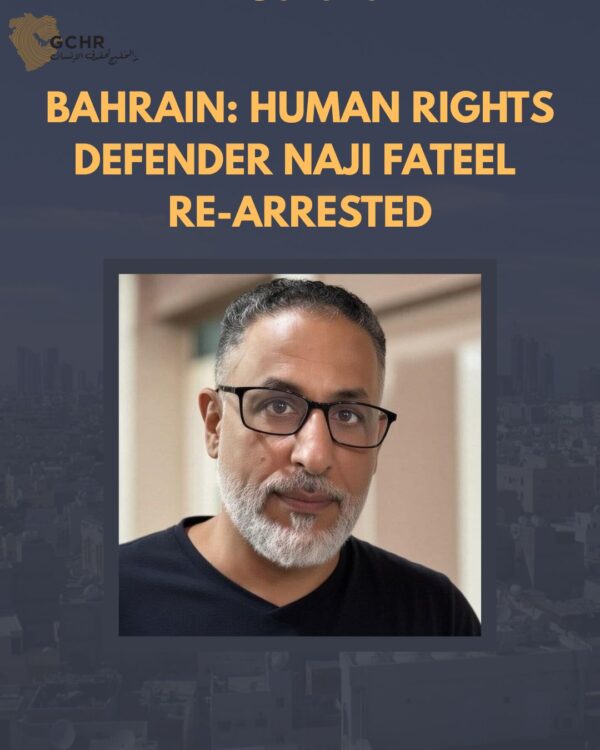 Bahrain
Human rights defender Naji Fateel re-arrested
Defenders Affected
-