This is the tenth periodic report of the Gulf Centre for Human Rights (GCHR) about violations during popular demonstrations in Iraq. This report sheds light on killings, abductions, prosecution and intimidation by filing lawsuits against human rights activists and protesters in Iraq.
Activists taking part in the demonstrations are still exposed to assassinations, kidnappings and intimidation by the authorities and armed groups in Baghdad, the capital, and other central and southern cities.
With the increasing acts of violence, which can clearly be described as systematic, there were not any noticeable steps taken by the Iraqi government in order to ensure justice for the victims and hold the perpetrators accountable, which has led to an increase in violations against activists in Iraq.
In the midst of the violations committed against activists and protesters, in November 2020 the Iraqi Parliament sought to pass the Cybercrimes Law, which human rights organisations consider as a method to restrict freedom of opinion and expression, and an attempt to gag civil society online.
GCHR has documented at least 43 activists who were threatened with death in southern Iraq, forcing all of them to leave their cities and flee to other cities.

Violations and assassinations were not limited only to activists and demonstrators at protests, but also carried out against those who supported them. On 01 November 2020, unidentified gunmen assassinated tribal leader Sheikh Abdul Nasser Al-Tarfi Al-Taie (photo 1) in front of his house in the city of Amara, southern Iraq. Al-Taie is one of the most prominent tribal sheikhs who support and defend the protests, and has appeared in repeated videos defending protesters.
On 20 November 2020, a civil society activist who was in charge of the tent for retired people in Al-Tahrir Square, retired Brigadier General Ghazi Al-Tamimi Abu Mohammed, died in a Baghdad hospital (photo 2), after his health deteriorated as a result of serious injuries sustained during an assassination attempt on 06 November 2020. Eyewitnesses stated that unidentified gunmen in a car shot him with a silencer weapon while he was in his car on Mohammed Al-Qasim Road after leaving Al-Tahrir Square.
On 20 November 2020, civil society activist Bashar Al-Nuaimi (photo 3) was wounded after an assassination attempt that occurred while he was returning from the funeral of Ghazi Abu Mohammed in Al-Tahrir Square in central Baghdad. Al-Naimi was wounded in the shoulder with a silencer weapon, and was then transferred to the Medical City Hospital in Baghdad.
Activists on social media continued to support the protests in Basra, Dhi Qar and other Governorates, despite risks from the armed groups which continued to monitor them. On 22 November 2020, unknown assailants targeted the home of civil society activist Ammar Al-Khazali (photo 4) in Al-Siniyah sub-district of Al–Qadisiyah Governorate with an explosive device, in addition to shooting at the house. Al-Khazali is considered one of the most prominent protest activists in Diwaniyah. People close to him told GCHR, “The attack on Al-Khazali almost claimed the life of his family, and the aim was to push him to retreat from the protests.”

On 25 November 2020, prominent civil society activist Akram Athab (photo 5) was subjected to an assassination attempt by gunmen in the Talbiyah area, east of Baghdad, hours after his participation in a protest stand in Baghdad against the Cybercrimes Law, which the Iraqi Parliament was planning to pass into law.
A video shows the moment of the assassination attempt on the activist Akram Athab, when a gunman got out of a white car and fired shots inside a shop where Athab and his colleague Omar Al-Taie were present. Al-Taie spoke to GCHR about the moment of the assassination attempt, explaining: “At eight o’clock on the twenty-fifth of November, a masked person carrying a silencer got out of a car and shot at Athab, who fled the bullets.” He added, “Athab escaped and entered a Mini Market but some other masked guy got out of another car and shot him, hitting him with three bullets in the abdomen and the leg.”
A bloody night in Dhi Qar
On 27 November 2020, clashes took place in Al-Haboubi Square in Dhi Qar Governorate between protesters and an armed group, claiming the lives of five activists. They are Tahseen Raed Adnan (no photo available due to privacy concerns), Haydar Khalid Al-Nasiri (photo 6), Abbas Hussain Ali (photo 7), Ahmad Radi Jalab (photo 8) and Ali Ihsan Fleifel (photo 9).
The protesters in Dhi Qar were preparing to commemorate the first anniversary of the Nasiriya Massacre, known as the “Zaytoun Bridge Massacre”, which occurred on 28 November 2019 during Abdul Mahdi’s government, when 500 protesters were killed, wounded and injured by tear gas, but before they solemnised this memory they were attacked by gunmen.

Despite the attacks they were exposed to that night and the burning of their tents by the gunmen, the protesters returned to Al-Haboubi Square and set up their tents again, denouncing the government’s “silence” about what they suffered, and subsequently demanding the government of Prime Minster Mustafa Al-Kadhimi to resign. They also appealed to the United Nations to defend them.
On 27 November 2020, demonstrator Anwar Al-Iraqi (photo 10), a resident in Karbala, was arrested at the entrance of Dhi Qar Governorate, after his participation in the first anniversary of the Zaytoun Bridge Massacre in Al-Haboubi Square.
On 28 November 2020, peaceful demonstrator Hussain Katea (photo 11) died of burns covering his body after he set fire to himself and attempted suicide in protest against the security forces’ incursion into the main protest square in the centre of the city of Kut, in Wasit Governorate, when they took down his tent.
On 28 November 2020, civil society activist Hussam Al-Abedi (photo 12) survived an assassination attempt by unknown gunmen in Al-Shamiya, a district located in the west of Al-Qadisiyah Governorate. Al-Abedi posted the details of the incident on his Facebook page and mentioned the following, “I was in the sit-in square and I was broadcasting live and pitying the martyrs of Nasiriyah and talking about the subject. I ended the broadcast and headed home. A car was driving behind me slowly. One minute after I entered the house, very heavy gunfire began on the house and car, the shooting lasted more than seven minutes, and the bullets entered the house through the windows, causing minor damage and panic and fear among the family and neighbours … The number of bullets was more than 80.”
Al-Abedi uses his Facebook page to support the popular movement and urge youth to act so that corrupt candidates are not elected again in the upcoming elections.

On 01 December 2020, a number of civil society activists in Dhi Qar Governorate confirmed that security forces raided their houses aiming to arrest them. Activist Amer Hussain Al-Faran (photo 13), whose house was raided at night, said: “At two o’clock in the middle of the night, a joint force of all sorts, including the police, army, intelligence and counter-terrorism, led by a number of senior officers, raided my house, but I managed to flee. During that raid, I was bruised and my left hand was injured, the attacking force tried to arrest me and fired five shots, before they lost sight of me.”
On 02 December 2020, the house of civil society activist and demonstrator Nawaf Khalid Jiyad Al-Nasiri (photo 14) was targeted with an explosive device, and on the same day the house of the civil society activist Falah Al-Ziyadi (photo 15) in Suq Al-Shuyukh district was targeted in with an explosive device. GCHR considers these to be acts of intimidation aimed at pushing activists to abandon their participation in the protests.
According to activists, Al-Nasiri and Al-Ziyadi are among those being pursued by the Iraqi security forces, and are considered to be among the most prominent actors in the protests in Dhi Qar Governorate.
On the evening of the same day, activist Mustafa Al-Jaberi (photo 16) was assassinated in the centre of the city of Al-Amara, centre of Maysan Governorate in the south of the country, and pictures were published of him in his car with bullet holes.

On 03 December 2020, unknown gunmen assassinated comedic actor Ahmed Al-Hakim (photo 17) on the day he returned to the country, by firing six bullets at him in the head and chest in the Al-Shuala area in Baghdad.
GCHR considers these to be acts of intimidation aimed at pushing citizens, including various activists, to abandon their participation in the protests.
On 03 December 2020, activist Mohammed Aflouk wrote on his Twitter account: “A joint force of the police is raiding my family’s house, taking their IDs and terrorising them, searching for me despite their knowledge that I have been outside the Governorate for months, while the gang members who attacked me a year ago were rewarded with contract appointments in the municipality department despite the issuance of more than one arrest warrant against them.” Aflok was severely beaten on 12 January 2020 in the centre of Kut by an unknown group, after he left the sit-in square, and required hospitalisation to receive the necessary treatment.
On 03 December 2020, a prominent activist in Dhi Qar Governorate, Zayed Al-Assad (photo 19), wrote on his Facebook account: “The threats and incitement against my life and the life of my family forced me to run away and leave my home in sadness and grief. I’ve been always grieving at the farewell hours when I leave Nasiriya and Baghdad to outside the country or even to another Governorate. My brothers and I, who are active in the protest movement, suffer from an attack of betrayal and demagoguery, just because we say the truth and never compromise with falsehood.”
On 03 December 2020, the house of activist Ahmed Hamid Al-Jubouri (photo 20) was shot at in the Najaf Governorate, and the house of activist Ali Gibran (photo 21) was also attacked with a sound device.

On 04 December 2020, the security authorities in Dhi Qar Governorate arrested activist Salam Ghafil (photo 22) from Al-Bat-ha district in the Governorate. People close to him told GCHR that, “Ghafil is detained in the Anti-Terrorism and Intelligence Directorate and will be transferred to the Nasiriya investigation court in Dhi Qar Governorate.”
Days before his arrest, Ghafil published a picture of the protesters’ blood who were killed in Al-Haboubi Square on 27 December 2020, with the caption: “Nasiriyah, and the blood continues.”
On the same day, 04 December 2020, demonstrators Zaid Al-Iraqi (photo 23) and Ali Al-Mousawi (photo 24) survived an assassination attempt in an area close to Al-Mishkhab popular market, in the western Governorate of Najaf.
Al-Mousawi is considered one of the most prominent media and human rights figures, who raises his voice to achieve the demands of the popular movement in Iraq. As for Al-Iraqi, he is one of the young media and human rights figures who recently emerged in the popular protests, and he was previously attacked by the Najaf Governor Protection Force. Local sources in Najaf Governorate confirmed that civil society activists are still facing the risk of assassinations, which are often preceded by threatening messages that reach them on the phone or through their accounts on social media.

On 04 December 2020, activist Safad Al-Nadawi (photo 25) posted on her Facebook account a few pictures and a video of her being shot at near Al-Nida’a Mosque and wrote: “Today, after I got back from Al-Tahrir Square with my mother and her friend, we were exposed to an assassination attempt.” She added: “A four-wheel drive car followed us, I did not focus on its type or number. The car kept bothering me, and then it approached me and fired four bullets at us, some of which came through the car doors.”
This assassination attempt also targeted her mother, civil society activist Intisar Jaloub Jasim Al-Muhammadawi (Umm Muhammad) (photo 26), who was injured in the shoulder. Civil society activist Dr. Safaa Kadhim (photo 27) was also injured in the attack.
Al-Muhammadawi, born in Babylon in 1958, works as a school principal and is the head of the non-governmental organisation Seeds of Mercy which supports women and children. She is one of the most prominent feminist figures in the Iraqi protests, which addressed human rights issues related to women’s rights, domestic violence, and others.

On 11 December 2020, after leaving Al-Tahrir Square, civil society activists Mohammed Rahim (photo 28) and Mohammad Jamal (photo 29) were stabbed with sharp instruments, which led to head and back wounds, and received the necessary treatment at the Medicine City Hospital in Baghdad.
Civil society activist Silwan Ahmed Al-Saadi (photo 30) also spoke of a kidnapping attempt while he was passing by the Al-Saadoun area. This video shows him with signs of torture saying: “I was kidnapped at 2:30 in the afternoon, in front of the police and army officers. They continued torturing me for two hours or more.”
On 15 December 2020, unknown gunmen riding a motorbike fired their silencer weapons at prominent civil society activist Salah Hassan Al-Iraqi (photo 31) after he left his home in the New Baghdad area, east of the capital, Baghdad. He died almost immediately, and the police at the checkpoint did not move a finger even though they were a few metres away.
Al-Iraqi is one of the leaders of the popular movement in Baghdad, and was known for his courage. On 13 December 2020, he wrote on his Facebook account, which he uses to support the popular movement, the following, “Despite all the circumstances and militia threats, I arrived at Al-Tahrir Square to confront the corrupt.” In a video of him recorded few months ago after he was shot in Al-Tahrir Square, he says, “Al-Tahrir Square has been suppressed …To you, Iraq. To you, oh martyr … We will die with dignity.” He died shortly after.
On 11 December 2020, civil society activist Abbas Al-Taie (photo 32) was kidnapped by an armed group, who tortured him and forced him to sign pre-written papers. Al-Taie spoke about the details of his abduction and torture in a video he recorded after his release on 13 December 2020. Al-Taie participated in the popular movement from the start, maintaining his constant presence in Al-Tahrir Square despite the serious threats against him. On the same day, Salah Al-Iraqi wrote on his Facebook page, saying, “Praise be to God. Abbas Al-Taie came back and the youth did not fail, but Abbas’s rights will not be lost.”
Targeting academics in Maysan Governorate

On 16 December 2020, two people riding a motorbike assassinated Dr. Ahmed Abdul-Zahra Al-Sharifi (photo 33), the scientific assistant to the dean of Al-Manara private College, in downtown Al-Amara, the centre of Maysan Governorate, southern Iraq.
Just eight hours before his murder, Al-Sharifi, 49 years old, published a post on his Facebook account under the title, “Targeting university professors, an alarm bell ringing in Iraqi higher education” He wrote, “Through the course of events during the recent period, we notice a remarkable increase in the targeting of scientific and academic experts in particular and the rest of society in general, and what happened yesterday evening in targeting the home of the President of Maysan University is a systematic terror aimed at emptying the country of these professions.”
The house of the President of Maysan University, Dr. Abdulbasit Mohsen Ayal (photo 34), was attacked by a stun grenade which was placed near the outer fence and exploded late at night on 15 December 2020, causing only material damage.

On 21 December 2020, the houses of civil society activists Wali Al-Saeedi (photo 35) and Karar Al-Ezirjawi (photo 36), were attacked with improvised explosive devices by unknown persons, and according to activists from Dhi Qar Governorate, this targeting was due to their participation in the protests.
Judicial targeting against women’s rights organisation
The Organisation of Women’s Freedom in Iraq (OWFI), legally registered with the NGO Department of the General Secretariat of the Council of Ministers, faced judicial targeting because of its unlimited support for the current popular movement and its active participation in cultural and social activities about women’s rights and their role in the protests in Al-Tahrir Square in Baghdad, the main sit-in square, where the organisation set up two tents.
The General Secretariat of the Council of Ministers filed a lawsuit against prominent human rights defender Yanar Mohammed as the head of the organisation. The complaint included several allegations, including violating the law, harbouring women fleeing their homes with various cases and exploiting girls by facilitating their travel outside the country.
The Karrada Court of First Instance in Baghdad held several sessions to look into the case, the first of which was on 23 March 2020. The defense team of lawyers Mustafa Hadi Al-Saadi and Anmar Haitham Al-Saadi was following the case closely and with great efforts.

On 16 November 2020, the Karrada Court of First Instance dismissed the case (photo 37). The court stated in the text of the decision, “The evidence does not rise to the level of evidence contained in the Evidence Law No. 107 of 1979, as amended, considering that evidence is the basis of the truth and the motive of its life, and the basis on which every judgment issued by the judiciary is made. The plaintiff bears the burden of proof, [and] due to the plaintiff’s evident incapacity, the court decided to dismiss the case and to charge the plaintiff the expenses and attorney fees of the defendant’s attorney.”
The OWFI began establishing the first safe havens for women in Iraq in 2003 and expanded the number of these safe houses to 11 in five Iraqi Governorates. Because of its work defending Iraqi women’s rights, it was awarded the Gruber Prize for Women’s Rights in 2008 and the Rafto Prize in 2016.
This complaint, which was filed and rejected by the Iraqi judiciary, lacked the legal basis due to the close cooperation between the OWFI and the various competent government agencies, including the Ministry of Labour and Social Affairs, since its establishment in 2003, as well as the fact that the NGO Department is entrusted with the task of resolving violations by civil society organisations. Through meaningful healthy dialogue and meetings between the representatives of the two parties, resorting to the judiciary came after all other means had been exhausted, including the warning stated in the first paragraph of Article 23 of the Non-Governmental Organisations Law No. 12 of 2010: “Alerting the organisation to the necessity to remove the violation within a period not exceeding (10) ten days from the date of notification of the warning.”
Draft Law on Combatting Cybercrimes
On 23 November 2020, the Iraqi Parliament began discussing the draft Law on Combatting Cybercrimes (previously known as the Law on Information Technology Crimes), which caused a great deal of argument in Iraqi circles, as the draft law was considered an attempt to restrict freedom of opinion and expression, and a restriction of popular activity on the Internet.
The draft Law on Information Technology Crimes that was first introduced to Parliament in 2011, then withdrawn in 2013, and then re-introduced in January 2019, includes extreme provisions imposing life in prison, as an attempt to legislate the Internet and impose government control over it.
The new draft law introduced in November 2020 is very similar to the draft law presented by the Iraqi parliament in its previous session in January 2019, which met widespread popular rejection, represented by demonstrations and protests by human rights organisations and civil society organisations, due to its restriction of freedoms and violations of a number of articles and paragraphs of the Iraqi constitution, especially Article (38) which guarantees freedom of opinion and expression.
Considering the need to organise media work, electronic space and taking into account all the accounts and institutions that are on the Internet, which incite violence against activists and broadcast hate speech, the Parliament must reject the law in its current form.
Article 2 of the law states, “This law aims to provide legal protection for the lawful use of computers and the information network, and punish the perpetrators of acts that constitute an assault on the rights of its users, whether natural or moral, and to prevent its misuse in committing computer crimes.”
However, the wording of many vague articles of the law, and the severe penalties that are not commensurate with the type of violations will lead to the confiscation of public freedoms, especially freedom of expression and the activities of journalists, bloggers and dissidents on the Internet.
GCHR confirms that, “The current draft of the law is the same old version that were introduced in the previous parliamentary session, which was rejected by non-governmental organisations and the new government did not conduct the appropriate revisions.”
Article 3 of the law stipulates that “Life imprisonment and a fine of not less than (25,000,000) twenty-five million dinars and not exceeding (50,000,000) fifty million dinars shall be imposed on anyone who intentionally uses computers and the information network with the intention of committing information crimes.”
Article 4 states: “He shall be punished with life imprisonment and a fine of not less than (25,000,000) twenty-five million dinars and not exceeding (50,000,000) fifty million dinars whomever establishes or manages a website on the information network with the intention of committing terrorist operations under fictitious names or facilitating contact with leaders and members of terrorist groups, promoting terrorist acts and ideas.”
In the absence of a clear and explicit definition of the concept of terrorism, it will be easy to use it against political opponents and online activists, especially since Article 6 states: “He shall be punished with life imprisonment and a fine of not less than (25,000,000) twenty-five million dinars and not exceeding (50,000,000) fifty million dinars each, whomever uses computers and the information network with the intent to incite armed disobedience, threaten or harm it, or incite sectarian or sectarian strife or discord, disturb security and public order, or harm the country’s reputation, and publish or broadcast false or misleading facts with the intention of weakening confidence in the electronic financial system or commercial papers and electronic finance and the like, or harm the national economy and the financial confidence of the state.”
Article 18 states: “Anyone who refuses to provide information or data to the judicial or administrative authorities shall be punished with imprisonment or a fine of not less than (5,000,000) five million dinars and not exceeding (10,000,000) ten million dinars,” and herein lies a great danger. People are forced to submit incorrect confessions in order to get rid of the pressure of the authority. Therefore, the parliament must reconsider this article.
This draft law contradicts basic articles in the Iraqi constitution, namely Articles 15, 17, 37, 38, 39, 40, 41and 42, all of which affirm the rights of citizens to personal freedom, freedom of the media, freedom of expression and opinion, freedom of assembly and peaceful demonstration, freedom of association and choice of political parties, and freedom of communication and postal, telegraphic, telephonic and electronic correspondence. It is not permissible to monitor, wiretap or disclose personal information about citizens.
In conclusion, the Iraqi legislation’s use of vague, unclear and ambiguous terms and conditions could lead to the use of the law to target politicians, activists, human rights defenders and journalists who criticise the situation in the country or deal with the country’s public affairs, or who publish information for the purpose of uncovering corruption. All this puts freedom of expression on the Internet in real danger.
Recommendations
The Gulf Centre for Human Rights (GCHR) recommends that the Iraqi government should:
- Provide full protection to protesters, including civil society activists, as well as sit-in squares in all Iraqi cities, and prevent them from being pursued by security forces simply because of their demands for their civil and human rights;
- Announce the results of previous investigations into the assassinations of civil society activists;
- Bring the perpetrators responsible for the killings and violence committed against the protesters to court for fair trials;
- Respect freedom of expression, freedom of the press, and freedom of peaceful assembly, which are guaranteed by the Iraqi constitution and international conventions to which Iraq is a signatory; and
- Amend the draft Law on Combatting Cybercrimes to ensure protection of freedom of expression on the Internet, and the participation of Iraqi civil society in the discussions about amendments that will be made to the draft law.

-
Latest News
-
Related Publications
Latest Urgent Action
 Bahrain
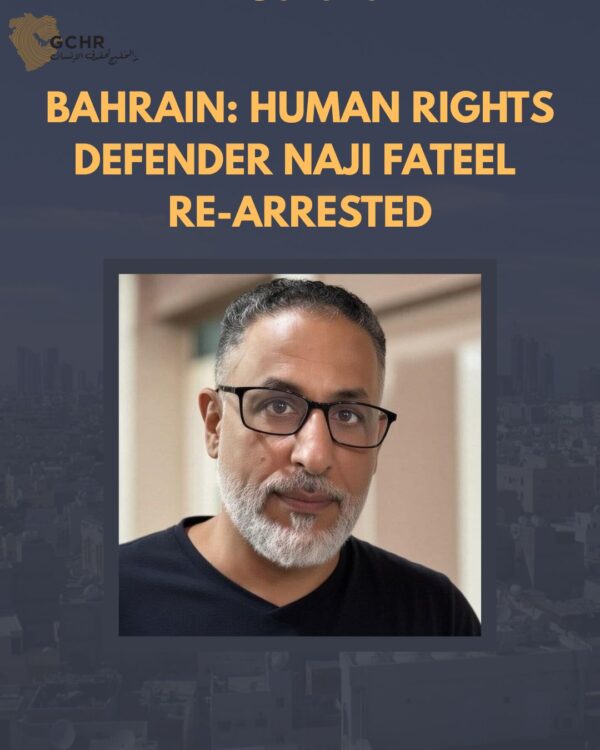
Human rights defender Naji Fateel re-arrested
-