In this Joint Submission to the UN Universal Periodic Review (UPR), CIVICUS and the Gulf Centre for Human Rights (GCHR) examine the legal framework related to civic space in the Kingdom of Saudi Arabia, which lacks basic rights protections and severely restricts freedoms of association, peaceful assembly and expression. The submission documents in particular the continued misuse of the overly broad and vague Counter-Terrorism Law of 2017 and the Cybercrime Law of 2007 to clamp down on human rights and peaceful activists. The submission also sheds light on the continued judicial persecution of human rights defenders, including women human rights defenders, who face additional systemic barriers and challenges such as sexual harassment as they advocate for gender equality and the rights of women.
The United Nations Human Rights Council’s Universal Periodic Review is a unique process which involves a review of the human rights records of all 193 UN Member States once every 4.5 years. This submission was made in advance of the 45th UPR session in January-February 2024, in the context of the 4th UPR cycle.
Introduction
CIVICUS is a global alliance of civil society organisations (CSOs) and activists dedicated to strengthening citizen action and civil society around the world. Founded in 1993, CIVICUS has members in more than 180 countries throughout the world.
The Gulf Centre for Human Rights (GCHR) is an independent CSO, founded in 2011 and based in Lebanon, that works to provide support and protection to human rights defenders (HRDs) in order to promote human rights, including freedoms of association, peaceful assembly and expression.
In this submission, the two organisations examine the Government of Saudi Arabia’s compliance with its international human rights obligations to create and maintain a safe and enabling environment for civil society. Specifically, we analyse Saudi Arabia’s fulfilment of the rights to freedoms of association, peaceful assembly and expression and unwarranted restrictions on HRDs since its previous UPR examination in November 2018. To this end, we assess Saudi Arabia’s implementation of recommendations received during the 3rd UPR cycle relating to these issues and provide follow-up recommendations.
During the 3rd UPR cycle, the Government of Saudi Arabia received 52 recommendations relating to the space for civil society (civic space). Forty of these recommendations were accepted and 12 were noted. An evaluation of a range of legal sources and human rights documentation addressed in this submission demonstrates that the Government of Saudi Arabia has only partially implemented eight recommendations relating to civic space. The government has persistently failed to address unwarranted restrictions on civic space since its last UPR examination and acute implementation gaps were found with regard to the rights of HRDs and freedom of expression.
We are deeply concerned by the legal framework, which lacks basic rights protections and severely restricts freedoms of association, peaceful assembly and expression, and particularly the continued misuse of the overly broad and vague Counter-Terrorism Law of 2017 and the Cybercrime Law of 2007 to clamp down on human rights and peaceful activists.
We are further alarmed by the continued judicial persecution of HRDs, including women HRDs (WHRDs), who face additional systemic barriers and challenges such as sexual harassment as they advocate for gender equality and the rights of women.
As a result of these issues, civic space in Saudi Arabia is currently classified as ‘closed’ by the CIVICUS Monitor, the most serious category, indicating the existence of severe civic space restrictions.
Section 2 of this submission examines Saudi Arabia’s implementation of UPR recommendations and compliance with international human rights standards concerning freedom of association.
Section 3 examines Saudi Arabia’s implementation of UPR recommendations and compliance with international human rights standards related to the protection of HRDs, civil society activists and journalists.
Section 4 examines Saudi Arabia’s implementation of UPR recommendations and compliance with international human rights standards concerning freedom of expression and media freedom.
Section 5 examines Saudi Arabia’s implementation of UPR recommendations and compliance with international human rights standards related to freedom of peaceful assembly.
Section 6 contains recommendations to address the concerns raised and advance implementation of recommendations under the 3rd cycle.
Section 7 is an annex on the implementation of 3rd cycle UPR recommendations related to civic space.
-
Related Publications
Latest Urgent Action
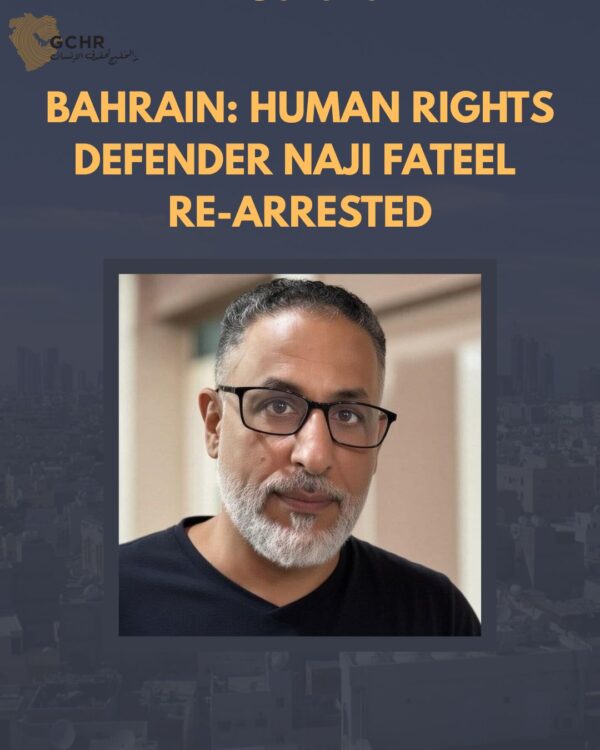 Bahrain
Human rights defender Naji Fateel re-arrested