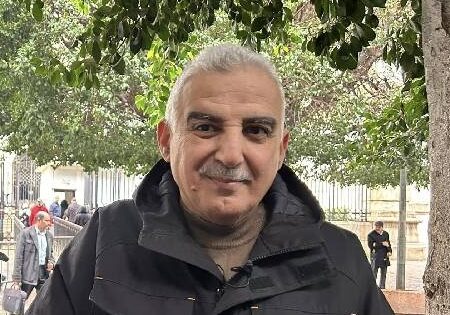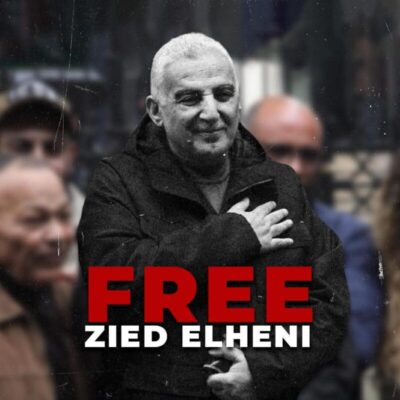
Update: Tunisian journalist Zied El-Heni was sentenced to one year in prison on 07 May 2026 for social media posts critical of the authorities.
Well-known journalist Zied El-Heni is currently in prison awaiting his verdict on 07 May 2026, when he could face up to two years in prison. The Gulf Centre for Human Rights (GCHR) joins the call on the Tunisian authorities to drop the charges against El-Heni and unconditionally and immediately free him.
El-Heni, editor-in-chief of independent news site Tunisian Press, was arrested on 24 April 2026 and taken to Mornaguia Prison after two days in police custody. He began a hunger strike in prison on 26 April 2026 as a protest against the illegitimacy of the proceedings, which he ended on his own terms before it had any serious health consequences, his daughter Ela El-Heni told GCHR. He is being tried outside the framework of Tunisia’s Press Freedom Decree-Law No. 115, on defamation charges filed without any prior individual complaint – a clear violation of press freedom standards.
He responded to a summons to appear before the Fifth Central Unit for Combating Information and Communication Technology Crime in Tunis. He is being investigated on charges of “harm to others” under Article 86 of the telecommunications code for social media posts in which he criticised the unjust sentencing of journalist Khalifa Guesmi, who spent three and a half years imprisoned, and a National Guard officer who died after being detained. Both were ultimately exonerated after the court dismissed their charges.
At El-Heni’s trial on 30 April 2026, journalists were physically barred from the courtroom, and the judge interrupted the defense attorney’s plea before it was completed, another violation of due process. He was immediately returned to detention.
In a letter from Mornaguia Prison on 06 May 2026, El-Heni wrote, “For the tenth time in my professional career, I face prosecution for an opinion or position I expressed and published in the exercise of my journalistic duties. Today I wage a battle in defense of Decree-Law 115 – a law I had the honour of representing the National Union of Tunisian Journalists in drafting and debating, and in whose formulation I participated as a member of the body tasked with achieving the goals of the Revolution. I also defended the exclusion of Article 86 of the Telecommunications Code from cases related to freedom of expression.”
He continued, “I am exposed to an illegitimate trial in which all my legal rights have been violated. I emphasise the word illegitimate – because research has revealed that the case against me did not originate from a security report or an individual complaint, but from verbal instructions. Based on those instructions, and following my hearing, I was detained and a prison admission order was issued without any legal basis – something that did not happen to me in the trials of 1994, 2023, or 2024. If this were only about legal violations, I would have simply filed a complaint. But as long as this trial is illegitimate, I do not recognise it, I will not accept any outcome it produces, and I will not appeal the verdict issued against me.”
El-Heni concluded, “This is not an act of rebellion against state institutions – my country is what gave me my place in society. It is, however, a protest against the tampering with state institutions.”
Among other journalists arrested in Tunisia recently for public comments critical of the authorities, Sonia Dahmani and Ghassen Ben Khelifa, have been sentenced to prison, but remain conditionally free after spending time behind bars on various charges related to their profession. They are at risk of being re-arrested.
Recommendations:
The Gulf Centre for Human Rights (GCHR) calls on the Tunisian authorities to:
- Drop the charges against journalist Zied El-Heni, among other journalists arrested in violation of their right to free expression, and immediately and unconditionally free him;
- Ensure due process during all hearings and trials of journalists; and
- End the prosecution of journalists and others simply for exercising their rights to freedom of expression, and uphold the articles of Press Freedom Decree-Law No. 115.

-
Latest News
Defenders Affected