Introduction
This is the first annual report published by the Gulf Centre for Human Rights (GCHR). The report documents aspects of human rights developments in the Gulf region with a particular focus on issues related to freedom of association and expression. The report attempts to give an overview of issues related to the work of human rights defenders in the region during 2012. It examines the dangers they face and the attempts made to hinder their important human rights work including by the enforcement of legal and policy restrictions by state actors. The report covers 10 countries: the six Gulf Cooperation Council (GCC) member states (Oman, Kuwait, Bahrain, Qatar, UAE and Saudi Arabia), Iraq, Iran, Yemen, and Syria.
The inclusion of Syria, which is not part of the Gulf region, in the report is necessitated by the extraordinary events and the massive human rights abuses taking place in the country at present which have implications for the whole region.
The report reveals a substantial increase in the violation of the right to freedom of association and expression and the targeting, in particular, of human rights defenders. Many human rights defenders featured in the report, were the subject of a myriad of abuses, varying from country to country, which included among others: arbitrary arrest and detention; harassment; intimidation; malicious prosecution; unfair trial; physical and electronic surveillance; restriction of movement and the imposition of travel bans; hijacking and blocking of Internet sites, personal blog spots, and social media accounts; physical assaults and verbal abuse; cyber and media smear campaigns; defamation; denial of access to the media; restriction on access to employment and means of livelihood.
2012 witnessed the introduction of collective measures by the GCC members which violate human rights in general and the right to freedom of association and expression in particular. Two worrying developments in this regard included the adoption by the GCC of a joint security agreement and the move to adopt a joint information technology crimes law. These developments are apparently part of an overall GCC strategy led by Saudi Arabia to harmonize the legal systems of the GCC states, to the detriment of the right to freedom of expression and association. Kuwait, which had refused in the past to adopt the joint security agreement, has now towed the line, triggering criticism within the country of this move, which human rights defenders regard as a serious setback to civil and other liberties in the country and the region.
Relations between Iran and the GCC states deteriorated during the year, which in turn saw an increase in the persecution of human rights defenders who were often accused in the region of being agents of Iran. In its summit held in Manama in December 2012, Bahrain, the GCC heads of state adopted a resolution condemning Iran and accusing it of undermining the security of the GCC states.
The year witnessed the introduction of economic and other sanctions on Iran by the US and the EU states in relation to its nuclear policy which led to an increase in the persecution of human rights defenders in the country and to Iran flexing its military muscle heightening an already tense situation in the Gulf region. Furthermore, in 2012, the human rights record of Iran was criticised by the UN at the UN General Assembly and through the work of the Special Rapporteur on Iran. Iran has so far refused, despite repeated calls, to allow the Special Rapporteur Mr Ahmad Shahid to visit the country.
Positive developments in the field of human rights in the region during the year included the accession of the UAE in July to the UN Convention against Torture and Other Cruel, Inhuman or Degrading Treatment or Punishment.
In 2012 Bahrain was scrutinised by the UN Human Rights Council on its human rights record. In May the Universal Periodic Review mechanism came up with numerous recommendations on aspects of human rights in the country including abuses committed against human rights defenders. The government of Bahrain’s undertaking to implement most of the 176 recommendations made by UN member states was welcomed by the international human rights community. There were, however, concerns that these pledges may not be fulfilled given the county’s failure to implement crucial parts of recommendations made by the Bahrain Independent Commission of Inquiry (BICI) which concluded its work of looking into the incidents that occurred during the period of unrest in Bahrain in February and March 2011, in November of that year.
In Kuwait democracy suffered a setback as a result of amendments introduced to the electoral law and the boycotting of the opposition of voting in the parliamentary elections in October.
The Gulf Centre for Human Rights reveals in its first annual report a deteriorating status of human rights in the region during 2012. Throughout the year the Gulf Centre for Human Rights documented numerous cases of abuses and sent missions to a number of countries in the region. During its first year the Gulf Centre for Human Rights trained about 120 human rights defenders on topics which included Digital security; the use of UN mechanisms; the use of Social Media networks to promote human rights; Security and protection; Transitional justice; and Documentation of human rights violations. In addition it sent two human rights missions to UAE, two to Bahrain, and one to Iraq.
Published by:
The Gulf Centre for Human Rights
Beirut
Lebanon
Copyright © 2013 by GCHR
-
Related Publications
Latest Urgent Action
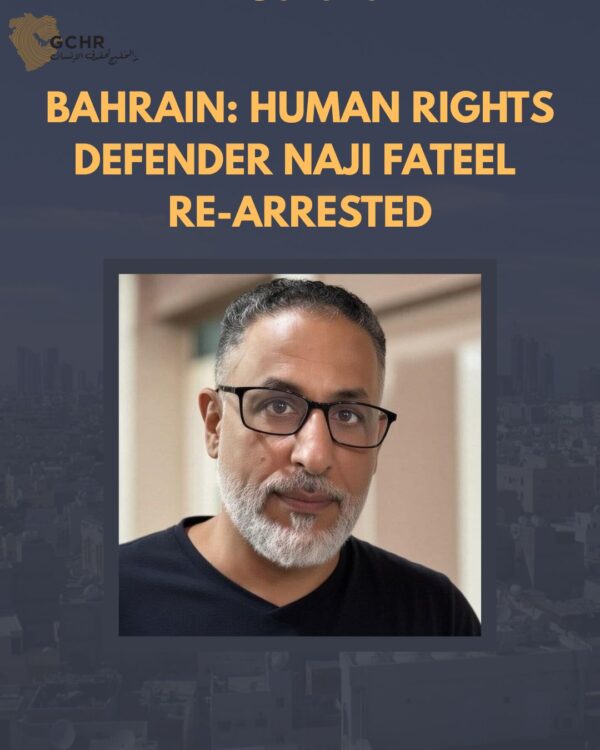 Bahrain
Human rights defender Naji Fateel re-arrested