1. Executive Summary
This report by the Gulf Centre for Human Rights (GCHR) documents recurring, detention-related patterns of torture and other ill-treatment in Iraq, the United Arab Emirates (UAE) and Bahrain, highlighting a persistent gap between formal safeguards and treatment in practice – most sharply in cases linked to peaceful expression, civic or political activity, or human rights work. Based on desk-based open-source research drawing primarily on United Nations documentation and reputable human rights reporting, it assesses State practice against applicable treaty obligations and domestic safeguards using core UN standards as strict benchmarks. Across the cases reviewed, risks cluster at three stages of the detention cycle: early custody, where detainees may be held incommunicado and cut off from confidential, effective access to counsel; interrogation, where coercion is used to obtain “statements” or “confessions”; and prolonged detention, where punitive isolation, poor conditions, denial of healthcare, and deaths in custody are repeatedly reported. Where access to lawyers and families is obstructed, independent medical documentation is delayed or unavailable, and complaints do not trigger prompt and impartial action, safeguards lose their protective function and the risk of abuse rises – while accountability and redress remain limited.
2. Introduction
Across parts of the Middle East and North Africa (MENA), detention is widely reported to be used as a central tool to silence dissent rather than a measure of last resort in a fair justice system. In a number of countries, people deprived of their liberty continue to face serious risks of torture and other ill-treatment, particularly when they are detained in connection with peaceful expression, civic or political activity, or human rights work. In such cases, weak oversight and ineffective accountability mechanisms mean that abuses committed behind closed doors are rarely prevented, remedied, or punished.
The documentation reviewed for this report shows that, in Iraq, the UAE and Bahrain, there are recurring and well-documented gaps between formal safeguards and actual practice. These gaps are especially sharp at three points in the life-cycle of a case: the first hours and days of custody, when detainees may be held incommunicado and cut off from legal assistance; the interrogation phase, where physical and psychological pressure is used to obtain “statements” or “confessions”; and prolonged detention in prisons and other facilities, where punitive isolation, poor conditions, denial of medical care, and deaths in custody are repeatedly reported.
This report examines how these patterns affect individuals who are targeted for the peaceful exercise of their rights, including human rights defenders, journalists, lawyers, academics, and other civic and political actors. It aims to provide a clear, evidence-based account of the risks they face in detention and of the systemic shortcomings that allow torture and other ill-treatment to persist, in order to inform advocacy before UN mechanisms and other international and national bodies.
The analysis is organised around three recurring patterns: Pattern 1 – early safeguards, focusing on incommunicado detention and denial of access to legal counsel in the first days of custody; Pattern 2 – coercive interrogation, physical and psychological abuse in custody, and statements or “confessions” obtained under torture or other ill-treatment; and Pattern 3 – conditions of detention, disciplinary measures including solitary confinement, access to healthcare, and deaths in custody.
The report is based on desk research using publicly available, open-source material. It draws primarily on UN documentation (including treaty bodies and Special Procedures) and on reputable reporting by the Gulf Centre for Human Rights (GCHR) and other national, regional, and international human rights organisations, and attributes each allegation to the source that documented it. The analysis assesses State practice against each State’s international obligations and relevant domestic constitutional and legislative safeguards, using core UN standards as strict benchmarks.
Click to download the full report in English.
-
Related Publications
Latest Urgent Action
 Bahrain
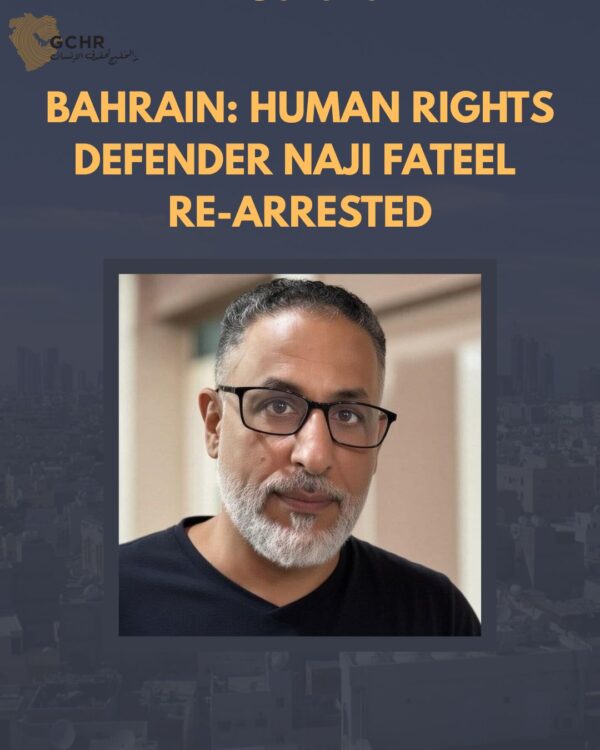
Human rights defender Naji Fateel re-arrested