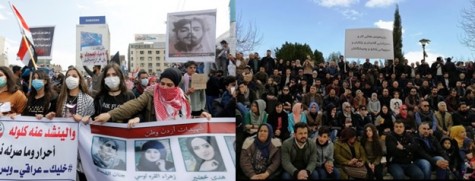
Demonstrators continued to demand comprehensive reform in the various Governorates of central and southern Iraq, as well as in the city of Sulaymaniyah in the Kurdistan region of Iraq, where peaceful demonstrations were launched. In reprisal, security forces, especially riot police and armed groups operating outside the law, targeted activists and peaceful demonstrators with threats, arbitrary arrest and detention, severe beatings, torture in secret locations, and assassination and killing. A number of children were killed in the past months. In addition, they continue to use excessive and unjustified force against sit-ins, including live bullets, hunting rifles, tear gas grenades, white weapons and sharp knives. These violations are documented in the Gulf Centre for Human Rights (GCHR)’s third monthly report of 2020.
On 01 March 2020, thousands of peaceful demonstrators from various central and southern Governorates of Iraq demonstrated on the Al-Karkh side of Baghdad and then headed to Al-Tahrir Square (picture on the left at top). Al-Karkh is historically the name of the western half of the capital Baghdad, or alternatively, the western shore of the Tigris River running through Baghdad. The protesters rejected the leadership of Prime Minister Muhammad Tawfiq Allawi – who announced his withdrawal recently after the 30-day deadline had passed and he was unable to form a government – and called for a new election law, and for elections to be held early. They also protested the repression and the ongoing killing of protesters by the security forces and armed groups supporting them, and demanded that the killers of hundreds of demonstrators be brought to face justice.
On 22 February 2020, thousands of people in the city of Sulaymaniyah in Iraqi Kurdistan demonstrated against widespread corruption and improper basic public services (picture on the right at top).
The use of hunting rifles against peaceful protesters

The use of hunting rifles resulted in the killing of a number of demonstrators and wounding dozens of others, causing various injuries, some of which are life-threatening. The hunting rifles contain cartridges stuffed with bird shot, a large number of lead balls or iron cubes known locally as “Sagam”, which are sprayed at demonstrators indiscriminately, leading to multiple injuries.
On 07 March 2020, blogger Ahmed Al-Atabi posted on his Facebook page – which he dedicates to reporting news of the current popular movement in the various Governorates, a picture of his 20-year-old nephew, peaceful demonstrator Ahmed Jawdat Al-Atabi (picture 1), just before he was operated on. He was attacked on 01 March 2020 by riot police with hunting rifles in Al-Khilani Square in Baghdad. He was hit by approximately 40 small iron balls in various parts of his body, leaving him in serious condition. Al-Atabi appeared in a video after the successful operation saying, “I went to bring a homeland to those sitting in their homes and we will bring it from the mouth of death.”
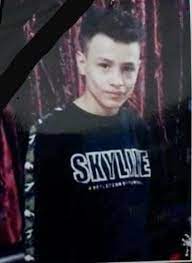
On 06 March 2020, peaceful protester Sajad Uday (picture 2), only 14 years old, was shot in the head and killed by riot police with hunting rifles in Al-Khilani Square, shattering his dreams of a beautiful homeland and a prosperous future. He is from the Allawi Al-Hilla district in Baghdad. A large funeral was held for him, with the participation of his family, in addition to a large number of his friends and fellow demonstrators.
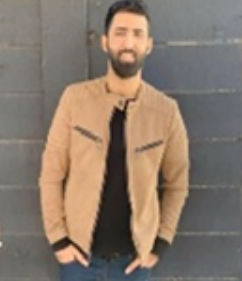
On 02 March 2020, peaceful demonstrator Mohammad Majid (Roussi) (picture 3), 18 years old, was hit by 18 iron balls after a member of the riot police in Al-Khilani Square fired a cartridge at him from a hunting rifle, injuring him in his hands and feet. Despite that, he remained smiling, raising the signal of victory with his hand.
Also, on 02 March 2020, peaceful demonstrator Ahmed Hassan Al-Lami (picture 4), was shot in the face by riot police with hunting rifles, in Al-Khilani Square. He died the next day due to his severe wounds.
Students at the heart of the peaceful popular movement

Every Sunday, the protesters of the sit-in in Al-Tahrir Square (picture on the left), and the other sit-ins, wait for the arrival of students, who, when they emerge through the tunnel leading to the square (picture in the middle), vigorously shout their support for the popular protests calling for comprehensive reform and the eradication of endemic corruption.
Student Haider Ahmed Khadum (picture on the right), only 16 years old, and a student in the fifth scientific class at the Distinguished High School in Baghdad, is one of many examples of the sacrifices that students make in order to achieve the goals of the peaceful popular movement. He was an excellent student, but he needed a homeland in which to live in dignity so he participated vigorously in the protests until he was shot dead by riot police near the Al-Ahrar Bridge on 29 November 2019. One of his friends wrote, “Your blood will not go to waste!”
Targeting of civil society activists and peaceful protesters

On 05 March 2020, human rights lawyer Mohammad Jouhi (picture 1), posted on his Facebook page news of a person trying to plant an explosive device in his home in Baghdad, where he lives with his father, who has had a stroke, and his elderly and sick mother. His brothers restrained this person after he entered the house at night and handed him over to the competent authorities.
On 02 March 2020, unidentified gunmen assassinated civil society activist Ali Al-Halfi (picture 2), showering him with bullets, and fled. The assassination took place in Al-Hartha district, in the north-eastern part of Basra Governorate. He is the father of nine girls and one baby boy. Most of his ambition was for his family to live in a secure homeland free from corruption. He owned a small store that was his only source of income. His mother threw herself on his coffin from the shock she suffered, and the people of other Iraqi Governorates attended the condolence gathering that his family set up on 03 March 2020.
On 01 March 2020, civil society activist Mohammad Al-Naimi (picture 3), was kidnapped by an unknown group after he left Al-Tahrir Square in Baghdad. Al-Naimi has participated in Al-Tahrir Square protests since the beginning.
On 28 February 2020, civil society activist and education employee Abdulazim Suwadi Al-Rubaie (picture 4), was killed after being stabbed repeatedly in front of his house in the Ghammas town of Al-Qadisiyah Governorate by an unknown group. Sawadi works in the education sector and is well-known for his criticism of corruption in the country.

On 26 February 2020, peaceful demonstrator Hussain Dosh Jassim (Hacker) (shown to the right of picture 1), was arrested by riot police in Al-Khilani Square due to his appearance with fellow demonstrators in a song that glorifies the ongoing popular movement and emphasises its goals to reject corruption. He was released on 29 February 2020. On 02 March 2020, a member of the riot police shot him on the foot with a pistol, and he is now in hospital for treatment.
On 26 February 2020, civil society activist Aid Mohammad Hassan Salman Al-Dujaili (picture 2), was released. He had been arrested on 21 January, while bringing first aid materials to Al-Tahrir Square protesters, by a group of people wearing military uniforms who belong to a government agency.
On 26 February 2020, peaceful demonstrator Mustafa Mohammad Ishoaib (picture 3), was kidnapped while returning from Al-Tahrir Square to his home in the Al-Shaab district of Baghdad. He is 19 years old and has participated in the popular movement since its start in early October 2019. He was released on 29 February 2020.
On 23 February 2020, armed forces intercepted the car carrying civil society activist Sameh Bassem (picture 4), arrested and transported him to the Military Intelligence Directorate in Karbala. He wrote details of his arrest on his Facebook account, in which he claimed the investigating officer tortured him and forced him to sign the investigation papers blindfolded. A warrant was issued against him pursuant to Article 222 of the Iraqi Penal Code, on charges of cutting and vandalising the streets and hitting security forces, which he denied. He was brought before the court, where the judge asked him about the validity of the charges against him, so he informed him that he was tortured and forced to sign the papers. The judge decided to release him on bail of 30 million Iraqi dinars (approx. USD$25,200). He uses his Facebook account to express openly and forcefully his views and unlimited support for the current popular movement.

On the evening of 22 February 2020, civil society activists Alaa Sheikh Ali (picture 1), and Tariq Mohammad Hammoud (Omar Al-Rassam) (picture 2), were kidnapped after they left Al-Tahrir Square and headed toward Al-Karrada area. They were released on 24 February 2020. Sheikh Ali established the Watan (Homeland) Tent in Al-Tahrir Square since the beginning of the protests, and Hammoud later joined him, where he worked as a paramedic providing first aid to injured protesters. The Watan tent perpetuates the momentum of the demonstrations and provides support to the protestors. Both of them have participated in the demonstrations in Tahrir Square since 01 October 2019.
On 19 February 2020, civil society activist Ahmed Al Wishah (picture 3), was kidnapped by an unknown armed group from a restaurant in the Al-Jadiriya area of central Baghdad. He was kidnapped just hours after a speech by Prime Minister-designate Mohammad Tawfiq Allawi, during which he pledged to protect demonstrators and release all detainees. Al Wishah participated in the demonstrations of Al-Tahrir Square since the first day, and on 04 February 2020 he delivered a speech in the name of the protesters in Al-Tahrir Square calling for protection for all protesters in the sit-in squares. He was released on 21 February 2020 in the early morning.

On 18 February 2020, in the early morning, peaceful protester Fahd Al-Khazali (picture on the left), was killed by riot police near the Sink Bridge in Baghdad. Al-Khazali is from Al-Shamiya district in Al-Qadisiyah Governorate, but he participated in the demonstrations in Al-Tahrir Square from its inception, and although he was injured several times before, he remained at the sit-in. He was providing first aid to his injured colleagues.
In the early morning hours of 17 February 2020, the home of civil society activist Haider Mezher (picture in the middle), in the center of Al-Amara, was targeted by an sound explosive device, by unknown masked individuals riding a motorbike, which caused only material damage, according to the photos he posted on his account on Facebook. Mezher has supported the protests in the city of Al-Amara since their beginning last October, and has been present in the square continuously, providing protesters with bread through the bakery that he set up in the square.
On 14 February 2020, 23-year-old civil society activist Mohammad Harb (picture on the right), was assassinated by a an unknow armed man who used a silencer weapon in the Al-Tahrir Square tunnel in Baghdad. He contributed to the popular movement from its inception and was loved by everyone. He used his Facebook page to express his deep love for Al-Tahrir Square, as a centre of sit-ins in the country and, in this video published on 25 January 2020, he echoed in a melodic voice, “The Tigris is calling, the colour of the river is red from the blood of my country.”
Targeting of voluntary paramedic teams

Voluntary paramedic teams continue to be targeted by security forces and armed groups with harassment, kidnapping, arbitrary detention, and burning of their tents, since the beginning of the popular protests.
On 08 March 2020, riot police, using live bullets, hunting rifles and tear gas canisters, launched a violent attack on protesters in Al-Khilani Square. Several local reports said that the number of protesters killed in the attack had reached eight, with 43 wounded, some of them in very critical condition.
Civil society activist and volunteer paramedic Amer Mahmoud Al-Ethawi (picture on the right), was shot and killed with a hunting rifle during the attack by riot police. El-Ithawi, from the Mahmoudiyah district of the Baghdad Governorate, was loyal to his work and loved by his colleagues. He gave his unlimited support to the popular movement from the first day and in the past four months he was always in the square to provide first aid to the injured protesters.
On 18 February 2020, civil society activist and paramedic Omar Ali Hassan (picture in the middle), was kidnapped from the centre of Al-Tahrir Square by armed militias traveling in an ambulance after they asked him to go with them to save one of the wounded protesters. Instead he was taken to an unknown location and his whereabouts remain unknown.
On 16 January 2020, civil society activist and volunteer paramedic Ibrahim Hussein (picture on the left), was kidnapped from Al-Tahrir Square by armed militias who tortured him and sent an image of him with blood flowing from his face to his family. He is the brother of civil society activist and popular actress Alaa Hussein (pictured on the left next to her brother). He had been previously kidnapped by the security forces in late November 2019 and he was only released in December 2019. However, he returned to the scene to support the protesters and provide first aid to those injured. On 19 January 2020, Alaa Hussein announced on her Facebook page that her brother had been released and confirmed that he was covered in bruises and cuts. On 05 March 2020, she posted a video and wrote: “I dedicate the video as a loving greeting for the campaigners of the Great October Revolution, for the remaining truthful [who are] steadfast, for beginnings are for all. Eternity for our young people the most beautiful martyrs.”
Ill-treatment and torture of civil society activists and peaceful demonstrators

According to reliable local reports, security forces, including riot police as well as armed groups acting outside the law, abused and tortured peaceful activists and protesters. The protestors of Al-Khilani Square posted a video on social networks which showed the riot police in Al-Khilani Square taking away a peaceful demonstrator after completely shaving his hair. A member of these forces appeared on the video threatening the protesters that he would slaughter them, by making a signal with his hand.
On 04 March 2020, civil society activist Raisan Al-Zarkani (picture 1), was arrested in Al-Khilani Square by riot police. He was released on 06 March 2020 after being tortured and severely beaten (picture 2). Al-Zarkani participated in the protests and was constantly present in the library tent located on Al-Saadoun street leading to Al-Tahrir Square.
In the early hours of 20 February 2020, civil society activist Raad Madi (picture 3), was kidnapped by unidentified gunmen in front of his house as he was headed out for Al-Tahrir Square. Madi is one of the most prominent protesters of Al-Joumhouria bridge, who participated in the protests since the first day, and refused to withdraw from the bridge over a period of four months in an act of dedication to his fellow demonstrators who died for a free homeland. He was released on 23 February 2020 after being subjected to violent beatings and severe torture (picture 4) by his captors.
Ongoing attacks on sit-in protesters in Al-Khilani Square, Baghdad
Riot forces continued their attacks against protesters in Al-Khilani Square and the surrounding areas during the past weeks and to this day are using unjustified excessive force including live bullets, tear gas grenades, hunting rifles, as well as violent beatings. As a result, many protestors were killed and injured. Reliable local reports confirmed that the number of wounded and injured peaceful demonstrators has exceeded hundreds, whether from live bullets, being suffocated by tear gas or subjected to violent beating.
On 23 February 2020, riot police launched an attack on the protesters in Al-Khilani Square in an attempt to advance towards Al-Tahrir Square tunnel. It started in the morning and continued until nightfall, when they used live bullets, tear gas grenades and hunting rifles. As a result, student Dergham Al-Janabi was killed and 12 other protesters were wounded. Some tents were also burned in that area. Al-Janabi was carrying his history textbook, as he was taking his exams and returning to Al-Tahrir square to participate in the protests as well as to study.
On 25 February 2020, riot police again used live bullets in their all-day offensive, which killed six peaceful protesters.

All Iraqis including Christian citizens have participated in the popular movement from all ages and affiliation who are yearning for comprehensive reform and the eradication of rampant corruption. On 25 February 2020, peaceful protester Raymon Ryan Salem (picture above), only 15 years old, was shot by riot police with hunting rifles, hitting him in the head with small iron balls.
He was demanding a better homeland for everyone. His family came from the city of Tal Asqaf, which is 30 kilometers from the city of Mosul in the Nineveh Governorate, and then migrated to Baghdad because of the war with Da’esh. On 28 February 2020, the young protestors in Al-Tahrir Square held a symbolic funeral and a condolence gathering for him attended by his family, where they talked about him, and his father said, “We hope that the demonstrators will reach the objectives that they are fighting for.” His mother said, “The land under Al-Tahrir was irrigated with the blood of the martyrs.”

On 25 February 2020, riot police killed civil society and artist Mohammad Ali Al-Mukhtar (picture 1), 20 years old, after they directly targeted him with a smoke bomb that hit his head. Al-Mukhtar was a student at the University of Al-Nahrain, which organised a funeral for him which was attended by everyone from the university (picture 3). He was a saxophonist and a beat box singer (picture 2) and participated in many activities, including Baghdad City of Peace Carnival. His fiancée appeared in a very sad video in which she said farewell to him during the funeral, saying “I won’t see you after today.” They hoped to get married in a month.
His sister, artist Rawan Ali Al-Mukhtar (picture 4), wrote on her Instagram account: “I am the sister of the martyr. My brother is gone for freedom. Al-Mukhtar was carrying only a flag… They silenced my brother and I will follow after [in the steps of] my brother.” She addresses the gender gap in Iraq and the unequal treatment that girls and boys receive in the family.
In a ceremony by the organisers of the Baghdad City of Peace Carnival, his father gave a speech and said, “The martyr sacrificed himself like the rest of the heroes for the sake of the homeland, so that its people would live in a homeland free from corruption, injustice and tyranny.” He added, “They give orders to the security authorities and hospitals not to confirm that the cause of death is that they have been martyred, and instead use the term ‘a quarrel’ in the death certificate; and the greatest calamity is the questioning of the martyr’s family and the failure to hand over the body until after this humiliation.”

On 25 February 2020, riot police in Al-Khilani Square shot civil society activist Alaa Kamel Al-Shammari (picture on the left), with live bullets, resulting in his death. He is from the second Al-Amin district of Baghdad. Al-Shammari recently got a government job, but without a salary, and got engaged a week ago. He was optimistic before the killing happened. A symbolic funeral took place in the heart of Tahrir Square.
On 19 February 2020, peaceful protester Rasool Nayef Hammad Al-Nimrawi (picture in the middle), was wounded by a bullet lodged in his head by riot police near al-Khulani Square, and lost his life on 29 February 2020. He had previously lost his father and sister during the war with Da’esh that took place in his home Governorate of Al-Anbar.
In a recently reported case, peaceful protester Abbas Sabah Jawad Al-Subaihawi (picture on the right), was among those killed on 06 December 2019, when armed militias in pick-up trucks and mini vans stormed Al-Khilani Square, followed by an attack on the Al-Sinak bridge garage, during which gunmen armed with Kalashnikov rifles randomly fired at peaceful protesters resulting in the deaths of 25 demonstrators and 135 injured, according to official reports. The coordinated attacks took place under cover of darkness after the power was cut off in the area. The attack was surprising and brutal and astonished people who expected to be able to protest peacefully in the wake of the Prime Minister’s resignation. His sister recently wrote that he was unfairly missing from media reports. He was brave and was working but when the protests began, he left his job and participated enthusiastically due to his sense of the injustice suffered by the crushed classes in Iraq.
Participation of people with special needs in the peaceful popular movement

People with special needs participated in the peaceful popular movement due to the negligence they suffered by the authorities. The volunteer paramedic Hussain Ali is one of them. He is 23 years old and lost his leg in a 2012 car bomb explosion in Baghdad. He is studying biology in the fourth year at the University of Babylon, and he has been on strike to participate in the protests of Al-Tahrir Square since its inception, where he works as a paramedic, providing first aid to the injured.
Targeting of journalists and media professionals continues
Media that represent the government and most political parties have deliberately neglected the popular movement dominating events in Iraq, but this did not prevent dozens of independent journalists, media workers, bloggers, and citizen journalists from participating in the protests effectively. They covered the demonstrations, gave protesters a window to speak to the world, and, while performing their press and media work, they faced all forms of repression and intimidation, including threats, kidnapping, and torture. They have been targeted like demonstrators with silencers and live bullets, tear grenades, sound bombs, violent beating with batons, and attacks with knives and sharp objects.

Broadcaster and photojournalist Hisham Fares Al-Adhami (picture on the left), 27 years old, from the neighbourhood of Adhamiya in Baghdad, was one of the first Iraqi journalists to sacrifice their lives while participating in and documenting the ongoing popular movement. On 04 October 2019, a sniper bullet penetrated his back and exited through the heart to lose his life immediately. He was covering the demonstrations that were taking place in Baghdad’s Al-Tayaran Square. He completed his studies in the directing department of the Academy of Fine Arts and worked as a program director for Alsumaria Satellite Channel and a photographer for Almasar Satellite Channel. His Facebook page tells how he used the TV programs to which he contributed as a means to express his human spirit in order to serve the people.
On 03 March 2020, civil society and media activist Hussain Rahm (picture in the middle) was stabbed in the head and body by a group of people in Al-Tahrir Square. He was transferred to hospital for treatment and in stable condition. Raham said in a tweet on his Twitter account, “The knives will not hold us back, we will continue this path that was written by the blood of the martyrs.” His twin brother, civil society activist and journalist Hassan Rahm (picture on the right), wrote on his Facebook page, “My brother Hussain Rahm was assaulted with knives in Al-Tahrir Square by a well-known political party.” He concluded, “Between us and you are the judiciary and the media, and the knives will not deter us.” Hussain Rahm works as a correspondent for the Clean Brotherhood page, and he and his brother participated strongly in the Al-Tahrir Square protests from the start. They previously worked as war correspondents for NRT Satellite Channel during the war with Da’esh.

On 03 March 2020, journalist and member of the Centre for the Protection of Iraqi Women Journalists, Kholoud Al-Tai (picture 1), was attacked in Tahrir Square by a group of people who beat her, knocked her down and stole her camera. Al-Tai participated in the protests of Al-Tahrir Square, documenting and reporting its events.
On 12 March 2020, civil society activist and journalist Rana Abdulhalim Al-Ziyadi (picture 2), was kidnapped by an armed group of masked men, while she was shopping in Al-Hanana area of Najaf city, who beat her in front of pedestrians and forcibly took her away in a pick-up truck. She was released the same day soon after. On 03 March 2020, Al-Ziyadi released a video talking about the details of her kidnapping, saying that one of the kidnappers threatened her with rape. As well, they confiscated her mobile phones, changed her accounts on social media, deleted some data and added other data.
On 22 February 2020, novelist and journalist Hussain Rashid (picture 3), was subjected to a failed assassination attempt on the Mohammad Al-Qasim Highway, according to novelist and poet Rua’a Zuhair on her Facebook page.
On 21 February 2020, riot police targeted a photographer for the French Press Agency (AFP) in Baghdad, Ahmed Al-Al-Rubaie (picture 4), in Al-Khilani square in Baghdad, after they had fired at him with a cartridge from the hunting rifles. Al-Rubaie documents the protest events in Tahrir Square and the surrounding areas, in central Baghdad. The attack resulted in an injury to his shoulder and feet, and he was transferred to the hospital for treatment.
On 15 February 2020, civil society and media activist Ayat Al-Marsoumi (picture 5), was attacked by riot police. Al-Marsoumi stated on her Facebook page that she was attacked in Al-Khilani Square on her way to supply the front line protesters with medicine and nourishing liquids when she was targeted with hunting rifles and tear gas grenades, which resulted in a severe injury to her hand. She was taken to hospital for treatment where she was discharged, but she requires surgical intervention later. She has participated in the sit-ins of Tahrir Square since the first day and documented its events and provided support to demonstrators.
Targeting of electronic blackmail experts

On 08 March 2020, Mohammad Hadi Khalaf (picture 1), who founded an electronic blackmail protection team in 2010 and was the director of “The Most Beautiful Smile” cultural gathering, was released. He was arrested on 20 January 2020 in the evening. He has received several certificates of appreciation for his hard work since 2009 in protecting social media users from electronic extortion and piracy. He has used his Facebook page to provide support to people as well as helpful information about using social media safely.
Another computer programmer and expert in fighting electronic blackmail, Ahmed Ghaleb Khadum (also known as Ahmed Al-Ghalib) (picture 2), is still in detention since 25 December 2019, when he was kidnapped in Baghdad by an unknown group driving a four-wheel drive vehicle without a license plate
Official statistics and statistics of civil society organisations
On 03 March 2020, an official source at the High Commission for Human Rights in Iraq stated that the total number of people killed since 01 October 2019 has reached 561, including 17 members of the security forces, while the number of wounded and injured has reached more than 24,000 wounded, mostly protesters, and 3,000 detainees, most of whom were released, with the exception of 35 protesters. This is at a time when civil society organisations report that the number of dead among activists, journalists and demonstrators has exceeded 700 killed, while those injured, suffocated, severely beaten and tortured has exceeded 30,000 in addition to the presence of hundreds of detainees in secret places in various Governorates.
The Gulf Centre for Human Rights (GCHR) offers its condolences to the families and friends of all those activists and peaceful demonstrators who have lost their lives, demanding a secure and prosperous homeland free from corruption and repression and declares its full solidarity with them. GCHR also calls on the Iraqi government to take full responsibility to protect all demonstrators and the sit-in squares where they gather and to work sincerely to identify the perpetrators of killings as soon as possible and bring them to court. Authorities must fulfill their constitutional obligations not to violate public freedoms, including the freedom to peaceful assembly, freedom of expression, and freedom of the press.

-
Latest News
-
Related Publications
Latest Urgent Action
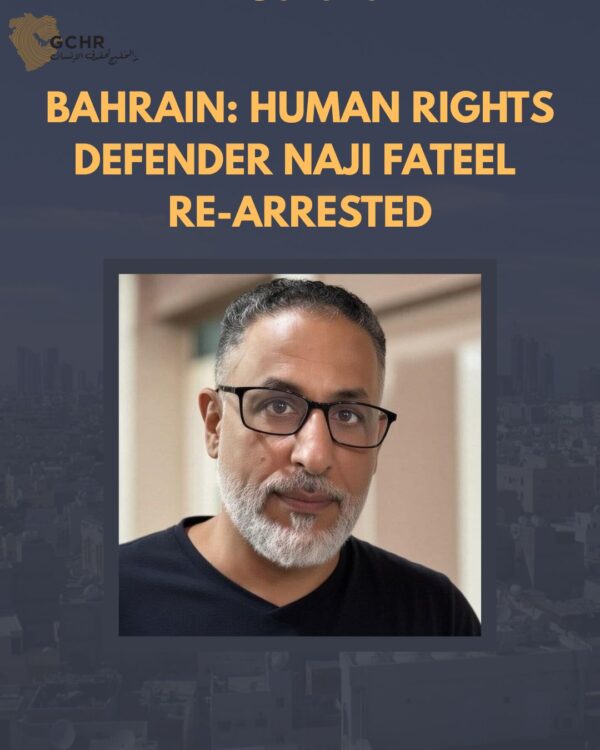 Bahrain
Human rights defender Naji Fateel re-arrested
Defenders Affected
-