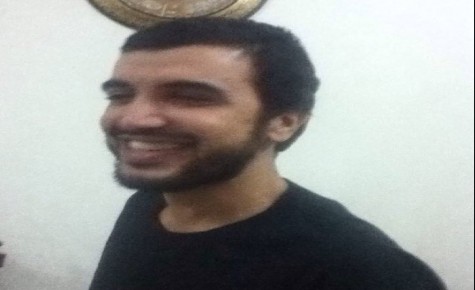
On 1 November 2013, Internet activist Abdullah Al-Hadidi was released after serving his 10 months prison sentence. Some reports received by the Gulf Centre Centre for Human Rights (GCHR) say that he lost 12 Kg of his weight during his imprisonment.
On 22 March 2013, in the early hours of the morning, Abdullal Al-Hadidi was arrested by plain-clothes policemen at his home in Sharjah with his wife and three children present. No warrant was shown for his arrest and he was taken directly to Sharjah police station. The officials at the police station told the family that he had been arrested for a financial offence and refused to allow him bail. Abdullah Al-Hadidi was interrogated and asked about the postings he had made on his Twitter account relating to the case of the UAE 94. He maintained at all times that what he said was an accurate account of the events at the hearing.
On 8 April 2013, the Abu Dhabi Court of First Instance sentenced Abdullah Al-Hadidi to a ten-month jail term. It was the first conviction under the new cyber-crime law adopted in late November 2012 (Federal Legal Decree 5/2012) and was based on the alleged publication of false information relating to the Supreme Court hearing of the case of the human rights activists known as the UAE 94. For more information please see our appeal dated on 11 April 2013:
https://www.gc4hr.org/news/view/378
The Gulf Centre for Human Rights (GCHR) condemns the targeting of Abdullah Al-Hadidi, as it believes that the conviction and sentence imposed on him is solely based on his peaceful and legitimate work in defence of human rights in UAE.
The GCHR urges the authorities in the UAE to:
- Immediately stop targeting and harassing Internet activist Abdullha Al-Hadidi;
- Immediately and unconditionally release all detained human rights defenders in UAE and drop all the charges against them;
- Guarantee in all circumstances that all human rights defenders in UAE are able to carry out their legitimate human rights activities without fear of reprisals and free of all restrictions including judicial harassment.
The GCHR respectfully reminds you that the United Nations Declaration on the Right and Responsibility of Individuals, Groups and Organs of Society to Promote and Protect Universally Recognized Human Rights and Fundamental Freedoms, adopted by consensus by the UN General Assembly on 9 December 1998, recognises the legitimacy of the activities of human rights defenders, their right to freedom of association and to carry out their activities without fear of reprisals. We would particularly draw your attention to Article 6 (c) which states that: “Everyone has the right, individually and in association with others: (c) To study, discuss, form and hold opinions on the observance, both in law and in practice, of all human rights and fundamental freedoms and, through these and other appropriate means, to draw public attention to those matters” and to Article 12.2, which provides that “the State shall take all necessary measures to ensure the protection by the competent authorities of everyone, individually and in association with others, against any violence, threats, retaliation, de facto or de jure adverse discrimination, pressure or any other arbitrary action as a consequence of his or her legitimate exercise of the rights referred to in the present Declaration.”

-
Latest News
Defenders Affected