UNHRC Side Event calls for action on Business and human rights in the Gulf and neighbouring countries
1/07/2018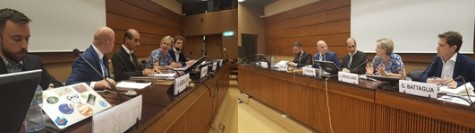
At a side event at the 38th session of the United Nations Human Rights Council’s (UNHRC) in Geneva on 28 June 2018, the Gulf Centre for Human Rights (GCHR) and its partners discussed strategies to pursue relationships with businesses to enhance the protection of freedom of expression, and called for a rights-respecting technology sector. The event was co-sponsored by Access Now, Americans for Democracy & Human Rights in Bahrain (ADHRB), CIVICUS, FIDH, Index on Censorship and the Institute for Human Rights and Business (IHRB).
Panelists addressed how technology such as surveillance tools are used in a negative way, leading to a lack of civic space and enabling human rights violation in the Gulf and neighbouring countries. They also discussed the responsibilities of businesses operating in repressive environments and the opportunities created by mega-sporting events such as the World Cup or the Formula 1. In their recommendations, panelists called on businesses working in the Middle East to implement the highest human rights standards similar to how they work in their own Western countries, by reforming their business models, including export practises.
Michael Payne, Director of Advocacy at American for Democracy and Human Rights in Bahrain (ADHRB), moderated the event. He opened by discussing international mechanisms of protection, such as the International Labor Organization’s Declaration on Fundamental Principles and Rights at Work adopted in 1998. He also raised the importance of following the UN Guiding Principles, which the HRC endorsed in 2011.
For example, ADHRB filed a complaint with the Organization for Economic Co-operation and Development (OECD) over breaches of the OECD’s Guiding Principles during the Formula 1 Grand Prix races in Bahrain, where activists and citizens have been jailed for protesting the event. ADHRB’s complaint resulted in Formula 1 formulating a due diligence policy concerning human rights.
GCHR Executive Director Khalid Ibrahim criticised Western companies that are providing governments in the Middle East with software and hardware tools to monitor online activists and hack into the electronic equipment of Internet activists. Ibrahim called for these companies to be held accountable for their actions, because they have had a serious and tangible impact, resulting in the imprisonment of activists. He called on businesses to bridge the gap and reach out to civil society organisations across the region.
He mentioned the British-German company Gamma which produced the spyware FinFisher, Hacking Team in Italy, and Netsweeper in Canada, which have all provided equipment to governments in the region including the United Arab Emirates (UAE) to block many human rights websites, including the GCHR website.
Ibrahim discussed how surveillance tools are also being used against human rights defenders to imprison them, including GCHR’s Founding Director Nabeel Rajab, sentenced to seven years in prison in Bahrain in two separate cases; and GCHR Advisory Board member Ahmed Mansoor, sentenced in May 2018 to ten years in prison in the UAE.
Peter Micek, who leads the Access Now policy team’s business and human rights work, discussed the hacking of Mansoor’s phone, which was an invasion of his privacy but, more dangerously, led to his imprisonment. Surveillance technologies aren’t being regulated in states such as Tunisia and Egypt, which makes it more urgent to include human rights conditions in their business plans, including whether it’s appropriate to export them to repressive countries.
Micek also noted that telecommunications companies based in the region are often linked to the government, and therefore more prone to shut down services during times of protest, for example in Duraz, Bahrain, which has sustained a lengthy period of blackouts over the past two years. He also noted that a digital rights survey found that companies operating in Qatar don’t disclose information transparently, despite the data protection law.
Guido Battaglia, Outreach Manager at the IHRB, presented some recommendations from the IHRB report published in 2015 “Human Rights Defenders and Business: Searching Common Ground.” They include engaging in effective dialogue with the community, refraining from working with security forces that have a record of human rights violations, forming associations of workers, investigating complaints of misconduct of partners, establishing grievance mechanisms for reporting human rights abuses, and submitting written complaints of abuses to the concerned government.
A thematic focus of the IHRB is on mega-sporting events, where some progress has been made to promote human rights, such as the FIFA World Cup. For example in November 2017, an agreement was signed between Qatari and French companies and the global trade union of construction workers, to protect migrant workers. Qatar, which hosts the World Cup in 2022, has been heavily criticised for the conditions of migrant workers. In May 2018, FIFA also launched a complaints mechanism for human rights defenders and media representatives who consider their rights to have been violated during FIFA events. Despite these advancements, Battaglia noted that Michel Forst, the Special Rapporteur on human rights defenders, has reported on repercussions to human rights defenders who criticise sporting events or business interests.
Lene Wendland is Chief of Section at the Office of the UN High Commissioner for Human Rights (OHCHR), where she has been leading the work on Business and Human Rights, and is a member of FIFA’s advisory board on human rights. Wendland noted the importance of the Qatari government’s endorsement of the UN Guiding Principles, and the fact that the World Cup opened up the opportunity to carry out joint inspections of construction sites, following intensive campaigning. She said that at the 2017 UN Forum on Business and Human Rights, companies expressed the desire to better address human rights and follow the UN Guiding Principles.
The UN Guiding Principles on Business and Human Rights are grounded in recognition of: (a) States’ existing obligations to respect, protect and fulfil human rights and fundamental freedoms; (b) The role of business enterprises as specialised organs of society performing specialized functions, required to comply with all applicable laws and to respect human rights; (c) The need for rights and obligations to be matched to appropriate and effective remedies when breached.