Introduction
“I have stayed up nights worrying about what I would do if I lost contact with colleagues on the ground, knowing very well that if I do not hear from the journalists I work with (and I have on several occasions) that they could be in great danger.”
Zaynab Al-Khawaja
Through its work with UNESCO’s Global Media Defense Fund on “Investigating impunity for crimes against journalists in the Arab States, while providing protection”, the Gulf Centre for Human Rights (GCHR) has encountered many challenges facing journalists in the Middle East and North Africa (MENA) region.
As we publish the investigations from this project, GCHR’s Journalists’ Protection Coordinator Zaynab Al-Khawaja says, “While working on this project I have been overwhelmed by how much my colleagues on the ground have to face and overcome, and I have been very scared for them.”
Journalists in our region face a myriad of high risks, and usually from more than one perpetrator, using many different methods to intimidate and target them. Working on projects such as this one we hope to shed light on those crimes, reveal those responsible for them and to support journalists to fight back by exposing those who attack them. Al-Khawaja added, “Of course investigating such crimes intensifies the risks on the journalists and I will always be in awe of the bravery of the people we work with.”
GCHR’s report, published on the International Day to End Impunity on 2 November 2022, notes that journalists in the MENA region continue to face grave violations of their civil and human rights, including murder by governments or armed groups, usually with total impunity. Countries such as Syria, Iraq, Libya, Palestine and Yemen continue to be classified among the most dangerous places for journalists. The report was published as part of GCHR’s impunity project with the UNESCO’s Global Media Defense Fund.
Through the GMDF project, GCHR hired journalists to investigate different types of violations that impact a journalist’s ability to work, including a case of a disappeared Syrian journalist who may have been murdered, and a Palestinian journalist shot in the eye, who nearly lost his life. In addition, we have cases of women journalists who are attacked and harassed in Iraq and Palestine, including with online photos, making them want to leave their work. We also have investigations in Morocco about the imprisonment of journalists through false accusations, and an investigation in Lebanon into the use of military courts to prosecute journalists. (See more details below.)
In early 2022, as part of this GMDF project, GCHR carried out a survey of journalists’ protection needs and awareness of UN and EU mechanisms, which shows that our support is desperately needed. We received 55 responses, including 27% women. Of the 55 journalists surveyed from at least 10 countries, 82% of journalists feel a “high” or “very high” level of risk in their work. (See more results in Annex 1)
While working on this project aside from the regular issues that one might expect to face in any project there were many others that we would like to mention. Both to highlight the difficulty and importance of this project and the resilience of the people we are working with.
A journalist said to Al-Khawaja: “I have to finish the editing tonight and agree on all details, as I have a court session tomorrow and I might not make it back home.” While writing about and investigating cases of imprisoned journalists, he too lives under the fear of being arrested at any time, and is forced to go to hearing after hearing always anxious that the next one will be the one he will be handcuffed and taken away in.
Al-Khawaja was told by a journalist that he was amazed by a courageous lawyer he interviewed for the investigation. He said, “He is fearless and insisted there is no need to quote him anonymously.” In a meeting when the investigation was done and ready for translation he said, “The lawyer has been arrested.”
UPDATE: This report was written before the terrible earthquake struck Turkey and Syria on 6 February 2023. Subsequently, Al-Khawaja says, “While working on this project, I have not been able to reach one of our editors, who has become a great friend, but I have heard that he has lost several members of his family in the earthquake.”
Another journalist told us in February 2023, “I am trying to keep warm as the weather has dropped to -4 and we have had no heating since the earthquake.” This journalist who is already a refugee, disabled and living illegally and under threat of being forced to travel back to Syria, is now suffering even more because he lives in an area that was hit by the earthquake. He said, “Because I am disabled I cannot like many of my friends relocate to safer areas as this is very challenging to me considering my physical hardships. For safety measures the Turkish government has turned off all heating in the area until the buildings have been inspected, and that is why I am sitting here in the cold.”
Impact on women journalists
The project had a strong women’s rights component. Three of the investigations were carried out by women, which is a big improvement on the 2021 project, with a focus solely on women in two cases, and another one which covers both men and women. We believe one of the reasons we are more successful this year in finding women journalists to work with is because we are not focusing on cases of killed journalists which are usually the most risky to investigate. By doing this we have been able to not only cover a myriad of issues journalists face but also guarantee a higher number of women participating in the project.
These kinds of investigations expose those responsible for the targeting of women, but also expose the culture of impunity that allows these crimes and campaigns against women to happen. Furthermore, the investigations are both empowering to the women involved in investigating and to the women whose cases are covered.
Al-Khawaja says, “As an activist who worked on the ground myself for many years in Bahrain I have had a first hand experience on how we as women are targeted both in most ways that the men are targeted but also in methods that are used for the most part primarily against women.”
She continued, “Having recently been involved in a discussion with women activists in the region we realized that we have had to deal with similar issues across the region. At the time I was imprisoned in Bahrain for example there were newspaper articles claiming that I had been ‘exposed’ during an arrest, and as that had not happened I know it was a tactic to humiliate me publicly as a woman. Many of the women in the group, from Saudi Arabia, Yemen, Jordan and Syria reported similar experiences. At the same time there was a program on television discussing why I was ‘lying down on the streets instead of in my home’ and that ‘this is why I didn’t have more children.’ These type of attacks unfortunately make many women think twice about being active because while many times we are willing to sacrifice a lot for our causes, and to be attacked for the work that we do as activists is expected, it is very difficult to also have to deal with being attacked simply because you are a woman.”
She concluded, “I work with woman journalists in the region who face much worse campaigns against them and get very little support from their families and communities. Many have had to deal with campaigns in which doctored pictures of them are circulated online for example, or they are targeted by smear campaigns, or they find their personal and private information being made public as a tool to shame or silence them. The fact that these tactics also result in fewer women activists getting support from their families and communities puts these women under an unbearable amount of pressure ad in many cases a feeling of complete isolation. To add to that because there is a lack of mechanisms that protect women, many are exposed to even more human rights abuses when they try to speak up about being targeted.”
In response, GCHR has several methods in trying to protect women in the region, including through this investigative journalism project to combat impunity for sexual harassment and attacks on women journalists.
In addition, as a preventative precaution we try to train as many women activists and journalists on how to protect themselves, both digitally, physically and mentally. We have had workshops that deal with ways to protect your private information and how to make one’s devices secure. But also in self care, and how to deal with trauma and burn out and panic attacks etc.
Another way we try to support is corrective, as we give the workshop participants information, a network and contacts in case they do face a campaign against them. For example, the contact information of digital experts who can support them. And we also support by writing appeals and reports to expose these kinds of campaigns and abuses.
GCHR has launched its new website and Emergency resource hub with over 100 resources for human rights defenders, activists and journalists in the region, who can contact GCHR for help, or browse the Resource Hub where they can find links to resources related to advocacy, safety, health and wellness, funding and emergency grants, fellowships, and many specialised resources catering to women human rights defenders and journalists.
Finally, we support women by helping create safe spaces for them to communicate and to meet other activists. Building a sense of community and helping women across the region to network makes many women who are targeted feel less alone and are given a chance to share their experiences in a supportive place.
Summary of the Investigative Reports
This is a summary of the investigative stories carried out through GCHR’s project funded by UNESCO’s Global Media Defense Fund.

Morocco: In February 2023, an investigation into the unjust imprisonment of journalists in Morocco was published in Hawamich (in Arabic), an online journal. It covers the use of false allegations of sexual harassment against male journalists, which are used to imprison them and silence them. The investigation, which took several months to complete, comes with 3 videos. It has been published in Spanish in El Público and published in English and Arabic on GCHR’s website.
On 23 February 2023,GCHR worked with a Tunisian NGO, Vigilance, to gather support from 40 other partners on a joint appeal calling on Moroccan authorities to immediately end the persecution and detention of prominent independent newspaper editor Taoufik Bouachrine, and scores of Moroccan journalists and human rights defenders imprisoned solely for peacefully exercising their right to freedom of expression.
The date marks the anniversary of the date that Bouachrine, founder and editor-in-chief of the independent daily Akhbar Al-Youm, was arrested on 23 February 2018, after writing editorials critical of high-ranking Moroccan officials and Saudi Crown Prince Mohammed Bin Salman. He is serving a 15-year sentence on false charges of sexual assault.
One of the alleged accusers, journalist Afaf Bernani, was sentenced to six months in jail for publicly accusing a police officer of falsifying her testimony. Like other persecuted critical journalists, Bernani went into exile immediately after her release from prison. The joint appeal was covered in a Moroccan independent online newspaper, Lakome2.

Iraq: An Iraqi woman journalist has written an investigative report (published by GCHR) about sexual harassment and sexual assault of women journalists at work, largely by their senior colleagues, which is making women leave their jobs. The investigation features the story of an anonymous woman journalist who had to leave her job – and even her city – after being sexually harassed, to focus on the issue of why so many women in Iraq cannot continue in the profession. She writes, “A large proportion of society is aware of widespread harassment in the streets, resulting from an exacerbated hypermasculinity. However, statements by several Iraqi women journalists confirm that this phenomenon did not spare women in press and media outlets, forcing a considerable number of them to quit journalism for good.”
The article notes that, “According to a survey conducted by a research team commissioned by the Press Freedom Advocacy Association in Iraq, 41% of working women journalists have been subjected to different kinds of harassment, and 15% of them were forced to leave their jobs and move to other organizations, whereas 5% quit their profession for good.”
Palestine: Two investigations were carried out about the threats to journalists in Palestine, one of the most dangerous places to be a journalist. Palestinian journalists including Shireen Abu Akleh, who was fatally shot on 11 May 2022 by Israeli Defense Forces (IDF), and Ghufran Warasneh, who was shot while reporting on camera on 1 June 2022, were murdered with impunity.

One investigation by Ahmad Al-Rajabi features a journalist in Palestine who lost his eye because he was specifically targeted by the IDF while on the job, despite wearing a PRESS vest, among a pattern of journalists targeted and murdered by the IDF while working. Daraj media published this investigation: Journalists in Palestine… the targeted “Eye of Truth”. (Arabic on Daraj and on GCHR’s website as well: English.)

In a separate investigation, Hala Al-Zuhairi reports on the case of a woman journalist, Najla Zeitoun, who was beaten during a demonstration in June 2021, and threatened with defamation and altered photographs, who then went to court and was harassed. The investigation reports, “Horrifying scenes and live footage of the assault on women journalists covering the demonstration were captured on cameras, as plainclothes security personnel, both men and women, cracked down on, beat, and dragged demonstrators and activists.” Zeitoun was “subjected to physical and verbal abuse during these demonstrations. She was battered with a stick by a plainclothes security officer, leaving bruises all over her body, and her phone was forcefully seized from her.” This article by Hala Al-Zuhairi was originally published on Achieve 24 FM Palestine in Arabic and is posted on GCHR’s website in Arabic and English.
Lebanon: A Lebanese journalist investigated cases of journalists being prosecuted militarily and summoned to appear before the Military Court or the Cybercrime and Intellectual Property Bureau, causing outrage in Lebanon. Some cases are still pending in the Military Court. The report says, “Repression is slowly eroding freedoms in the country, especially freedom of expression and freedom of the press. The past few years have been mired in successive political and security developments that were detrimental to freedom of expression.”
The Military Court was able to arrest a considerable number of journalists who were accused of disseminating false news, instigating violence, or attempting to offend the Lebanese Army. These journalists were rounded up in arrest, detention, and interrogation campaigns conducted to curtail political and security tensions. Some officials also took advantage of these circumstances and abused their powers to protect their personal interests. UPDATE: Read the investigation now online here.
Syria: A Syrian journalist has been investigating the case of a disappeared journalist in Syria, to find out if he is imprisoned, kidnapped or murdered. This journalist is also himself at risk and his investigation was impeded by the impact of the horrendous earthquake that struck Syria and Turkey on 6 February 2023. In the end, it may be too risky to publish this story.
Conclusion and Recommendations
While working with journalists in the region, GCHR’s Journalists’ Protection Coordinator Zaynab Al-Khawaja says, “I find myself on many occasions fearing for their safety, for their lives, and for their well-being. I find myself wishing there was more protection, a sense of safety and even simply just hope. I watch in awe as they investigate crimes that they unfortunately know they could well be victims of in the future, or in some cases already have been.”
We witness all the ways journalists already have been targeted and how little has been done to help them deal with the physical, emotional and financial consequences of simply doing their job. And somehow, they are still the luckier ones, because they are not dead or behind bars.
We believe in the power of journalism to create change – it is exactly why these journalists are being targeted so viciously, by all the powers that are determined to uphold the corrupt violent and criminal status quo.
In conclusion, it would be a great future in which journalists would not have to be self-sacrificing heroes to do their jobs, and would not have to put their lives, their freedom, their safety, their health, their reputation and their loved ones on the line just to write an article, or investigate an issue or crime.
The United Nations International Day to End Impunity, held each year on 2 November, and the efforts of UNESCO to highlight the risks facing journalists around the world is essential to bringing an end to the culture that allows journalists to be killed, wounded, harassed or arrested simply for doing their work.
GCHR therefore recommends that crimes against journalists are investigated internationally, that the perpetrators are shamed publicly and are brought to justice, in an effort to end the culture of impunity. This should be applied even more strictly to the most powerful perpetrators, holding the killers of Shireen Abu Aqla and Jamal Khashoggi accountable should be the start of this movement to protect our journalists.
-
Related Publications
Latest Urgent Action
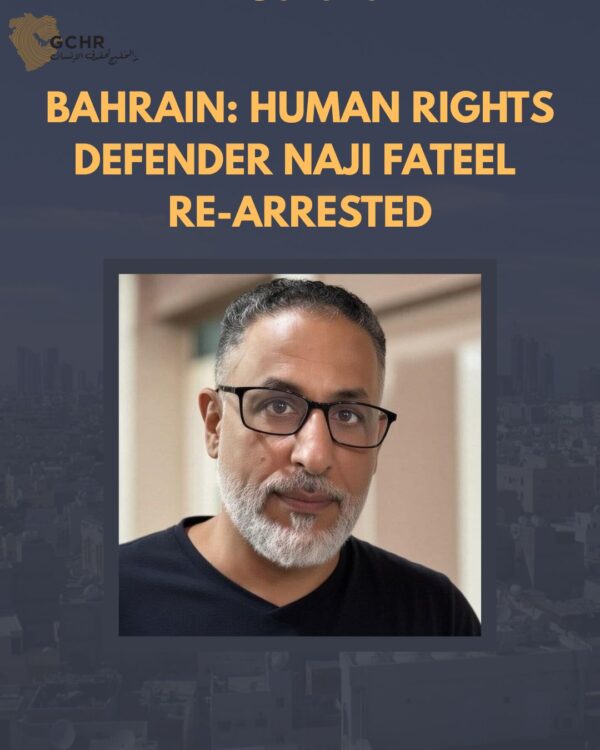 Bahrain
Human rights defender Naji Fateel re-arrested