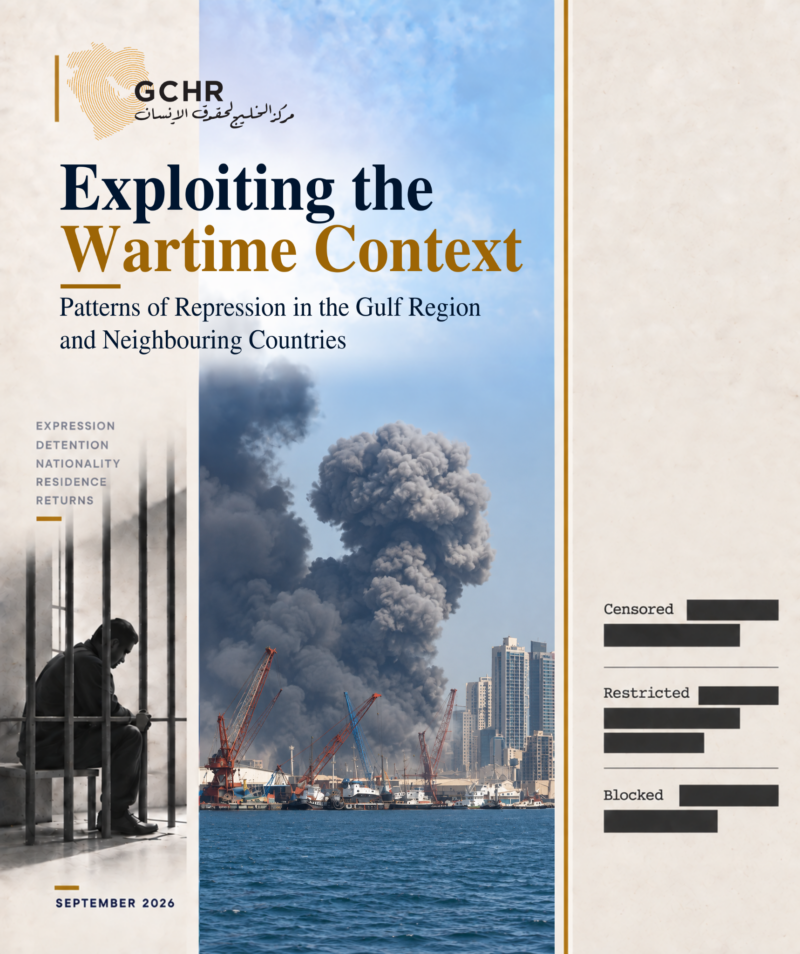
The Gulf Centre for Human Rights (GCHR) is releasing its 2025 annual report, “Human Rights in the Middle East Countries”, during one of the starkest periods of war and repression of civil society in the region.
“Year after year, most governments in the region continue to pursue systematic repressive policies, prioritising the suppression of citizens’ public freedoms, particularly freedom of expression online and beyond,” said GCHR Executive Director Khalid Ibrahim. He noted, “They have also exploited the ongoing war to intensify their repression of citizens, including human rights defenders, journalists, and online activists.”
Ibrahim added, “We strongly urge these governments to protect the civil and human rights of all citizens and to respect international humanitarian law during the ongoing war. We emphasise the need to protect civilians, avoid targeting civilian infrastructure, and ensure humanitarian access, and we declare that these grave violations amount to war crimes.”
GCHR’s report summarises its activities in 2025 advocating on behalf of human rights defenders (HRDs), activists, academics, journalists, protesters and citizens so that they can exercise their human rights peacefully and free from oppression.
In addition to documenting our advocacy efforts and activities, the report also covers the ways in which we have helped to strengthen the capacity of HRDs and other civil society actors working to peacefully promote and protect human rights throughout the region and neighbouring countries.
At the outset, GCHR wishes to recognise and pay tribute to its local, regional and international partners, including UN experts, with whom it has continued to enjoy fruitful relationships in our mutual work to amplify and support the work of HRDs and civil society organisations (CSOs) across the Gulf region and neighbouring countries.
Part I of this report summarises GCHR’s thematic and country-specific campaigns, advocacy before international organisations such as the United Nations and legal advocacy. Part II highlights the various thematic and country reports published by GCHR over the past year. Part III summarises the practical support GCHR has provided to HRDs and civil society actors throughout 2025. Part IV provides “snapshots” of the human rights situation in each of the countries we work in across the Gulf region and the report concludes with a regional human rights overview at Part V and recommendations for the coming year at Part VI.
This report is dedicated to all human rights defenders in the Middle East and North Africa (MENA), particularly women and members of minority groups across the MENA region who are under severe stress and threats for their work, including those living in countries targeted by war and violence.
Regional Human Rights Overview
Whilst 2025 brought cautious hope to the region with the fall of the Al-Assad government opening the possibility of a new chapter for the Syrian people, the year was quickly overshadowed by alarming reports of sectarian violence and summary executions along the Syrian coast, a stark reminder that political transition does not automatically bring protection for human rights. It is also deeply concerning to note the continued sportswashing of serious violations in countries such as Saudi Arabia, where executions reached at least 356 in 2025 alone, and where prominent HRDs and journalists continued to be imprisoned, tried and in some cases executed.
Similarly to previous years, arbitrary arrest and detention remain one of the most pervasive forms of repression used against peaceful HRDs across the MENA region, and HRDs and other civil society actors continue to face torture and ill-treatment, particularly in places of detention, with impunity. This is starkly illustrated in Yemen, where a consistent pattern of enforced disappearance, arbitrary detention and torture was documented across all parties to the conflict, including the detention of 69 UN staff members by the Houthi authorities; and in Bahrain, where prisoners of conscience including GCHR co-founder Abdulhadi Al-Khawaja continue to be held after years of imprisonment.
2025 has continued to evidence a deeply worrying crackdown on women’s rights, with the re-arrest and sentencing of Nobel Peace Prize laureate Narges Mohammadi in Iran in December 2025 serving as a powerful symbol of the ongoing and intensifying repression of women human rights defenders across the region. From Saudi Arabia, where WHRDs such as Nourah Al-Qahtani and Manahel Al-Otaibi remain imprisoned, to Kuwait, where amendments to the Nationality Law have had a disproportionate impact on women, to Oman, where the new citizenship law further entrenches discrimination against foreign women who marry Omani citizens, there is no sign of this pattern abating.
Finally, the systematic silencing of men and women HRDs, journalists, internet activists, peaceful protesters and other civil society actors through arbitrary arrests and detentions, judicial harassment, enforced disappearance, attacks, threats and assassinations, has once again been a recurring theme across the region. Particularly troubling is the increasing weaponisation of the judiciary and of counter-terrorism and cybercrime legislation to criminalise peaceful expression, as documented across Yemen, Jordan, Tunisia, Qatar and the UAE, and the shrinking of civic space through bans on civil society organisations, as seen in Yemen with the government’s decision to prohibit engagement with Mwatana for Human Rights.
RECOMMENDATIONS
In light of these patterns of oppression across the region, GCHR recommends that:
1. Governments across the MENA region repeal vague and punitive legislation that exerts a chilling effect on or even criminalises peaceful human rights work, freedom of expression and freedom of association.
2. Governments across the MENA region enact legislation on human rights, freedom of expression and assembly and information technology in line with international human rights norms.
3. Governments across the MENA region repeal archaic and oppressive laws limiting women’s freedom and enact progressive, rights-protecting legislation fit for the modern era.
4. Authorities across the region tackle impunity by enabling thorough, transparent and independent investigations into the perpetration of attacks, assassinations, enforced disappearances, arbitrary detentions, torture and ill-treatment against HRDs, civil society activists, journalists, lawyers and academics.
5. The international community cease to embolden the region’s governments in committing human rights violations with impunity by pandering to the efforts of oppressive countries to sanitise their image on the world stage.