Introduction
The Gulf region and its neighbouring countries are witnessing an unprecedented and systematic campaign of repression. The ongoing war is being used as a pretext to stifle free speech, confiscate citizens’ public freedoms, and target journalists, bloggers, and online activists who express opinions that do not align with government policies. These individuals are subjected to arbitrary imprisonment and detention, and unfair trials on fabricated charges using counter-terrorism and cybercrime laws. This is the second report published by the Gulf Centre for Human Rights (GCHR) on the effects of the war on the civil and human rights of citizens, following the first report published on 19 March 2026.
Bahrain
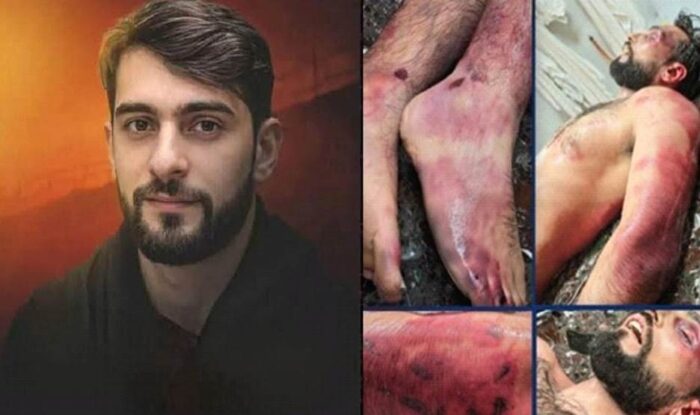
On 27 March 2026, the father of Mohammed Abdulmohsen Al-Mousawi, 32 years old, received a phone call from the Ministry of Interior without any prior notice, asking if he had received his son’s body. The call came as a tremendous shock to the family, but the shock was even greater when they received his body, finding signs of severe torture all over it, as seen in the image above.
Security forces had arbitrarily arrested him, along with his cousins, Ahmed Al-Mousawi and Mustafa Al-Mousawi, about whom no information is currently available, at a checkpoint in the Samaheej area of Muharraq Governorate while he was on his way to a religious gathering. They were taken to an unknown location and held incommunicado. Informed sources confirmed that the reason for their arrest was their publication of personal opinions on social media, not the charge of espionage for foreign entities, as claimed by the authorities.
Mohammed Al-Mousawi is a former prisoner of conscience who was released in 2024 after serving 12 years in prison. Citizens participated heavily in his funeral procession, and observers fear that many of them may be targeted for their participation.
It is worth noting that Ahmed Al-Mousawi’s family received a similar call on the same day, but despite their considerable efforts and inquiries with the relevant authorities, they have not yet learned his fate.
On 16 March 2026, the Ministry of Interior warned citizens and residents against using their social media accounts to “photograph, publish, or recirculate any image, video, or information that constitutes a threat to the security and safety of the nation.”
Reliable sources inside Bahrain confirmed to GCHR that the number of detainees has exceeded 200. They are being held in secret locations, isolated from the outside world, and without being allowed to contact their families or lawyers. They are being detained solely for expressing their personal opinions about the ongoing war on social media, and – for – some participating in peaceful demonstrations.
The authorities are using the pretext of the current war to stifle public freedoms in an unprecedented manner. Their security apparatus monitors online content and persecutes citizens, including internet activists and other activists, for expressing opinions that do not align with the government’s stance.
Kuwait
On 30 March 2026, the Attorney General of Kuwait issued a decision establishing the “State Security Crimes, Terrorism, and Financing Prosecution Office,” granting it “exclusive jurisdiction to investigate and prepare cases for prosecution in crimes that affect the state’s entity, security, and stability.”
Furthermore, on 22 March 2026, the Public Prosecution also issued a decision prohibiting publication in the cases of espionage and harming state security, asserting that “these acts constitute serious crimes affecting state security and are subject to the most severe penalties prescribed by law.”
GCHR had previously documented that Decree Law No. (47) of 1926 was issued on 16 March 2026, noting its use of vague and ambiguous language that could be used to stifle all free speech by threatening individuals with terrorism charges.
Credible information received by GCHR confirmed that security forces raided approximately 27 homes on 22 March 2026, and in the following days, arresting dozens of citizens on alleged charges including sympathising with and spying for a foreign state, and publishing opinions on social media that allegedly harmed state security.
In another arbitrary measure, the Ministry of Foreign Affairs of Kuwait issued a circular on 24 March 2026, adding the names of ten recently-arrested citizens to a terrorism list. This effectively freezes all their movable and immovable assets without allowing them any legal recourse or the opportunity to defend themselves against the alleged terrorism charges brought against them by the authorities.
The Ministry of Foreign Affairs had previously included, on 08 February 2026, the names of nine Lebanese hospitals on the terrorism list.
Jordan

The ongoing war has led Jordanian authorities to intensify their systematic repression of public freedoms and dissenting voices, targeting political and online activists who peacefully express opinions that do not align with government policies and official positions. A large number of these activists have been arrested and face charges including unlawful assembly and violating the Cybercrime Law by posting on social media.
Prominent journalist Hiba Abu Taha remains imprisoned, serving a sentence related to her peaceful expression of opinions online.
On 03 March 2026, authorities arrested Abu Taha for a Facebook post. On 19 March 2026, the Amman Criminal Court sentenced her to two years in prison after convicting her of inciting sedition, discord, or threatening social peace, under Article 17 of the Cybercrime Law. Her trial fell far short of international standards for a fair trial and due process. She was denied her right to a defence after her lawyer was prevented from presenting his case.
On 09 March 2026, the authorities arrested three political activists, including Dr. Omar Emil Awad, Osama Abu Zein El-Din and student Bahaa Aliyan. The reason for their arrest remains unknown, and no specific charges have been brought against them. On 12 March 2026, Abu Zein El-Din was released, while his two colleagues remained in arbitrary detention.
On 26 March 2026, political activist Ziad Hussein Abu Jarar, 65, was released on bail after his sentence was reduced to three months in prison, which was then commuted to a fine. He had previously been sentenced to six months in prison after being arrested earlier that year by the General Intelligence Directorate, where he was forcibly disappeared for 20 days before being transferred to Marka Prison. He was prosecuted under the Cybercrime Law for expressing his opinions in defence of prisoners of conscience in Jordan.
On 27 March 2026, after serving his three-year prison sentence, comedian Abdulqader Al-Aqaileh was released. He had been arrested for posting a video in which he expressed views contrary to the government’s policies.
On 21 March 2026, online activist Ahmed Al-Oleimat was arbitrarily arrested after posting a video on social media expressing his opinion on the ongoing war.
Online activist Mohammeh Ahmed Al-Nadi, 76, remains imprisoned more than a year after his arrest on 09 March 2025, by security forces at Queen Alia International Airport. He was referred to the State Security Court, which sentenced him to two years in prison under the Cybercrime Law, solely for peacefully expressing his personal opinions on social media. Despite suffering from chronic heart disease and being transferred to the hospital several times, he remains in Al-Muwaqqar prison in poor detention conditions.
From Bahrain to Jordan, the torture is the same

The ordeal of 32-year-old engineer Daham Al-Amoush began when Jordanian authorities forcibly returned him to Jordan after accusing him of attempted murder to justify his deportation, despite having left the country legally.
He was involved in a fight in 2021 during which someone sustained a minor stab wound. Al-Amoush was not the main perpetrator; several people were involved in the altercation, and the victim didn’t even know who had stabbed him. The matter was settled amicably at the time.
Afterward, Al-Amoush continued to pursue his ambitions as a young engineer determined to build his future through hard work and dedication. He travelled to Turkey through Queen Alia International Airport, entirely legally, and then moved to Qatar, where he successfully began working in the management of an engineering firm.
When Al-Amoush began publishing his writings on social media, which included sharp criticism of the Jordanian government, the authorities exerted every effort to silence him. This included reopening an old, closed case against him and falsely accusing him of attempted murder. Under this pretext, they contacted Interpol to have him extradited from Qatar to Jordan on criminal charges.
Upon his arrival, the authorities imprisoned him without trial. Forty separate attempts by his family to secure his release on bail were rejected. The presiding judge informed them that the decision to deny bail was not within his authority, but rather a decision issued by the General Intelligence Directorate.
After a year of imprisonment without trial, Al-Amoush decided to begin an open-ended hunger strike to protest his arbitrary detention without trial.
He spent ten days on hunger strike, then disappeared for two days before his family discovered he had been taken to Al-Bashir Hospital in critical condition, hovering between life and death after suffering brain damage. He was in a state of clinical death and was on life support. Security personnel were heavily present in his room, despite him being unable to move or speak.
When his family visited him, they were not allowed to approach his bed or examine his body. When his father finally managed to do so, he saw bruises and contusions around his neck, raising suspicions that he had been tortured to force him to end his hunger strike.
While on his deathbed, on 28 February 2026, he was sentenced to 12 years in prison, later reduced to eight years, after being convicted on the following charges, according to the politically motivated indictment:
1. Committing an act or making a statement intended to incite discord among the various segments of the nation, in violation of Article 150 of the Penal Code and Article 15 of the Cybercrime Law.
2. Defaming an official body, in violation of Article 191 of the Penal Code and Article 15 of the Cybercrime Law.
On 15 March 2026, his brother, Bassam Al-Amoush, announced his death and the family’s determination to pursue the perpetrators.
This video details the serious violations committed by the authorities that led to Daham Al-Amoush losing his life, most notably the poor conditions in Marka prison that led to him contracting blood poisoning and the lack of health monitoring of his blood sugar levels during his hunger strike, which led to brain cell damage that hastened his death.
The role of security forces should be to protect citizens, not kill them for freely expressing their opinions. It is not their duty to prevent them from caring for their children when their health is critically ill.
The case of Daham Al-Amoush tells the story of a successful engineer, a father of an infant he never saw and a young son not yet three years old. He was forcibly brought back to Jordan with the help of Interpol under the guise of a criminal case, to be politically persecuted for freely expressing his opinions. As a result, he faced a slow death, for which the security authorities, particularly the Intelligence Directorate, bear responsibility. This case clearly demonstrates their control over the judiciary and their use of it as a tool to persecute those with opinions contrary to those of the government.
Oman
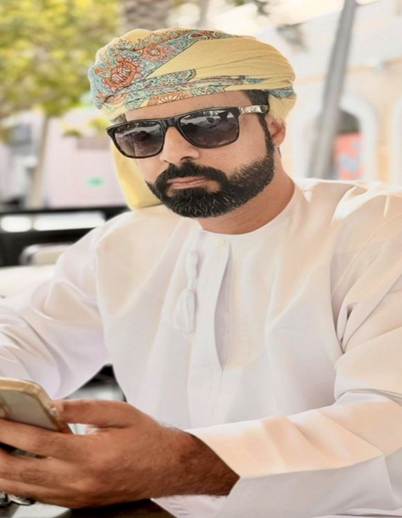
On 28 February 2028, the Government Communication Centre in Oman issued a warning to citizens and residents, urging them, in light of the rapidly unfolding events, to “obtain news from official and reliable sources.” It also called on everyone to “avoid engaging in discussions.” Undoubtedly, in a country with established institutions and genuine citizenship, no one needs such a warning or a limitation on what they can discuss.
Despite this, Oman has not witnessed the mass arrests and trials seen in other Gulf countries. It maintains the same level of repression affecting public freedoms, including freedom of expression and freedom of peaceful assembly, both of which face strict restrictions and laws designed to imprison dissidents and those with differing opinions if necessary.
On 29 March 2026, human rights lawyer Majid Al-Ruhaili was released after seven weeks of arbitrary detention. His family was prevented from visiting him in prison, and he was not allowed to contact a lawyer. Informed local sources confirmed that he spent 45 days of his detention in solitary confinement. Authorities charged him with publishing material that could incite public opinion and undermine the prestige of the state. His trial is scheduled to begin on 05 April 2026.
For more information, see here.
Qatar
On 02 March 2026, the Qatari Ministry of Interior issued a statement urging everyone to “obtain information from official and accredited sources.” It also warned against “gathering or going to incident sites, or filming and publishing videos related to field developments, to avoid legal repercussions.” This effectively imposes the government’s narrative and further restricts the work of journalists, in addition to the negative impact this has on public freedoms.
Reliable local sources confirmed to GCHR that security forces, acting on direct orders from the State Security Apparatus, arrested a number of journalists and online activists and closed their digital accounts because of their free expression of opinions that do not align with official government policies.
Furthermore, on 09 March 2026, the Ministry of Interior also announced the detention of 313 individuals of various nationalities for “filming and circulating videos, disseminating misleading information and rumors, and anything that could incite public opinion” during the ongoing war. The authorities can simply consider any dissenting opinion or audio broadcast of a discussion between citizens or residents as spreading misinformation and rumours and inciting public opinion, and thus target whomever they wish.
UAE
Despite the difficult conditions imposed by the current war, the authorities in the United Arab Emirates (UAE) refuse to apply the United Nations Standard Minimum Rules for the Treatment of Prisoners (the Nelson Mandela Rules), as prisoners of conscience in the UAE suffer from not having regular weekly visits, nor daily telephone calls with their families, and this is a blatant violation of these rules.
Furthermore, regular reports received by GCHR also confirm that the authorities continue to prevent citizens and residents from expressing their personal opinions on the ongoing war and force them to show their full support for government policies.
On 02 March 2026, the UAE State Security Service, in a statement published on its website, prohibited what it described as “the dissemination of unreliable information.” This means that the authorities will be the sole source of news, and that citizens or residents publishing their opinions or reliable news they possess about various aspects of life can be considered unreliable information by the authorities, subjecting its publisher to accountability and severe penalties.
This was followed by the arrest of dozens of residents, journalists, and tourists who published information about the ongoing war or photographed its effects. If prosecuted, they could face prison sentences of up to ten years and hefty fines under the Cybercrime Law No. 34 of 2021 and the Counter-Terrorism Law No. 7 of 2014. Both laws contain very broad and vague language, designed to enable security agencies to use the law to label all dissidents and those with independent opinions critical of government policies as terrorists.
Migrant Workers
While Western countries evacuated their citizens from danger zones in the region, migrant workers were left on the front lines. Some lost their lives and had no choice but to stop working and lose their only source of income. They were once again abandoned to their fate, just as they were during the COVID-19 pandemic. No shelters were provided, and no one trained them in wartime safety procedures. This has exacerbated their ongoing suffering due to the lack of adequate housing and proper medical care, as well as the denial of their fundamental rights, most notably their right to form independent unions to defend their rights.
Recommendations
GCHR calls on the region’s governments to respect the civil and human rights of citizens and residents at all times, whether in war or peace, hardship or prosperity. Security cannot be used as a pretext to stifle free speech, allowing only the government and its agencies to present the truth and information, while forcefully suppressing all other opinions to promote their own narrative.
GCHR also calls on the region’s governments to release all prisoners of conscience, including citizens and residents, among them online activists, who have been detained for exercising their right to freedom of expression online and offline, as well as their right to peaceful assembly. They must be released immediately and unconditionally, and public freedoms, especially freedom of expression, must be protected.
Finally, GCHR strongly calls for full respect for international humanitarian law during this ongoing conflict. We emphasise the need to protect civilians, avoid targeting civilian infrastructure, and ensure humanitarian access. We declare that serious violations amount to war crimes.

-
Latest News
-
Related Publications
Latest Urgent Action
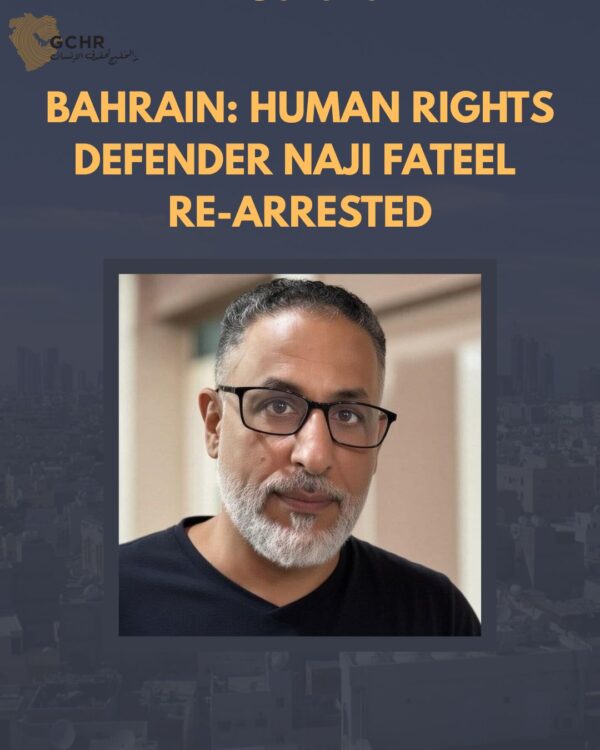 Bahrain
Human rights defender Naji Fateel re-arrested
Defenders Affected
-