Most governments in the Gulf region and neighbouring countries, exploiting the current war, are intensifying their systematic repression to suppress public freedoms, including freedom of expression online and offline. This includes the arrest of hundreds of citizens for peacefully expressing their opinions, as well as the political targeting of others. This report will focus specifically on Kuwait, in addition to the United Arab Emirates (UAE), Bahrain, Iran and Jordan.
First: Kuwait
The Gulf Centre for Human Rights (GCHR) has received credible reports from various local sources confirming that the State Security Apparatus has carried out dozens of arbitrary arrests of citizens who peacefully expressed their opinions on social media. Among those arrested are elderly individuals and women with young children in need of care.
The same sources confirmed that most of those arrested were being held in secret State Security prisons for several days, during which they are denied contact with their families or lawyers, which is a commonly used tool to intimidate them. They were then referred to the Public Prosecution and detained in the Central Prison, after arrest warrants were issued against them for 21 days pending the completion of investigations.
Their families expressed their shock at the arrest of their members, arguing that they are well-known for their patriotism and significant contributions to the advancement of Kuwaiti society.
These arrests are part of a systematic pattern of repression adopted by the authorities, which has transformed Kuwait, once relatively free in terms of public freedoms compared to its neighbours, into a police state that suppresses dissenting opinions, imprisons those who express them, and uses citizenship as a weapon to punish opponents and discriminate among citizens of Kuwait.
Members of the family of opposition figure Lulwa Al-Hussainan targeted

On 07 March 2026, opposition activist and online commentator Lulwa Nasser Al-Hussainan, 29, posted a video showing State Security officers arbitrarily arresting her brother, Abdullah Nasser Al-Hussainan, 22, in front of his home without warning. She also commented that Interior Minister Fahad Al-Yousef was “taking revenge on me by kidnapping my brother.” The video, which she posted several times, received over 1.5 million views on one occasion, reflecting public sympathy for her.

On the same day, the Ministry of Interior published a statement on its Facebook page, which read, “The competent authorities at the Ministry of Interior were able to arrest three people, two citizens and one of Colombian nationality, after monitoring the spread of a video clip in which they appeared to be mocking the current situation in the country, which constitutes charges of broadcasting false news, harming the national interests of the country, and misusing a telephone. While the Ministry confirms that what was issued is considered unacceptable behaviour, the concerned authorities have begun to take immediate measures, and accordingly they were detained and the necessary legal procedures were taken to refer them to the competent authority.”
The ministry attached to its statement a photo (shown above) depicting the three individuals with their hands tied behind their backs. Among them were Lulwa Al-Hussainan’s other brother, Bader Nasser Al-Hussainan, 27, an influencer, content creator, and YouTuber whose videos are viewed by thousands (left in the photo), and her uncle, Fahad Musafir Hamza (middle of the photo). Local observers considered this a clear case of political targeting.
GCHR reviewed the video mentioned in the Ministry of Interior’s statement and found that the accused were exercising their constitutional right to freedom of expression by satirising their difficult circumstances. This cannot, under any circumstances, be linked to charges such as “spreading false news,” “harming national interests,” and “misusing a telephone,” which were included in the same statement.
Lulwa Al-Hussainan faced significant targeting orchestrated by Interior Minister Fahad Al-Yousef, forcing her to leave the country on 15 December 2024. She was sentenced twice: first to three years in prison on 16 March 2025, for “insulting the Emir,” a sentence overturned on 19 June 2025. On 08 January 2025, she received a second sentence from the Kuwaiti Criminal Court, this time for five years in prison on the same charge of “insulting the Emir.” Despite the fact that, according to the recordings reviewed by the GCHR, she addressed him with utmost respect and civility, this indicates that the cases were malicious and were considered a state security issue due to the Interior Minister’s attempt to undermine her.
Al-Hussainan uses her X account, which features the phrase, “My country, how harsh life is for the free and honest,” to express her personal opinions on public affairs, particularly her sharp criticism of the repressive tactics employed by the Minister of Interior and his leadership of the campaign to revoke the citizenship of thousands of citizens, mostly women and children. She can be described as a courageous and steadfast female voice, demanding rights and confronting the authorities’ repression at a time when many voices have been forcibly silenced.
On 14 March 2026, she posted the following on her X account: “What is happening is the height of a catastrophe. Fahad Al-Yousef is using the war as a pretext to justify his injustice and tyranny, and he is wielding his power as a sword against the people.”
On 12 March 2026, she asked, “I am against publishing the photos of the accused, but what is the Ministry of Interior’s standard for publishing photos?” Her question relates to the Ministry’s practice of publishing photos of detainees in cases related to publishing views, which violates their right to freedom of expression. The Ministry then commits an even greater violation by displaying photos of them, with their hands cuffed behind their backs, on various media outlets in order to defame them and imply that they have committed serious crimes.
On 03 March 2026, she wrote, “Given the difficult circumstances Kuwait is going through, I hope for the release of prisoners of conscience, as they are loyal sons of the nation, and I hope for the reinstatement of citizenships that were unjustly revoked.”
New laws issued at a questionable time
Following a wave of arrests of citizens, including online activists, the authorities announced the enactment of two laws at this particular time, raising suspicions among local observers regarding the timing of their issuance.
On 16 March 2026, Law No. (47) of 2026 concerning combating terrorism crimes was issued. The law consists of 31 articles distributed across five chapters. Penalties in this law can reach the death penalty as well as life imprisonment, despite the fact that some of its articles use vague terms that can easily be used by security authorities to target those with dissenting opinions, accuse them of terrorism, and subject them to the harshest penalties.
Article 1 of the law defines a terrorist act as “any act… aimed at spreading terror among the people or endangering the safety and security of society.” These are undoubtedly broad and open to interpretation, and can be used to stifle all free voices after threatening them with terrorism charges.
The same article, in its definition of the term “terrorist threat,” states: “A situation attributed to a person about whom there are grounds to believe that their conduct constitutes a serious threat of committing a terrorist act.” This definition provides full cover for security agencies to arrest any citizen based on their belief and judgment of their conduct, which may be contrary to the government’s orientations and policies, thus easily labelling them as terrorists. This undermines citizens’ constitutional right to freedom of expression, as stipulated in Article 36 of the Kuwaiti Constitution, which states: “Freedom of opinion and scientific research is guaranteed. Every person has the right to express their opinion and publish it orally, in writing, or otherwise.”
Furthermore, on 15 March 2026, Law No. 13 of 2026, concerning securing and protecting the supreme interests of military entities, was issued. This decree comprises 34 articles distributed across six chapters. The law includes prison sentences ranging from 6 months to 10 years, in addition to life imprisonment and a temporary prison term of 7 years, and fines of up to 10,000 Kuwaiti dinars.
This law is also not without vague terms. Article 26 imposes prison sentences ranging from 3 to 10 years and fines ranging from 5,000 to 10,000 Kuwaiti dinars on anyone who “broadcasts news, publishes statements, or spreads false rumours related to military entities, with the intent of weakening confidence in these entities, diminishing their prestige, casting doubt on their existence, or undermining their morale.” This article contains a large number of vague and clearly ambiguous terms whose precise meanings are difficult to ascertain and which can easily be used to target bloggers, internet activists, and those fighting corruption in government agencies. With this article in place, any post, even if true, will provide a military officer with an opportunity to claim it undermines their prestige and morale.
The two laws came into effect after their publication in the official gazette.
Two well-known activists arbitrarily detained

On the morning of 03 March 2026, the State Security Apparatus arrested two prominent activists, Suad Al-Munayes (73 years old) and Fareah Al-Saqqaf (67 years old), for peacefully and respectfully exercising their constitutional right to express their opinions on social media, specifically on their accounts on the X website.
Al-Munayes is a member of the “Kuwaitis for Jerusalem Committee” and a member of the Women’s Cultural and Social Society (WCSS), which has made women’s empowerment the core of its mission. She has dedicated most of her life to defending human rights and supporting women’s participation in public life. She uses her X account to express her personal opinions on public affairs concerning citizens in Kuwait and the Arab world.
Al-Saqqaf is the daughter of the prominent Kuwaiti poet Ahmed Al-Saqqaf, who passed away in 2010. Throughout her productive life, she has engaged in various volunteer and charitable activities and has been an active member of the Kuwait Red Crescent Society. She is also a member of the WCSS and a columnist for various newspapers both in Kuwait and abroad. In 2002, she co-founded LOYAC with a group of women. LOYAC empowers young people through a range of programs designed to support their personal and professional development. She currently serves as its Chairperson and Managing Director. Like her colleague, she uses her X account to express her personal opinions on public affairs.
Reliable reports confirm that Al-Munayes spent ten days in arbitrary detention by the State Security Apparatus before being transferred to the Central Prison, where she was ordered to remain in pretrial detention for 21 days pending further investigation. There is no confirmed information regarding Al-Saqqaf’s whereabouts, but it is certain that she was arbitrarily detained by the State Security Apparatus after her arrest.
Well-known media personality arrested

On 05 March 2026, the State Security Apparatus arrested broadcaster Halima Boland, 46, for her social media posts. She began her media career at Kuwait TV in 2001, where she presented various television programs. She also presented numerous programmes on Gulf and Arab channels, including “Halima’s Riddles”, which aired on Al-Rai TV. She received the Best Arab Media Personality award in 2008, and her Instagram account has over 3.5 million followers.
Reliable reports confirmed that she was arbitrarily detained by the State Security Apparatus for two days before being transferred to the Central Prison. She was ordered to remain in pretrial detention for 21 days pending further investigation.
Second: The UAE
The United Arab Emirates (UAE) is completely closed, and its most prominent human rights defenders are imprisoned, such as Dr. Mohammed Al-Roken, Dr. Nasser bin Ghaith, and Dr. Mohammed Al-Mansoori, in addition to our colleague, the well-known blogger and board member of GCHR, Ahmed Mansoor. Mansoor has been held in solitary confinement since his arrest on 20 March 2017, and is serving two prison sentences totalling 25 years on fabricated charges. This is a country that does not recognise public freedoms and does not respect dissenting opinions. Once, an Iraqi blogger posted a video about the torrential rains that flooded Dubai. He spoke innocently about what he witnessed and ended up in prison.
The ruling family opposes any kind of publication that contradicts its wishes, which are to praise it and promote its achievements. The harsh reality is that anyone who wants to exercise freedom of expression and describe what is currently happening in the country amidst the ongoing war and unprecedented repressive measures puts themselves at risk, as they may be subject to counter-terrorism and cybercrime laws, often resulting in a long prison sentence.
The Emirati authorities have long severely restricted the freedom of journalists, and these restrictions on their movements and writings have intensified. The authorities, particularly the State Security Apparatus, closely monitor online content, requiring creators of content related to current events in the country to obtain prior approval before publishing, even if it concerns personal opinions on public life, such as the overcrowding in hotels or restaurants, or the impact of the war on citizens and residents. It is clear that the authorities expect online activists to declare that everything is fine and cannot tolerate any criticism, however slight.
It is within this context that the Emirati authorities’ warning should be understood: “Photographing or sharing images of sensitive or vital security installations, as well as publishing unreliable information, may lead to legal action and endanger national security.” A term like “unreliable information” is being used to categorise all criticism at this particular time as spreading misinformation and undermining national security. A combination of federal laws and executive decrees contributes to the flexibility of Emirati law, enabling it to suppress all free voices, silence them, and imprison their owners under the pretext of security threats. The UAE government can easily issue orders or executive decrees imposing temporary restrictions on the publication of certain information and broaden the definition of “sensitive news items” or “critical infrastructure” that are prohibited from all forms of media coverage.
Both the Cybercrime Law No. 34 of 2021 and the Counter-Terrorism Law No. 7 of 2014 contain very broad, vague, and preemptive language designed to empower security agencies to adapt this law to label all opponents and those with independent opinions critical of government policies as terrorists. This flexibility allows the authorities to apply existing provisions more strictly or in new contexts, such as escalating geopolitical tensions or cross-border threats.
Under these difficult circumstances, prisoners of conscience in the UAE are denied regular weekly visits and daily phone calls with their families. This is a blatant violation of the UN Standard Minimum Rules for the Treatment of Prisoners (the Nelson Mandela Rules).
Third: Bahrain
What is happening in Bahrain is no different from what has been documented in other Gulf countries. The authorities have exploited the current war to suppress the civil and human rights of citizens. According to reliable local sources, 168 people have been arrested, including two women, who were arbitrarily arrested for peacefully expressing their opinions on social media or participating in peaceful demonstrations. The authorities have published their photos to defame them and levelled various charges against them, which, if they are convicted, could result in heavy prison sentences.
Fourth: Iran
The internet has been almost completely shut down, and citizens are unable to access social media. Only the authorities and their affiliated media outlets can operate within the country along the lines drawn for it. This means that the truth is conveyed to the world only through official narratives, and there are no journalistic or media sources capable of reporting from the scene of events around the clock.
Fifth: Jordan
The ongoing war has contributed to the authorities exploiting it to continue their repressive policies, which have included confiscating public freedoms and imprisoning activists.
On 03 March 2026, the authorities arrested journalist Hiba Abu Taha due to a Facebook post. On 19 March 2026, the Amman Criminal Court sentenced her to two years in prison after convicting her of publishing material that could incite sedition, discord, or threaten social peace, according to Article 17 of the Cybercrime Law. Her trial lacked the minimum international standards for a fair trial and due process, as she was denied the right to a defence after her lawyer was prevented from presenting his arguments.
On 09 March 2026, the authorities arrested three political activists, Dr. Omar Emil Awad, Osama Abu Zein El-Din and student Bahaa Aliyan. The reason for their arrest remains unknown, and their lawyers were not allowed to ask them about the charges against them when they met with them. Similarly, political activist Kamal Jihad Al-Jabari was arbitrarily arrested on 09 March 2026, in front of his home by the General Intelligence Service and released on 14 March 2026.
Conclusion
Governments throughout the region must respect the civil and human rights of all citizens and residents at all times, whether in war or peace, hardship or prosperity. Security cannot be used as a pretext to stifle free speech, allowing only the government and its agencies to present the truth and information while forcefully suppressing all other viewpoints.
Countries in the region, particularly the Gulf states, have severely restricted journalistic work during the current war, preventing journalists from accessing conflict zones and threatening them with legal repercussions for publishing any information or recordings. These measures undoubtedly hinder responsible journalism, isolate professional journalists from the events, and obstruct their efforts to convey the truth to the world. This leaves the government and its mouthpieces as the only voices heard. This will have numerous negative consequences for the protection of citizens’ public freedoms, especially freedom of expression online and offline, and will lead to the rapid spread of rumours due to the suppression of independent sources.
In conclusion, protecting citizens’ security is paramount, but it can never be used to prevent access to accurate information or to stifle free speech and promote the government’s narrative and that of its supporters.
GCHR calls on the region’s governments to release all prisoners of conscience unconditionally and to protect public freedoms, especially freedom of expression.

-
Latest News
-
Related Publications
Latest Urgent Action
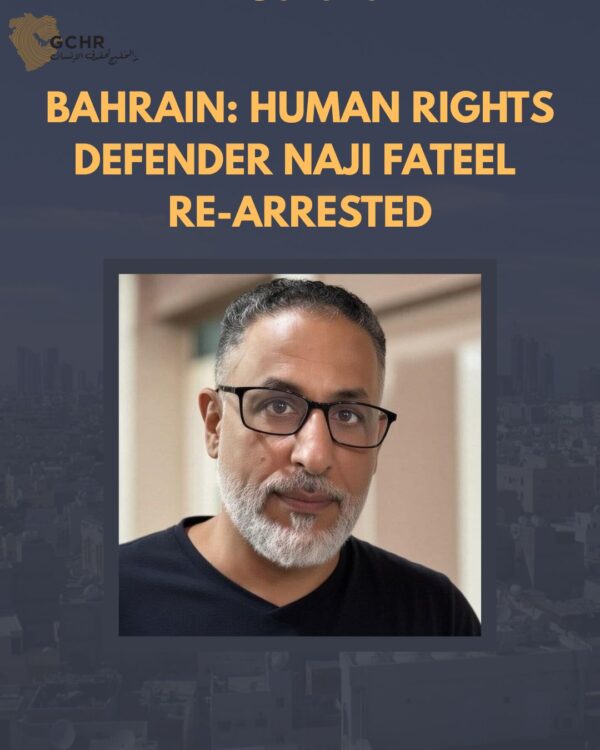 Bahrain
Human rights defender Naji Fateel re-arrested
Defenders Affected
-