In its seventh periodic report on violations during the popular demonstrations which began in Iraq in October 2019, the Gulf Centre for Human Rights (GCHR) documents ongoing attacks on peaceful protesters and targeted assassinations and kidnappings of members of civil society, including activists, academics and journalists. Despite the high temperatures, demonstrations have taken place across Iraq, including Kurdistan, since the beginning of July 2020, and some of them have been met with force. GCHR applauds the efforts of the authorities to hold those responsible for past human rights violations, and to pass a domestic violence law. However, GCHR is alarmed at the ongoing pattern of violations of the rights to freedom of assembly and expression, and the lack of information about the whereabouts of those kidnapped, dating back to October 2019.
On 30 July 2020, Hisham Daoud, an advisor to the Prime minister, announced that the number of victims of the current popular movement who lost their lives due to violence had reached 500, most of whom were protesters, whose families the government will support. Daoud said, “The government will establish a fact-finding committee to uncover the circumstances of the events that accompanied the demonstrations.” He added, “The government will announce the parties involved in the violence against the demonstrators, after the results of the fact-finding committee.” Local human rights groups have suggested that the number of deaths may be higher.

On 03 August 2020, Iraqi Prime Minister Mustafa Al-Kazemi received 17-year-old Mohammed Saeed (photo above) in his office and offered him an apology after he was subjected to a brutal assault by some members of the Law Enforcement Forces for participating in the protests in Al-Tahrir Square. The Prime Minister ordered the removal of the commander of these forces from his post and the formation of an investigation committee to determine who was involved in the attack in order to dismiss them from service. The Ministry of the Interior announced at a later time the identification and arrest of the perpetrators of this attack. On 01 August 2020, in a video widely circulated on social media, Saeed appears to have been stripped of his clothes while members of the Law Enforcement Forces interrogated and insulted him and cut his hair with a sharp object. The incident took place on 14 May 2020 in an alley in the Al-Sinak area in central Baghdad, and Saeed was held in a Baghdad police station for 10 weeks after that, during which time his family had no news of him.
Academics, journalists, and activists kidnapped and forcibly disappeared

On the evening of 21 July 2020, German civil society activist Hela Mavis was kidnapped near her office by an unknown armed group. Mavis runs various artistic programs and helps to hold an exhibition and training art workshops at Tarkib House, which she founded and has managed since 2015. Tarkib House focuses on “Empowering youth, especially women, and artistic works that constitute the boundary between art and everyday life, and discovering new cultural and social spaces.” She supported the current popular movement and was in a meeting with the protesters in Al-Tahrir Square prior to her kidnapping.
Mavis has fallen in love with Baghdad, with its sunshine, its heritage houses, and its love for Iraqi folklore, since her first visit in 2010, accompanied by a theatre group from Germany. She visited repeatedly and was planning joint artistic projects. In 2011, she decided to live in Baghdad and participate in the activities of the German Goethe Institute for Culture in Baghdad, in which she worked as a director of the cultural department and also participated in teaching the German language. A video clip spread on social media showing her kidnapping while she was traveling on her bicycle near Tarkib House on Abu Nawas Street in the centre of Baghdad. Local reports stated that the incident took place under the watchful eye of a police officer in a nearby police headquarters, who did not intervene to stop the kidnapping. On 24 July 2020, the Iraqi authorities announced that she had been freed and had left Baghdad to return to Germany. No information was available about those responsible for the kidnapping, which means it is unlikely that anyone will be held accountable and brought to trial.

Since October 2019, many journalists, academics and activists have been kidnapped and at least nine of them have not been freed for many months. They include:
- On 07 October 2019, human rights lawyer Ali Jaseb Hattab Al-Heliji (photo 1) was kidnapped in the city of Al-Amara.
- On 14 November 2019, engineer and peaceful demonstrator, Qutaiba Najm Al-Sudani (photo 2), was kidnapped in the Dora district of Baghdad.
- On 24 November 2019, Dr. Majed Ibrahim Al-Dhafiri (photo 3) was kidnapped in Al-Ghazaliya district in Baghdad.
- On 03 January 2020, civil society activist and photographer Osama Muthanna Al-Tamimi (photo 4) was kidnapped while returning home from Al-Tahrir Square in Baghdad.
- On 31 January 2020, the publisher and writer Mazen Latif (photo 5) was kidnapped in Baghdad.
- On 19 February 2020, journalist Raed Salam Dahham (photo 6) was kidnapped in Baghdad.
- On 09 March 2020, journalist Tawfiq Al-Tamimi (photo 7) was kidnapped after leaving his home in the Ur neighborhood of Baghdad.
- On 29 March 2020, civil society activist Abdulmasih Romeo Jean Sarkis (photo 8) was arrested, and there is no information on his whereabouts.
- On 18 May 2020, civil society activist Mohammed Hafez Salman (Mohammed Model) (photo 9) was kidnapped on his return from Al-Tahrir Square to the Karrada district in Baghdad.
For more information on the details of their abduction, see GCHR’s sixth periodic report: https://www.gc4hr.org/news/view/2420
Activists and journalists assassinated
On 06 July 2020, a well-known journalist and security expert, Dr. Hisham Al-Hashemi, was assassinated in front of his home in Zayouna district in Baghdad. GCHR issued an appeal in which it expressed its deep sorrow for his death, stating, “The Iraqi government bears full responsibility for this assassination and other operations that have taken place against journalists and activists, and the authorities must expose the perpetrators as quickly as possible and bring them to a fair trial.” It is worth noting that despite more than a month passing since the assassination, the Iraqi authorities have failed to identify the perpetrators.

On the evening of 26 July 2020, the Law Enforcement Forces, coming from Al-Tayaran Square, attacked protesters in Al-Tahrir Square. This attack, which continued intermittently until the next day, resulted in the killing of four peaceful demonstrators, namely, Mahdi Abdullah Al-Tamimi, Latif Osama Al-Salman, Sajad Haider Hassan Al-Jumaili, and Karar Haider Yas. In addition, the attack caused dozens of injuries due to the use of live ammunition and rubber bullets, hunting rifle cartridges, smoke and sound bombs, as well as assaults with sticks and batons. Many tents in Ummah Park were also burnt (photo 1).
Civil society activist Mahdi Abdullah Al-Tamimi (Abu Ahmed Al-Nahat) (photo 2) was documenting with his camera the attack of the Law Enforcement Forces on Al-Tahrir Square when a bullet fatally hit him in the head. He was a courageous man who never left his place and made sculptures in his tent under the liberation monument, leaving behind a wife and ten children, whom the Prime Minister received on 05 August 2020, pledging that, “Justice will take its course, [we will] punish the offender to take his fair penalty, whatever his title. “
Civil society activist Latif Osama Al-Salman, from Karbala Governorate, appears in photo 3 in front of a mural of human rights defender Safaa Al-Saray, who was killed in Al-Tahrir Square with a smoke bomb that penetrated his head on 28 October 2019. Al-Salman obtained the right to residency and was granted a travel document in Greece in 2018, where he got a job, but he returned to his country to participate in the popular movement and join the sit-in protesters in Al-Tahrir Square. He wrote on his Facebook page: “Iraq first, I left everything and returned to my country, for my patriotic duty because Iraq deserves it.” He was waving the Iraqi flag before he was targeted with a fatal shot.
A peaceful demonstrator, Sajad Haidar Hassan Al-Jumaili (photo 4), 19 years old, was hit in the head by a smoke bomb, which caused his death after he was taken to the hospital. Twelve hours before he was targeted, he posted on Instagram: “I want to support everyone, to leave something beautiful and different, and for someone to smile when he remembers me.”
On the morning of 31 July 2020, the first day of Eid al-Adha, the funeral took place in Al-Tahrir Square, according to his mother’s wish, for peaceful demonstrator Karar Haydar Yas (photo 5), a 17-year-old from the Al-Fadl district in Baghdad, who was fatally shot by a member of the Law Enforcement Forces. Karrar had suffered several injuries before that but refused to leave Al-Tahrir Square because, as one of his friends described, it was his “second home”. He had gone out to claim a homeland, as his family explained in a video interview about the tragic situation they were living in.
The Prime Minister ordered the formation of a committee to investigate the attacks that took place in Al-Tahrir Square on 26 and 27 July 2020, and promised that it would complete its investigations within 72 hours. On 30 July 2020, Minister of Interior Othman Al-Ghanimi announced that the preliminary investigation had established that three members of the Law Enforcement Forces had personally used hunting rifles in the attack, which resulted in the killing of two protesters. The three men were arrested and referred to the judiciary after they acknowledged the charges against them, and their statements were confirmed by the investigative judge.
The Law Enforcement Forces, which include 34,000 officers and members, were formed in October 2019 during the era of former Prime Minister Adel Abdul Mahdi, according to a decision issued by the National Security Council. Their job was to ensure order during demonstrations and protect demonstrators, but local reports confirm their involvement in many serious human rights violations, including the killing of peaceful protesters.

On 14 August 2020, two masked gunmen stormed the office of an Internet service located in Al-Junainah, in the centre of Basra city, run by human rights defender Tahseen Osama Ali (also known as Tahseen Al-Shahamani, pictured above) and fired 21 rounds with silencer pistols, killing him immediately. Ali is one of the most prominent activists of the Basra demonstrations, and his office is close to the main sit-ins where his fellow protesters often meet. On 09 August 2020, he wrote on his Facebook page, about Basra Governorate Police Commander Rashid Flaieh that, “He is accused of giving suppression orders to the demonstrators and he is the first to order the use of hunting rifles to suppress the demonstrators.”
On 08 August 2020, he called for the killers of the demonstrators to be identified, saying, “We demand a unity issue, which is uncovering the killers.” He was courageous and continued his peaceful work in support of the popular movement despite dozens of threats from armed militias. He left behind a wife and four children, and he had mentioned that on one occasion his young daughter Shams asked him not to go out in order that he would not be killed, so he answered her: “I must go out in order to overthrow the corrupt ones because it is our only opportunity.”
Following his assassination, on 16 August 2020, demonstrations took place in the city centre near the house of the Governor of Basra, demanding the disclosure of the armed groups that killed Ali and other peaceful demonstrators. The security forces and other forces affiliated with the Governor of Basra fired live ammunition intensively in order to disperse the demonstrators.

In the early hours of dawn on 15 August 2020, journalist and broadcaster Wissam Nazem Al-Tamimi (Wissam Al-Dhahabi) (photo 1) survived an assassination attempt by an armed group on a motorcycle, who sprayed his car with bullets, leaving only material damage. Al-Tamimi has contributed to the popular movement in Al-Nasiriyah since its inception. He uses his Facebook page to support the protesters and call for social justice and to keep weapons in the hands of the state and the armed groups. Immediately after the assassination of civilian activist Tahseen Osama Ali in the city of Basra, he asked, “When will the bloodshed by criminal gangs end after their failure to run the state?”
On 04 August 2020, the human rights defender and coordinator of the Students’ Union of Maysan Governorate, Reda Ali Al-Okaili (photo 2), announced on his Facebook page that an unknown armed group had targeted his home with a rocket-propelled grenade and the continuous firing of a PKC machin gun, which caused material damage only to his home. Al-Aqili had been the target of a previous assassination attempt on 12 March 2020, when two masked persons riding a motorcycle fired seven bullets at his car, which was parked in front of his house in the centre of the city of Al-Amara.
On 29 July 2020, the home of civil society activist Ahmed Shahid Al-Rikabi (photo 3) in Al-Rifai city in the Nasiriyah Governorate came under fire from a barrage of live bullets, but he was unharmed. Al-Rikabi uses his Facebook page to support the popular movement, fight corruption and defend citizens’ rights. Before his targeting, and on 26 July 2020, he held a poll on his page, asking readers for their views on how to solve the crisis in Al-Rifai and what are the most prominent steps to be taken.
On the evening of 17 July 2020, civil society activist Khaled Al-Samer (photo 4), 29 years old, survived an assassination attempt at the Tarbiyah (Education) intersection near the central sit-in square in Basra city (Al-Bahriya Square) where two unknown persons riding a motorcycle shot him several times. He was taken to hospital for treatment and is in stable condition. On his Facebook page, he wrote on 21 July 2020 about the assassination attempt: “After I was hit by treacherous hands which fired eight gunshots, five of them did not penetrate into the car and were stopped and three of them entered to hit me. If you kill me, then a thousand Khaled’s appear to you because we are an idea, and the idea does not die.” Al-Samer participated in the popular movement in Basra with strength, fortitude and courage, despite the constant threats issued by armed militias.
Several demonstrations in various Iraqi Governorates attacked by security forces

In the past several weeks, despite the high temperature, demonstrations started in the Governorates of Basra, Maysan, Qadisiyah, Dhi Qar, Wasit, Muthanna, Karbala, Najaf, and Babil, in addition to Al-Sadr City in Baghdad. Protesters cut off roads, denouncing the poor public services and the continuous power outages and demanding the expulsion of corrupt officials. In addition, university graduates, lecturers who work without pay, and those with higher degrees have organised numerous demonstrations in which they demanded their right to jobs and a decent life.
On 29 July 2020, despite the high temperature that exceeded 50 degrees Celsius, the youth of Al-Azizia district in Wasit Governorate launched a peaceful demonstration (photo on the left), in which they demanded the dismissal of the governor and judicial officials and the completion of all the lagging government projects.
On the evening of the same day, the demonstrators in Maysan Governorate, for the third day in a row, cut off the Amara-Baghdad road (photo on the right) in protest against an ongoing power outage.
The security forces attacked some of these demonstrations. On 01 July 2020, the security forces in the Green Zone severely beat the protesters in front of the Ministry of Foreign Affairs in the Salhiya area of Baghdad, who are graduates of political science colleges. This led to various injuries that necessitated the transfer of protesters to hospital for treatment.
On 15 July 2020, the security forces severely beat and used batons in order to disperse the demonstrators who surrounded the Sheraton Hotel in downtown Basra, where a cabinet session was held. The demonstrators demanded the dismissal of Governor Asaad Al-Eidani and Police Chief Rashid Flaieh and the improvement of their living conditions.
On 27 July 2020, a number of demonstrators holding higher degrees, who are staging a sit-in outside the headquarters of the Ministry of Higher Education and Scientific Research, were attacked by the security forces and the Ministry’s protection force, who used electric batons – as seen in the video that documented this targeting of peaceful demonstrators.

Local sources confirmed that a large force of 30 people and ten military vehicles raided the home of civil society activist Hamza Talib Al-Mandalawi (also known as Hamza Kool, pictured above) in his house in Dur Mandali, Baladruz district of Diyala Governorate, at 6 a.m. on 15 August 2020. He has been arrested without a court order. He is known for his tireless work to serve the citizens in his area, his support for the current popular movement and his organisation of peaceful protests against rampant corruption.
Demonstrations and arrests in Iraqi Kurdistan
Mass demonstrations erupted throughout the Kurdistan region and its various cities due to the inability of the local authorities to pay the salaries of employees for more than six months and the dire economic situation they are suffering, which the government has failed to improve. (See photo at top of this report.)
On 12 and 13 August 2020, in Sulaymaniah Governorate, demonstrations were launched in the city centre of Sulaymaniyah, and the areas of Rania, Qala Diza, and Halabja. Demonstrators condemned corruption and the spread of poverty among the population and demanded the dissolution of the Kurdistan Regional Government, preparation for early elections within six months and the formation of an interim government to manage the upcoming elections. In addition, they called for the disbanding of the current party elections commission in the Kurdistan region and for an independent commission to be formed. Local reports mentioned clashes between the security forces and the demonstrators, which led to a number of injuries on both sides. Some demonstrators erected sit-in tents in the centre of Sulaymaniyah in their efforts to continue the protests until their demands were met.
 Similar demonstrations were scheduled to take place in the Governorates of Erbil and Dohuk, but the security forces prevented the demonstrators from doing so. Dozens were arrested, and local sources confirm the presence of at least 76 detainees in prisons. Among the detainees was a civil society activist and young poet, Halo Sami (photo on the left), who was arrested on the evening of 14 August 2020 for reciting a poem at the Citadel of Erbil, in which he demanded freedom and the release of the detainees, including his mother, prisoner of conscience Samira Hamad Amin Ibrahim, who has been detained in Erbil since 06 August 2020.
Press reports have confirmed that despite the security forces preventing any gathering of demonstrations in the Governorates of Erbil and Dohuk, with the Asayish (Kurdish intelligence) threatening to arrest the activists who organise protests in these two Governorates, some citizens have held demonstrations in some areas and villages far from the centre of the two cities.
Journalists in Kurdistan prevented from covering protests
Reliable local reports from Erbil, Sulaymaniyah, and Dohuk Governorates, have confirmed that the security authorities, especially the Asayish, prevented journalists, reporters and photographers of TV and radio crews from covering the demonstrations, as they confiscated photographic equipment and personal phones in many cases. Some reporters have been arrested for a short time, then released.
Meanwhile, on 12 August 2020, the correspondent of the “Gali Kurdistan” TV channel, Huner Rasool, died while covering the protests in the Rania district of Sulaymaniyah Governorate, after being transferred to the hospital following a heart attack. Some reports indicate that he was hit by a stone in his chest, while other sources suggested that he fell to the ground after tear gas canisters were fired by the security forces at the demonstrators.
Domestic Violence Law approved
On 04 August 2020, the Iraqi government approved, in its weekly session, the Law on Combating Domestic Violence in order to protect vulnerable segments of society, especially children and women. The bill has been sent to Parliament for debate and approval. Civil society organisations hope that the law will help put an end to domestic violence, including gender-based violence, and provide real legal protection for children and women through prosecution of the perpetrators. This comes at a time when reports of violence against children and women continue. Maha Hassan, a 17-year-old who is married with two children, was subjected to ill-treatment and repeated, severe beatings by her husband. He reportedly burned her because she did not feed his dog and his birds, which required her to stay in hospital to receive the necessary treatment.
Recommendations
GCHR calls again on the Iraqi government to assume full responsibility for protecting all protesters, journalists, human rights defenders and members of civil society, including during the outbreak of the coronavirus (Covid-19). In addition, the Iraqi parliament should discuss and pass the law against domestic violence as soon as possible, especially when women and children are most vulnerable during the isolation imposed by the current crisis. While welcoming the positive steps recently taken by the Iraqi government, as mentioned in this report, GCHR calls on the authorities to work diligently to identify all perpetrators of kidnapping, torture, and killing of human rights defenders, peaceful protesters and other activists, and bring those responsible to justice immediately. The authorities must fulfill their constitutional obligations not to violate public freedoms, including freedom of peaceful assembly, freedom of expression, and freedom of the press, which can be respected while protecting public health.
We strongly call on all international mechanisms, including the United Nations system, to advocate for the Iraqi authorities to fulfill their constitutional obligations to protect peaceful protesters and activists and stop the killings and assassinations that are carried out by members of the security forces and members of armed groups.

-
Latest News
-
Related Publications
Latest Urgent Action
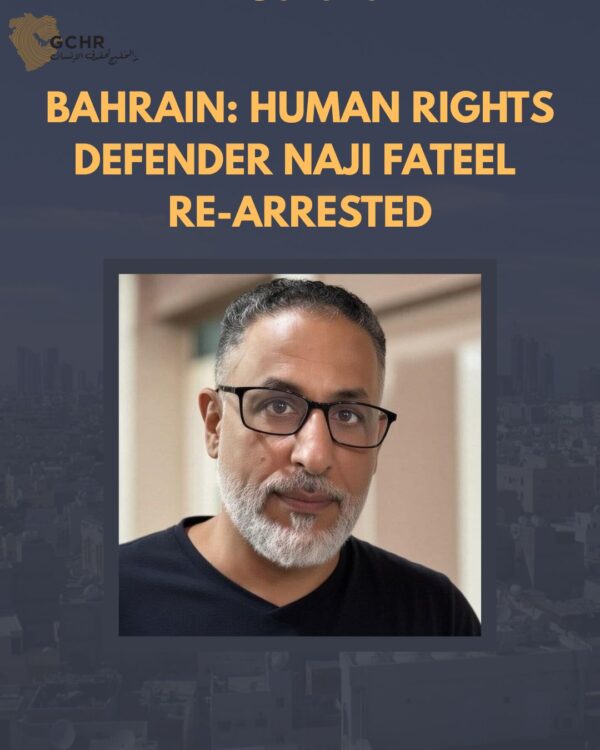 Bahrain
Human rights defender Naji Fateel re-arrested
Defenders Affected
-