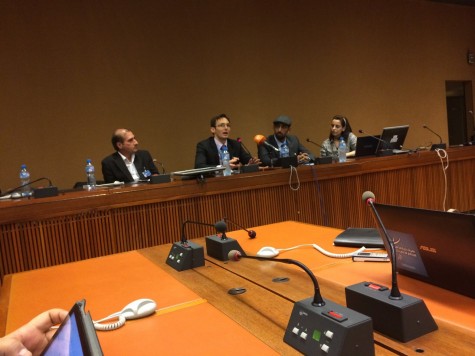
On 09 September 2014 the Gulf Centre for Human Rights (GCHR), Cairo Institute for Human Rights Studies (CIHRS), World Alliance for Citizen participation (CIVICUS), Saudi Civil and Political Rights Association (ACPRA), Women’s Driving Campaign and National Committee for Monitoring Violations (NCV) organised a side event at the 27th session of the Human Rights Council to launch a new report entitled ‘OHCHR, the Human Rights Council and the Gulf Countries: An Analysis of actions undertaken since 2011’ and also to talk about the Women’s Driving Campaign in Saudi Arabia in addition to the situation of human rights defenders in Kuwait.
Dr. Hala Aldosari, a women rights defender from Saudi Arabia reported on the progress of Saudi women driving campaign, reviewing the history of women advocacy to lift the ban since 1990 through 2011, and lastly on 2013. Participating women were arrested, interrogated, defamed, had their cars confiscated, and faced serious family conflicts due to the authority’s insistence on involving their guardians.
Nawaf Al-Hendal, an independent human rights defender from Kuwait talked about the ongoing attacks on human rights defenders in the country. He specifically mentioned the two cases of Abdulhakim Al-Fadhli and Mohammed Al-Ajmi. He also talked about the community of Bedoon (stateless) in Kuwait and described how the authorities continue to violate their basic rights.
Khalid Ibrahim, co-director of the GCHR, launched a new report entitled ‘OHCHR, the Human Rights Council and the Gulf Countries: An Analysis of actions undertaken since 2011’. He mentioned that the report analysed actions taken by the United Nations, in relation to Bahrain, Kuwait, Oman, Qatar, Saudi Arabia and the United Arab Emirates (UAE). He explained that overall it found that, while action was strong in relation to Bahrain, other Gulf countries particularly Oman, Qatar, and Kuwait, did not receive as much attention as warranted by the grave human rights situation. He also talked about the systematic targeting by the authorities in Saudi Arabia of ACPRA which was established on 12 October 2009 in response to the increased number of arrests following the second Gulf war. Most co-founders and members of ACRPA are in prison charged with inciting public dissent, breaking allegiance with the ruler or the Ministry of Interior, questioning the integrity of government’s officials, promoting protests, communicating with foreign organizations including the UN and international human rights organizations, defaming the country’s reputation, and joining an unlicensed civil society organization.
Jeremie Smith, director of the Geneva office of CIHRS, started by saying that human rights defender and co-director of GCHR Maryam Al-Khawaja who supposed to participate in the side event and talk about attacks on ACPRA and other human rights defenders in Saudi Arabia was arrested and detained upon her arrival to Bahrain International Airport in the early hours of 30 August 2014. He then rounded up the meeting and introduced the speakers and the topics. During the talks he said that “We must stand up against reprisals and intimidation of human rights defenders who are co-operating with the UN system” and added by saying “Remember all speakers as they may face reprisal for engaging with the UN mechanisms and we need to make sure that they will arrive home safe.”
The Report ‘OHCHR, the Human Rights Council and the Gulf Countries: An Analysis of actions undertaken since 2011’ is available HERE

-
Latest News
Defenders Affected