Introduction
The war in Yemen
The Houthi coup in Yemen and the ongoing conflict in the country represent one of the most glaring challenges facing Yemen in recent years. In September 2014, the armed Houthi group took control of the capital, Sana’a, and parts of Yemen. Since then, Yemen has been facing internal conflict with escalating violence and unrest. The Houthis in Yemen are an armed group that represents the de facto government in the capital, Sana’a, and is in a state of fierce war with the internationally recognized Yemeni government, which has its base in the city of Aden in southern Yemen. The difficulty of a political settlement in Yemen comes in part from religious, nationalist, and political tensions dating back to a long period of conflict and unrest, but also regional and international powers are at work to complicate and continue the conflict, making it difficult to reach a peaceful political solution.
The conflicts in Yemen are characterized by a significantly deteriorating humanitarian situation. The Yemeni people suffer from a severe shortage of food, water, and health care, and the country is witnessing a stifling humanitarian crisis. The ongoing war and conflict have displaced hundreds of thousands of people, destroying the infrastructure and basic services.[1]
The continuation of the war and its impact on human rights defenders
Human rights defenders in Yemen face great challenges carrying out their work due to harsh conditions and security risks. They are subjected to threats, arbitrary arrest, enforced disappearance, torture, and physical and verbal assaults. Restrictions on freedom of movement, freedom of peaceful assembly and freedom of expression, as well as travel bans, constrain their work and prevent their access to affected areas and victims. Their efforts to collect information, monitor and document violations, and write public reports are also obstructed.
On the other hand, due to the deterioration of the general humanitarian situation in Yemen, and the urgent need for humanitarian aid, human rights defenders play a vital role in monitoring and documenting violations and shedding light on the tragic conditions in the country. Their reports and the collection of victim testimonies contribute to increasing public awareness and international pressure to stop violations and achieve justice.
Despite the enormous challenges they face, human rights defenders in Yemen continue to work with courage and commitment to address human rights violations and defend the oppressed. Some local and international organizations support them and provide training and resources to enable them to do their work better, but civil society organizations in Yemen hope for effective cooperation with international mechanisms, especially UN mechanisms and international human rights organizations, in order to strengthen the human rights movement within the country.
Houthi violations against human rights defenders[2]
There are documentary reports that record Houthi violations against human rights defenders in Yemen. Below are some of the violations that have been documented:
1. Repression and arbitrary detention: Houthis carry out repression against human rights defenders and civil activists. They are arbitrarily arrested and detained in secret centers, and are subjected to torture and cruel treatment inside prisons.
2. Enforced disappearance: Houthis are known to practice forced disappearance of human rights defenders and activists. They are arrested and transferred to an unknown location, and their families are prevented from communicating with them or knowing their fate.
3. Targeting and threats: Houthis target human rights defenders and their families with threats and direct targeting. They are targeted through arbitrary arrests, physical attacks, and the destruction of their homes and property.
4. Restricting freedom of expression: Houthis restrict freedom of expression and freedom of the press in the areas they control. Journalists are repressed, anti-Houthi information is banned from getting published, and threats are constantly directed at journalists and their families.
5. Indiscriminate targeting of civilians: Houthis use indiscriminate attacks on civilians and civilian buildings as a means of political and military pressure. Hospitals, schools, markets and infrastructure are being targeted, resulting in massive civilian casualties.
The role of human rights defenders
The efforts of human rights defenders in Yemen require more international support and cooperation to achieve the desired successes and to reach positive change in the current situation. We have many examples of the successes of human rights defenders in Yemen. Despite the great challenges they face, they have been able to achieve some victories and change. Below are some examples:
1. Documenting violations: Human rights defenders in Yemen have made great efforts to document violations and monitor crimes against humanity that occurred during the current conflict. By documenting these violations and collecting evidence, the ICC and other international mechanisms have been provided with the information needed to prosecute perpetrators of serious human rights violations.
2. International campaigns: Human rights defenders in Yemen have succeeded in using international campaigns to raise awareness of the situation in Yemen and to put pressure on international bodies to intervene. Demonstrations, awareness campaigns and appeals to the international community were organized to help end the conflict and protect human rights.
3. Community work and awareness: Human rights defenders in Yemen work continuously to educate the local community about human rights and their importance. They organize workshops, discussions and lectures to educate people about their rights and their role in promoting justice and peace.
4. Training and education: Human rights defenders seek to enhance their capabilities and develop the necessary skills to deal with challenges. They receive training and education in human rights, monitoring, documentation and reporting, which enables them to do their work better and more effectively.
Challenges and risks facing human rights defenders
Human rights defenders in Yemen face many important and difficult challenges when it comes to carrying out their work. The most important of these challenges include:
1. Security and stability: The ongoing armed conflict in Yemen is causing a deterioration of security and stability, putting human rights defenders at risk, and hindering their ability to work freely and effectively.
2. Human rights violations: Yemen is witnessing widespread human rights violations by all warring parties, including attacks on civilians, enforced disappearance, torture, and forced displacement. These violations expose human rights defenders to danger, and obstruct their efforts to document and condemn these violations and their work to stop them.
3. Financial constraints: Human rights defenders in Yemen face major financial challenges, as the country suffers from a stifling economic crisis. Civil society organizations and human rights activists may be unable to obtain the necessary funding to implement their projects and finance their activities.
4. Legal and political restrictions: The various Yemeni de facto authorities may impose legal and political restrictions on the activity of human rights defenders and civil society organizations. Often freedom of expression, freedom of assembly and freedom of the press are restricted, hindering the effective work of human rights defenders.
5. Access to affected areas: Due to the ongoing conflict, it is often difficult for human rights defenders to gain full access to affected areas. Security, military and logistical restrictions may impede the arrival of humanitarian aid, and reduce opportunities for direct communication between human rights defenders and victims among the citizens, while their goal is collecting data accurately.
Recommendations and measures to improve the situation of human rights defenders
1. Securing funding: Adequate funding must be provided to support NGOs and institutions working in the human rights field in Yemen. Local, regional and international donors can play a crucial role in providing sustainable funding and resources to enable human rights defenders to continue their work.
2. Providing technical support and training: It is important to provide technical support and training to human rights defenders in Yemen. Training programs and workshops that enhance skills and knowledge in human rights, research methodologies, documentation, effective communication and networking with international mechanisms can be implemented.
3. Strengthening local and international partnerships: Partnerships and cooperation between human rights defenders, local and international organizations and local government must be strengthened. Fruitful partnerships can provide important financial, technical, political and legal support to strengthen the work and protection of human rights defenders.
4. Enhancing protection and safety: The necessary measures must be taken to ensure the protection of human rights defenders in Yemen from threats and attacks. This includes providing health insurance, personal protection and appropriate security measures to ensure their safety and that of their activities.
5. Achieving transitional justice, accountability, and ending impunity: Efforts to achieve transitional justice must be strengthened, including reparation and justice for victims, and establishing accountability and ending impunity, in order to hold all those responsible for human rights violations accountable. This can be achieved by strengthening the judicial system, and providing legal and technical support to human rights defenders to pursue cases, give testimony and collect evidence.
[1] https://www.undp.org/ UNDP website (Assessing the impact of the war in Yemen)
[2] https://jusoorpost.com/ Jusoor Post website (The Houthis commits 280 violations against human rights defenders),18 December 2022
https://yemen.un.org/ United Nations website (United Nations human rights report on Yemen), 29 March 2023
-
Related Publications
Latest Urgent Action
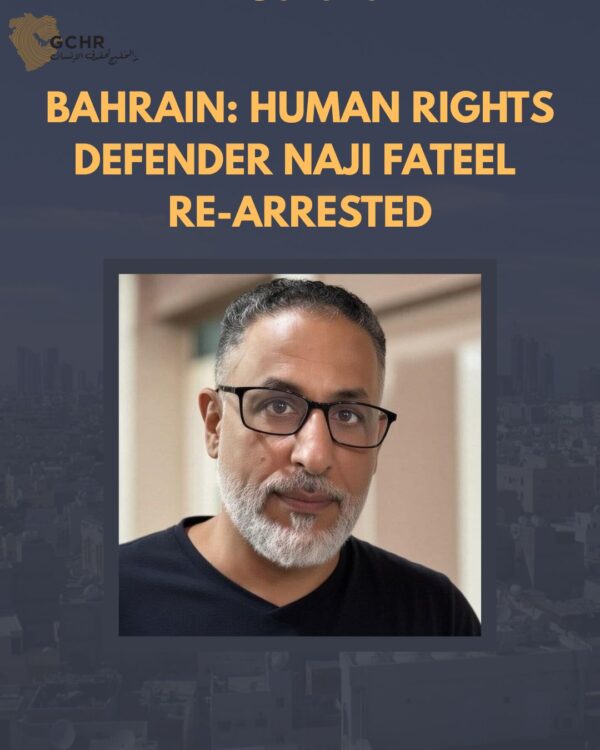 Bahrain
Human rights defender Naji Fateel re-arrested