Introduction
This report aims to evaluate the articles mentioned in the Iraqi Constitution related to citizens’ civil and human rights, and the extent of their effectiveness in protecting human rights in the country. This will be achieved through highlighting the gross human rights violations committed by the authorities and armed groups since the popular movement, which took place on 01 October 2019.
The Iraqi constitution and human rights
The Iraqi constitution consists of 144 articles divided into six sections: fundamental principles, rights and freedoms, federal powers, Powers of the Federal Government, Powers of the Regions and Final and Transitional Provisions.
The Section on Rights and Freedoms
This section includes 46 articles that deal with various civil and political rights of citizens, which are, in the order of their appearance in the Constitution; Equality before the law, The right to enjoy life, security and liberty, the equal opportunities, the right to personal privacy, the sanctity of the homes, the right to Iraqi citizenship, the independence of the judiciary, the right to participate in public affairs and to enjoy political rights, the prohibition of extraditing Iraqis to foreign entities and authorities, the right to work, the sanctity of private property and the right to own property anywhere in Iraq, the freedom of movement of Iraqi manpower, goods, and capital, the reform of the Iraqi economy, the encouragement of investment, protecting public assets, imposing taxes and fees, preserving the family and protecting motherhood, childhood, and old age, social and health security for citizens, the right to health care, care for the handicapped and those with special needs, the right to live in safe environmental conditions, the right to education, the state’s promotion of cultural activities and institutions, the practice of sports, the protection of liberty and dignity of man and the prohibition of all forms of torture, the state’s guarantee of public freedoms, the freedom to form and join associations, the freedom of communications and correspondence, the freedom of citizens in commitment to their personal status, the freedom of thought, the freedom to practice religious rites, the freedom of movement, travel and residence, and strengthening the role of civil society institutions and the advancement of Iraqi clans and tribes. The Iraqi constitution did not address digital rights in detail, but they can be considered as part of the personal rights included in the constitution, and this reduces their importance as basic rights like other rights. Below we will discuss some articles related to human rights and evaluate their repercussions on the Iraqi reality.
Articles related to rights and freedoms
Article (14)
(Iraqis are equal before the law without discrimination based on gender, race, ethnicity, nationality, origin, color, religion, sect, belief or opinion, or economic or social status.)
The text is clear and explicit when it comes to establishing the principle of equality among all citizens, yet it is always violated by the three authorities. In the Iraqi Parliament, some representatives who have political wings or protection from armed groups enjoy full protection, while other representatives who have no one to protect them are targeted.
In a report published by Adam Center for Defending Rights and Liberties entitled (The Right to Equality Before the Law) it is stated: “It always happens that equality before the judiciary is violated by the Iraqi courts in the details and particularities of cases, and it is violated by some judges who fall under the influence of political, financial, or religious parties.” The report also stated: “With regard to the executive authority, the principle of equality before the law is violated twice. First in terms of legislating regulations, decisions, ministerial decrees, and administrative directives and procedures, which are in violation of the principle of equality before the law, and these regulations, decisions, and directives are implemented without objection from anyone.”
Article (15)
(Every individual has the right to enjoy life, security and liberty. Deprivation or restriction of these rights is prohibited except in accordance with the law and based on a decision issued by a competent judicial authority.)
Another clear and unambiguous constitutional text: The right to life, security, and liberty are among the basic rights of citizens in Iraq, but they have never been implemented. Hundreds of civil society activists, journalists, bloggers, and peaceful protesters have been killed, as will be illustrated in the detailed examples below.
On the night of 28 October 2019, a riot police force stationed on the Al-Jumhuriya Bridge overlooking Al-Tahrir Square in central Baghdad directly targeted human rights activist Safaa Al-Saray, with a tear gas canister hitting him in the head. He was taken to hospital and, despite the medical attention he received, lost his life two hours later.
The same morning, he had posted on his Facebook page a video showing a blatant assault by some members of the security forces on the students of a Baghdad school who were holding a peaceful demonstration.
The 26-year-old activist, a poet and artist, participated in most of the protests in Baghdad since 2011 and was beaten and arrested several times. He graduated from the Department of Computer Science at Baghdad University of Technology and did not get a job until one week before his death.
On the evening of 24 December 2019, human rights defender Thaer Karim Al-Tayyib, one of the leading organisers of the protests in the city of Diwaniyah, died of wounds sustained in an explosion caused by an adhesive device on his car on 15 December. Fellow civil society activist Ali Al-Madani, visiting from the capital Baghdad, was slightly injured in the blast. Al-Tayyib was known for his kindness, generosity, sacrifices and campaigns to provide relief to the poor, orphans and those injured in recent demonstrations in his governorate. He was also a supporter of the current protests against rampant corruption. Thousands of citizens went out to the streets in his home town to participate in his funeral the following day. They declared that they will continue following Al-Tayyib’s peaceful path until they succeed in reaching their objectives for the formation of an independent government, an end to corruption, social justice and respect for public freedoms in addition to putting perpetrators of killings before the court of justice.
On 25 November 2019, 19-year-old university student and civil society activist Zahra Ali Al-Qarralucy was thrown in front of her house after she was severely tortured by an unknown group who kidnapped her for 8 to 10 hours. She was electrocuted and stabbed with a knife, and had fractures in her jaw and skull, leading to her death in the hospital the next day. Al-Qarralucy, along with her father Ali Salman, a peaceful demonstrator, distributed food and drink to protesters in Tahrir Square, in the capital Baghdad, and this would appear to be the only motive for her murder.
On 10 January 2020, in Basra, Iraq, unidentified gunmen on a motorbike shot at journalist Ahmed Abdul Samad, a correspondent of the Dijlah satellite TV channel, killing him immediately with a fatal shot to the head. His colleague, photojournalist Safaa Ghali, was transferred to Basra General Hospital after being shot three times in the chest, and died as a result of severe injuries.
The two men were driving their car around 6pm when the attack occurred, near the Assyrian Club in Basra. They had just ended their coverage of the massive demonstrations that took place in Basra, including the sit-in that occurred in front of the Police Headquarters building after the arrest of a number of individuals. The detainees were soon released after the building was surrounded by their fellow protesters.
Samad, 39 years old, is a courageous journalist who worked with several television channels, and has made every effort to convey the voice of demonstrators in Basra. He also used his Facebook page to addressed his fellow citizens, saying, “I will use it to communicate with you to pass on your suffering and concerns. Interact with the page as it will be a challenge to politicians and help to citizens.”
Hours before his assassination, the journalist published a video clip in which he criticised the crackdown on protesters and also said, “Our cause is the cause of our homeland.” Prior to his killing, Samad received many threats from militants due to his work as a journalist.
On the evening of 10 March 2020, an unidentified armed group assassinated human rights defender Abdulqudus Qasim, a theatre/television producer and actor, and his colleague, Karar Adel, a human rights lawyer who worked at the Maysan Federal Appeal Court. The masked gunmen stopped the car in which they were traveling in the middle of Al-Amara city and instructed them to get out, then shot and killed them immediately.
Qasim, dedicated his Facebook page to show his unlimited support for the popular movement and he had told his colleagues that he expected to be killed by the outlaw militias. In an interview before his assassination he said, “I am 37 years old, from the city of Al-Amara. I entered the world of theater after the Iraqi regime change in 2003. I am striving for change and fighting unawareness and superstition, and this is what I have worked on in many theatrical works.”
Likewise, Adel dedicated his Facebook page to support popular protests. They have been advocates of non-violence, and have participated in protests since they began.
The Iraqi human rights movement was devastated to learn of the murder of prominent human rights defender Dr. Riham Yaqoub who was assassinated on the evening of 19 August 2020, by unidentified gunmen who fired rounds of bullets at her. She was driving her car near the intersection of the commercial street in the centre of Basra, accompanied by her sister and friend, who were slightly injured from the shattered glass of the car windows.
On 27 December 2017, she wrote on her Instagram account, “God created us as a separate being, so it is shameful to be a follower.”
The targeted killing came on the heels of a massive online hate campaign against Dr. Yaqoub, aimed at distorting her legitimate and peaceful human rights work. She informed her colleagues that she had received a lot of threats from anonymous sources since 2018.
Dr. Yaqoub is a graduate of the College of Education and Sports Sciences at the University of Basra in 2013 and a PhD student in the same college since 2019, holding a master’s degree in sports training in 2016. She is also a lecturer at Basra University, a fitness expert, a researcher in dietetics, and has a degree in sports medicine from the Academy Science and scientific research in London in 2016. She started working as a fitness trainer since 2016. Likewise, she worked in the media in 2015 with Basra Time Square Radio and then Al-Rasheed FM.
The whole of Iraq was distressed after the news spread of the assassination of popular poet Jaseb Hattab Al-Heliji, father of kidnapped human rights lawyer Ali Al-Heliji. Ali Al-Heliji was kidnapped on 07 October 2019 in the city of Amara, the capital of Maysan Governorate. On 10 March 2021, Jaseb Al-Heliji was shot and killed in the exhibition area of Al-Amara, in a targeted assassination.
On 30 June 2022, civil society activist Jamil Suleiman Ailo Al-Zarro (40 years old) was killed by unidentified gunmen in Sinjar district. Colleagues of Suleiman said during their communication with GCHR that, “Suleiman was subjected to previous threats by armed men of the necessity of abandoning his activities and defending civilians and demanding them to remove the influence of armed groups from the judiciary.” They added, “As he refused to comply with their threats, they killed him. He felt very endangered by these threats, but he insisted not to submit to them.”
His body was found in the afternoon of the same day in an unfinished house located in Dhola complex, which is 17 kilometers from his house in Sinuni sub-district of Sinjar district.
According to his Facebook page, he was a member of Gilan Organisation, a civil society organisation established in 2019, specialised in care and rehabilitation. He was also an official of the Foreign Relations Committee of the Yazidi House Foundation, a religious and social institution that provides assistance to the needy and war victims, in addition to being a member of the independent Sinjar Youth Gathering, and he and his comrades called for the removal of all armed forces from the Sinjar district.
On 07 December 2023, the founder of the Al-Da’i Party, Fadel Al-Marsoumi, was assassinated by unknown gunmen on a motorcycle, who opened fire on the civilian car in which he was riding. He died immediately, and the gunmen fled to an unknown destination.
Al-Da’i party, which he leads, participated in the provincial council election that took place on 18 December 2023, and its campaign slogan was, “Patriots demand reform”.
Article (19)
(First: The judiciary is independent and no power is above the judiciary except the law.)
Despite the clear constitutional provision for the independence of the judiciary, political pressure from various parties with great influence, both inside and outside the government, has led to a lack of accountability in the killings of civil society activists, journalists, and peaceful demonstrators, as is clearly shown by the stalling which accompanied the judiciary’s handling of the case of journalist and security expert Dr Hisham Al-Hashemi who was assassinated in broad daylight in the capital, Baghdad.
On 31 July 2023, the Federal Court of Cassation issued its verdict, which it published on its Facebook page, annulling the death sentence issued by the Central Criminal Court against the individual convicted of killing Dr. Al-Hashemi. The Federal Court returned the case file to the Central Investigation Court to implement the necessary legal procedures again.
The court attributed the reason for its decision to the fact that the committee that investigated the case, the Committee of order No. 29, which former Prime Minister Mustafa Al-Kadhimi ordered to be created to investigate major corruption files – and was dissolved by a decision of the Federal Court in 2022, “does not have any authority to investigate the crime,” according to the text of the court’s decision.
On 10 July 2023, Al-Hashemi’s family issued a statement announcing their shock at the decision to overturn the verdict after the frank confessions of the man convicted of the murder, and asked, “Does changing the government mean changing justice?”
This case is a blatant example of the targeting of human rights defenders and journalists, and the failure of the judiciary to hold fair trials for the perpetrators responsible for these murders and the armed groups behind them.
On 06 July 2020, during the daytime, a member of an armed group riding two motorcycles and in a civilian car assassinated Dr. Al-Hashemi, in front of his house in the Zayouna area, in the centre of Baghdad.
On 16 July 2021, the Iraqi government announced the arrest of Dr. Al-Hashemi’s killer and put him on trial in a criminal case without investigating further the militant groups that are likely behind the killing.
On 07 May 2023, the Supreme Judicial Council announced in a statement that a death sentence had been issued against the murderer of Al-Hashemi by the Al-Rusafa Criminal Court, in accordance with Articles Two and Four of the Anti-Terrorism Law No. 13 of 2005. His trial hearings were postponed ten times due to his absence.
Article (33)
(First: Every individual has the right to live in safe environmental conditions.
Second: The State shall undertake the protection and preservation of the environment and its biological diversity.)
The environment in most Iraqi cities is far from a healthy and sound environment, which is a constitutional right for every Iraqi citizen.
On 26 October 2023, the Gulf Centre for Human Rights (GCHR) published information about a Position Paper by a number of Iraqi human rights groups on “Climate Change and Environmental Activity in Iraq for the Climate Prospects Campaign”, following consultations with policy-makers, community leaders, and environmental experts in September and October 2023. The Position Paper makes recommendations to the authorities to protect the rights of environmental activists and peaceful protesters to publicize and campaign against the issue of climate-induced forced displacement, while encouraging Iraqi authorities to support the rights to freedom of expression and assembly. The report follows a widespread social media campaign to raise public awareness of the issues.
The Position Paper was prepared by the campaign partners – Continuous Women’s Capacity Development Organization, the Iraqi Women’s Network and Al-Tawahhuj organization for development and human rights – as a subgrant which was a part of a project with the Innovation for Change MENA Hub in partnership with GCHR.
The Position Paper notes that, “The impacts of climate change in Iraq have become evident across various levels and sectors, casting shadows on the environment and public life. These effects have worsened due to the country’s unstable conditions and deteriorating infrastructure.”
It continues, “Iraq urgently needs to develop and implement an adaptation plan addressing the impacts of climate change on vital sectors. In response to these challenges, environmental activists, civil society organizations, and volunteer teams have been working to adapt and mitigate the profound effects on various aspects of public life. Simultaneously, environmental initiatives and activists in Iraq face numerous challenges hindering their efforts to achieve sustainable climate outcomes.”
Iraq’s environmental crisis has led to nation-wide protests, including 2018 protests in Basra against water shortages and, more recently, 2023 protests in Dhi Qar against unwarranted violence and excessive use of force against those raising awareness of droughts and mismanagement that has contributed to water scarcity in the region.
You can find out more by checking out an interactive map for documenting and closely monitoring instances of forced displacement triggered by climate change. The platform will enable comprehensive analysis and visualization of the issue, fostering greater awareness among the public and policymakers and shed light on the human rights violations that result from climate change issues in Iraq.
You can also download the full Position Paper here.
Article (37)
(First
A – The liberty and dignity of man shall be protected.
B – No person may be kept in custody or investigated except according to a judicial decision.
C – All forms of psychological and physical torture and inhumane treatment are prohibited. Any confession made under force, threat, or torture shall not be relied on, and the victim shall have the right to seek compensation for material and moral damages incurred in accordance with the law.)
This clear and explicit constitutional text protecting the freedom of citizens and preserving their dignity, and prohibiting arrest except by judicial order, is not implemented on the ground in many cases, as citizens suffer from security forces and unknown powerful armed entities carrying out arbitrary arrests and detentions without a judicial order. The calls and reports of the Gulf Center for Human Rights are rich with dozens of examples, which can be read by clicking on the following link:
https://www.gc4hr.org/category/news
Torture is common practice in official detention facilities that belong to the government, and in secret detention facilities that belong to armed groups as well.
On 12 February 2021, at half past seven in the evening, four masked gunmen traveling in a pick-up truck with no registration number kidnapped civil society activist Ali Naseer Allawy, 25, from the Amir neighborhood in the city of Najaf. They threw him on the floor of the vehicle and covered his eyes. Although the car was passing in the opposite direction on Nationality Street where the security forces are present, no one dared to stop the vehicle. The gunmen took him to an office, where they began subjecting him to various forms of torture, kicking him with their feet, beating him with their hands and rifle butts, and shocking him after tying his chest and feet with electric wires, while asking him a torrent of questions about protesters participating in the popular movement in Najaf Governorate. They also used an acid chemical to remove the “25 October” tattoo from his shoulder, and they did not leave him until after he fainted. When he regained consciousness, he managed to escape from his captors at around 5am in the morning and went to his house. From there, he went with some members of his family to a private hospital to receive the necessary treatment.
On 5 October 2022, GCHR launched “Patterns of Torture in Iraq” which focuses on the main patterns of torture in Iraq since the beginning of the widespread peaceful demonstrations that erupted across the country on 01 October 2019. The report also addresses a list of practical and urgent recommendations to the Government of Iraq in order to end the cycle of impunity currently enjoyed by perpetrators of torture.
This report by GCHR adds to and builds upon the recent spotlight that has been cast by UN reporting mechanisms on grave human rights abuses in Iraq. In the first half of 2022, Iraq came under the scrutiny of the UN Committee Against Torture and the UN Human Rights Committee which concluded that torture remains a widespread and systematic practice in Iraq that takes place against a backdrop of socio-political turmoil characterised by the oppression of human rights defenders, members of wider civil society and minority groups by state and non-state actors.
Article (38)
(The State shall guarantee in a way that does not violate public order and morality:
First: Freedom of expression using all means.
Second: Freedom of press, printing, advertisement, media and publication.
Third: Freedom of assembly and peaceful demonstration, and this shall be regulated by law.)
Governmental agencies and armed groups impose severe restrictions on freedom of expression online and offline, as well as on freedom of peaceful demonstration, despite the express constitutional stipulation in Article 38 above to respect these rights. In previous years, the major political parties sought and are still seeking to legislate three repressive laws: the draft law on freedom of expression and peaceful demonstration, the draft law on the right to access information, and the draft cybercrimes law. Civil society organizations in Iraq, in cooperation with international organizations and mechanisms, have succeeded in preventing the enactment of these laws so far. Below are two examples of widespread violations affecting citizens’ public freedoms. Other examples can be found here:
https://www.gc4hr.org/category/news
On 01 October 2023, security forces dispersed a demonstration in Al-Tahrir Square in Baghdad, in which hundreds of human rights defenders and other activists participated, to commemorate the fourth anniversary of the start of the October Popular Movement on the same day in 2019 throughout the central and southern governorates of the country.
During the demonstration, the protesters raised the same slogans as they did during the popular movement, demanding comprehensive reform, eliminating rampant corruption, and stopping policies of suppressing public freedoms. They raised pictures of protesters who gave their lives for a homeland that provides all citizens with a future in which social justice prevails and their civil and human rights are respected.
On 12 September 2023, Najaf Guide newspaper denounced on its Facebook page the threats directed at its editorial board member, journalist Ahmed Al-Silawi, by a person associated with one of the political parties operating in Najaf Governorate. In its post, it also called on security services to address the complaint submitted to them by Al-Silawi in relation to these threats.
Recommendations
The Iraqi government must implement all the constitutional texts mentioned in the section on rights and freedoms, and legislate the required laws that must be in line with the essence of the articles of the constitution and do not contradict it. The Iraqi government must keep in mind the protection of the civil and human rights of all citizens, without any exception. In order to build a prosperous future for Iraqis, public freedoms must be respected. There is no creativity without respect for human rights.
-
Related Publications
Latest Urgent Action
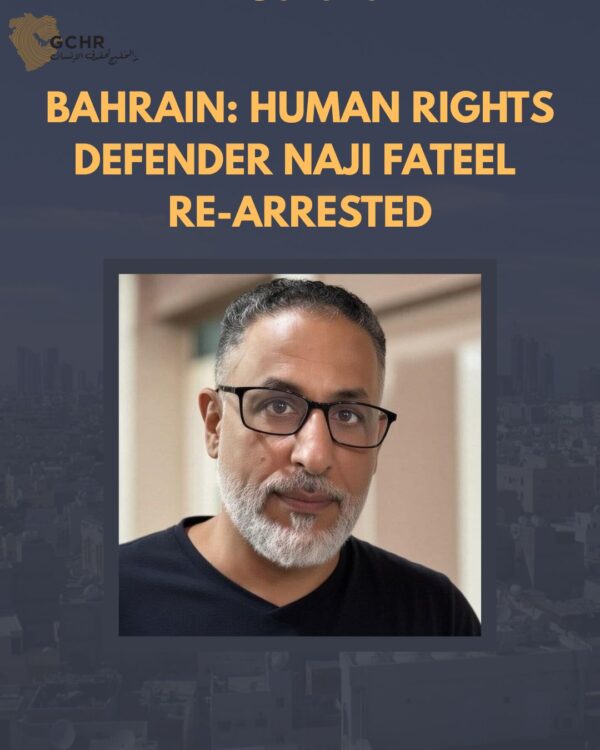 Bahrain
Human rights defender Naji Fateel re-arrested
Defenders Affected