The Gulf Centre for Human Rights (GCHR) carried out advocacy on behalf of human rights defenders (HRDs) at the 63rd session of the United Nations Human Rights Council (UNHRC) in Geneva, held from 07 September to 07 October 2026.
The various activities aimed to secure support from UN member states for the release of detained human rights defenders and strengthen the protection of public freedoms across the Middle East and North Africa (MENA). They also highlighted the need to end impunity and ensure accountability for human rights violations across the region.
Resolutions
GCHR followed the Arab Group’s resolution on Yemen, which focused on technical assistance and capacity-building under Item 10. This raised concerns as, following the non-renewal of the Group of Eminent Experts’ mandate in 2021, the resolution did not provide for a report by the High Commissioner on the human rights situation in Yemen or a dedicated interactive dialogue. Ultimately adopted without a vote, it requested that the High Commissioner report to the Council’s 66th session on the implementation of technical assistance.
GCHR also followed discussions on the resolution on the human rights of migrants, presented by Mexico under Item 3. GCHR sought to include language addressing abuses linked to migrant workers’ dependence on employers, with particular attention to migrant women, especially domestic workers. Language on women migrant domestic workers was added. Ultimately adopted without a vote, the resolution requested an OHCHR study and an intersessional panel discussion on human rights violations affecting migrants.
Side Events
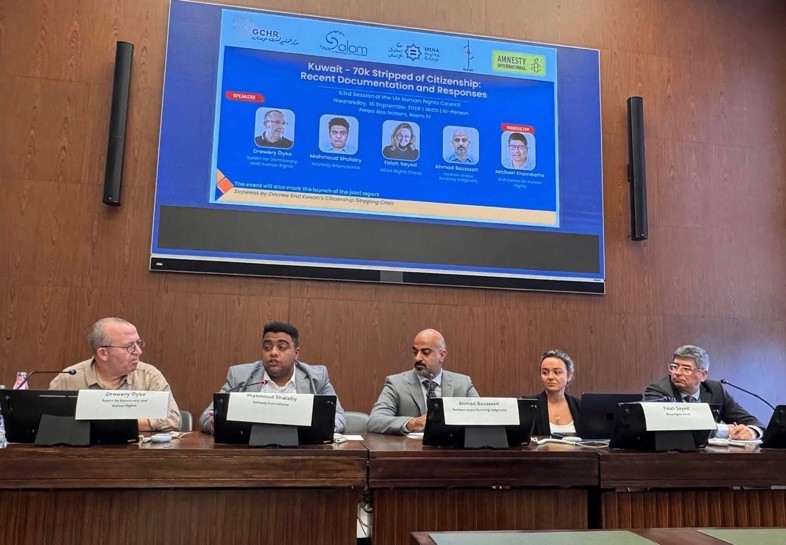
On 16 September 2026, GCHR, in co-operation with SALAM for Democracy and Human Rights, MENA Rights Group, Northern Arabia Surviving Indigeneity (NASI) and Amnesty International, organised a side event focused on Kuwait and entitled, “Kuwait – 70k Stripped of Citizenship: Recent Documentation and Responses”.
The event, which was moderated by Michael Khambatta, Geneva Representative for GCHR, included speakers Drewery Dyke of SALAM for Democracy and Human Rights; Mahmoud Shalaby of Amnesty International; Falah Sayed of MENA Rights Group; and Ahmad Benswait of NASI. The event marked the launch of the joint report, “Stateless by Decree: End Kuwait’s Citizenship Stripping Crisis”. Khambatta also referred to GCHR’s separate report on Kuwait’s revised nationality legislation, published that day.
The moderator and speakers discussed Kuwait’s large-scale citizenship revocations since 2024, which had affected at least 70,000 people directly, with further consequences for family members. They highlighted the resulting statelessness and risk of statelessness for others, loss of employment and pensions, and restrictions on access to public education and subsidised housing.
They also raised concerns over changes to nationality legislation, including the retroactive effects of citizenship revocation decisions and the absence of a right to appeal them. The discussion addressed the longstanding statelessness of the Bidoon community, alongside wider concerns over restrictions on freedom of expression, counterterrorism legislation and state-security prosecutions.
The discussion included calls for an end to arbitrary citizenship revocations and greater international action to address statelessness, including the situation of the Bidoon community. The joint report called on Kuwait to suspend further revocations, restore nationality to those deprived of it without due process, and bring its nationality legislation into line with international human rights standards.
GCHR also co-organised a side event entitled, “Yemen: Economic Harm, Civilian Suffering, and Pathways for Redress”, with the Yemeni Archive (Mnemonic), the Cairo Institute for Human Rights Studies (CIHRS) and the Yemeni Network for Victims Associations (YNV). The event, moderated by Michael Khambatta, Geneva Representative for GCHR, focused on the economic harm suffered by civilians in Yemen, including lost livelihoods, unpaid salaries, unlawful levies, damaged infrastructure and restrictions on humanitarian aid, as well as the need for victim-centered accountability, reparations and long-term redress.
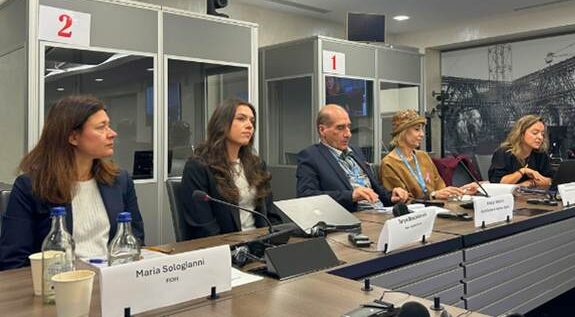
GCHR co-sponsored a side event on the human rights situation in Bahrain, organised by the Bahrain Center for Human Rights (BCHR). Khalid Ibrahim, GCHR’s Executive Director, highlighted the continued imprisonment of human rights defenders Abdulhadi Al-Khawaja and Dr. Abduljalil Al-Singace, as well as concerns over torture, enforced disappearance and impunity in Bahrain. He also discussed similar patterns of repression across the Gulf region, including travel bans, restrictions on access to public-sector employment and freedom of expression, and surveillance, stressing the importance of engagement with UN human rights mechanisms.
Statements at the HRC
On 22 September 2026, GCHR delivered a statement in cooperation with ALQST for Human Rights during the Item 4 general debate. The statement highlighted reports of human rights violations as territorial control shifted in Yemen, alongside abuses by all parties to the conflict since 2014. GCHR criticised the Council’s response following the non-renewal of the Group of Eminent Experts’ mandate in 2021, noting that the existing Item 10 resolution barely implied a need for accountability and did not call for an interactive dialogue, and urged stronger action. The statement also raised concerns over Saudi Arabia’s execution crisis, citing at least 860 executions since the beginning of 2024, more than half for non-lethal drug-related offences, with foreign nationals disproportionately affected. It cited testimonies of abuses during arrest, detention and trial, including a lack of access to consular support, legal representation and adequate interpretation of court documents.
On 24 September 2026, GCHR delivered a statement in cooperation with ALQST for Human Rights during the interactive dialogue on the Secretary-General’s report on cooperation with the United Nations. The statement welcomed the report’s follow-up on ongoing cases of reprisals in Bahrain, Yemen and Saudi Arabia, as well as new and ongoing reprisals against Mwatana for Human Rights in Yemen. GCHR also expressed surprise over the omission of the cases of Dr. Mohammed Al-Mansoori and Ahmed Mansoor in the United Arab Emirates, despite updated information being submitted, and hoped they would be included in future reports. The statement highlighted the absence of newly reported cases of reprisals in most Gulf states, alongside the closure of civic space, limited engagement with the UN and transnational repression against defenders in exile. GCHR asked that consideration be given to highlighting countries where no resident civil society members had engaged with UN bodies during the reporting period, arguing that this strongly indicated closed civic space.

-
Latest News
Defenders Affected