Highlights of the Report
- Kuwait revised its 1959 Nationality Law on 2024 -2026. As of September 2026, the Nationality Law became more restricted and enacted through Decree-Laws 116/2024, 52/2026, and 79-2026.
- This campaign of stripping Nationality from naturalised Kuwaiti citizens and some Kuwaiti citizens by origin has been conducted when the Parliament was dissolved and revisions of the Constitutions have been in process.
- New restrictions in the revised Law include definition of Kuwaitis by origin, citizenship through marriage, citizenship through naturalisation.
- One alarming feature is the much broader grounds for withdrawal or loss of citizenship. It gives the executive government the right to withdraw citizenship for what they consider harmful act or national security concern. These have already affected many activists or opposition figures including former Members of Parliament.
- People started learning of their nationality being stripped through weekly newspaper lists of names, without any path to legally challenge the decision.
- To date, there are an estimated 70,000 Kuwaitis who have lost their nationality; adding to an existing stateless Bedoon population of over 90,000. The cumulative estimate of those who have recently lost their nationality, along with their dependents, is around 250,000- 300,000 people. This estimate represents almost a quarter of the Kuwaiti population, mostly women and children.
- Individuals who were affected are given a 3 to 4-month period to “prove seriousness” in adjusting their nationality. The procedure involves affected individuals handing over their identification documents (IDs) to a special committee and signing a voluntary waiver of their former Kuwaiti personality. They are then given a temporary stateless identification document and are expected to restore their original non-Kuwaiti nationality or obtain a new nationality within one year time to seek residency in Kuwait. This latter condition is practically impossible for naturalised Kuwaitis through their parents or grandparents. Additionally, obtaining another nationality in one year’s time is virtually impossible for most people.
- Once the decision of stripping nationality is announced, a person and their dependents become stateless. That means their access to banking services, education, healthcare, governmental social support, jobs, pensions, or communication services, are suspended without a valid ID.
- Those affected by decisions to withdraw citizenship faced extreme difficulties in obtaining government IDs, exercising their property rights, as well as obtaining healthcare, education, and support for people with disabilities.
- Some groups, such as the foreign wives of Kuwaiti citizens were given few exceptions to continue their jobs or businesses and to be treated similarly to Kuwaiti, but the full information is not available yet.
- The revised law is in breach of International Humanitarian Law (IHL) in many aspects. While IHL recognises the state’s sovereignty in nationality decisions, it must be in consideration of the public interest:
- Ensuring no arbitrary deprivation of nationality.
- Responsibility of misconduct in acquiring the nationality is personal; meaning dependents and relatives who acquired the nationality later should not be affected.
- Avoidance of statelessness; meaning each state has the obligation to prevent people from being stateless.
- The child’s best interest should be observed by ensuring each child has a nationality and all the rights related to it.
Conclusion
The Gulf Centre for Human Rights (GCHR), therefore, concludes that the campaign of stripping nationality from thousands of Kuwaiti men, women and children, did not observe or respect the above-mentioned criteria of IHL.
Introduction
The Gulf Centre for Human Rights (GCHR) has been receiving regular emails and requests for help from many Kuwaiti citizens whose nationality has been withdrawn or revoked. Kuwait has one of the most restrictive nationality laws, Law No. of Nationality of 1959, with tiers of classes of citizenship based on whether ancestors of a person settled in Kuwait prior to 1920 or later. Revisions of the Nationality Law has taken place in the past, but not with the catastrophic outcomes of the recent revisions in 2024-2026.
GCHR has published recently a thorough analysis on the amendments to the Kuwaiti Nationality Law of 1959, and the serious implications of the Kuwaiti authorities’ campaign to revoke and strip nationalities from citizens and their dependents. In the report, an overview of this tier-system of citizenship has been outlined and analysed.
Since 2024, and under the current Emir, Sheikh Mishal Al-Ahmad Al-Sabah, Kuwaiti authorities started extreme political measures, including the dissolution of the Kuwaiti Parliament “National Assembly”, revisions to some constitutional articles, and a campaign to strip nationality retrospectively from citizens for various claims such as fraud, duality of citizenship, unlawful procedures of naturalisation, or perceived threats to the national interests of the country. The active campaign left thousands of Kuwaiti citizens stateless in a process that lacked judicial oversight and in the absence of public representation.
In addition, many human rights defenders who came forward to object to the unlawful and unconstitutional nature of such processes were targeted by the authorities. An estimated figure of 70,000 naturalised Kuwaitis’ citizenships has been since withdrawn. If the number of their dependents and descendants is added, then the number easily reaches hundreds of thousands of people who were rendered stateless.
The last revision of the Nationality Law grants full authority to the Emir and the executive power without oversight by the legislative or judicial powers over decisions which affect the lives of thousands of Kuwaiti citizens. The Kuwaiti government claimed that the withdrawal of nationality is aimed to remove the “impurities” in Kuwaiti society and restore the citizenship rights of the “original” Kuwaitis. In practice, nationality was withdrawn from thousands of Kuwaitis who legitimately gained the nationality through decrees of previous governments, based on articles of the Nationality Law of 1959.
Those included Kuwaitis who were naturalised as foreign wives of Kuwaiti citizens, people who honourably served Kuwait, and descendants and dependents of naturalised Kuwaiti citizens. Also documented are cases of people whose nationality, and that of their dependents and descendants, were withdrawn for their dissent.
The latter category was stripped of their nationality based on the authorities’ claim of “national interests”, rather than the violation of the law. The affected individuals are Kuwaitis by origin, and whose acts were simple online criticism or protests outside of Kuwait. Moreover, the revised Article 11 grants the government the right to withdraw the nationality from Kuwaitis who reside continuously and for more than two years outside of Kuwait.
The majority of those affected by this amendment are women and children, who now have no clear path to citizenship or belonging. The problem is compounded by the fact that Kuwait has one of the largest stateless populations in the world, who have advocated for decades for a path to naturalisation to no avail. This report will mainly focus on the recent amendments of the Kuwaiti Nationality Law and the implications on Kuwaiti peoples’ livelihood and rights.
Background on the Kuwaiti Nationality Law
Kuwaiti Nationality Law has gone through several revisions through several stages of state foundation. Before the oil discovery and before 1940s, Kuwait was a relatively small society enclaved between the Arab Gulf states and Iraq. Borders at the time were less defined and people used to move between different regions and locations freely with no official documentations. In 1959, the first Nationality Law was established and defined who is considered a Kuwaiti by origin and who can be naturalised as one. The Law granted citizenship to those who were residing in Kuwait before 1920 and continued to reside in it. The Law also granted Kuwaiti citizenship to other people who fulfilled certain conditions.
The year 1959 marked the establishment of the Nationality Law and the census of the people of Kuwait, both as citizens and non-citizens. Another census, conducted in1957, many years before the actual law, has also been significant for many. Both censuses were used later as indicators of the presence of people before the state has established the nationality rights. When the Law was later founded, many people registered for Kuwaiti Nationality while others did not. Reasons for that varied; some families lived a tribal life of constant mobility, others served in the police or military and did not realise the significance of registration at the time, and others held other nationalities and did not need to register. Hence, a community of Bedoon or stateless people existed since then.
Debate continues to rise in Kuwait as to which of those two censuses can be used as evidence of residence in Kuwait prior to the foundation of the law. However, historical residency in Kuwait alone, through census, was not enough to establish nationality. Rather, granting nationality was also subjected to conditions of the law and the discretion of the authorities. In the 1970s and 1980s, many stateless people worked in the military, the national guards, the police, and in various state agencies without nationality and were granted certain basic rights to education, healthcare, and public services despite not being registered as citizens.
The Gulf War of 1990-1991 created a major pivotal point in the situation of the stateless population. For political and security reasons, the state restricted the rights of the stateless population and claimed that many of them had hidden their original nationalities. The Nationality Law of 1959 established certain cases of who is considered an original Kuwaiti (those who resided in Kuwait before 1920 and remained there), and a naturalised Kuwaiti (who acquired the nationality through residency, marriage to Kuwaitis, or providing honourable services to Kuwait).
In 2010, the Central Apparatus for Illegal Residents’ Affairs (CARIRS) was established. It was tasked with studying the files of stateless individuals, validating their documents and potential nationalities, regulating their access to certain services, and submitting recommendations to authorities about various cases. However, numerous reports published by human rights organisations, including GCHR, have confirmed the CARIRS’s abject failure to achieve its goals or provide any real support to members of Bedoon society in the country.
Highlights of the Main Revisions of the Nationality Law
Kuwaiti authorities announced in 2024-2025 the abolition of the legal basis of granting citizenship to Kuwaitis who were part of the 1965 census. In practice, that means that individuals whose predecessors were documented as residents of Kuwait in 1965 no longer have the legal rights to nationality. This significantly complicated the legal status of descendants who remained stateless in Kuwait for generations.
The major highlights of nationality revisions included restrictions on granting nationality in general. There are now expanding withdrawals or revocations of nationality from those whose applications involved fraud or submissions of incorrect information. There is also an abolition of pathways to naturalisation for certain conditions such as the inclusion in the 1965 census, and retrospective revisions of large numbers of individuals who were naturalised.
In 2026, a new decree was issued to revise several articles of 1965 Nationality Law:
- A stricter definition of who is a Kuwaiti by origin: A Kuwaiti by origin is someone who inhabited Kuwait in 1920 and remained until December 1965.
- Citizenship by marriage has been substantially restricted: A change from previous law that allowed foreign wives of Kuwaiti men to apply for nationality under certain conditions. The 2024 amendment ended this route and made marriage itself insufficient to grant nationality. Divorced or widowed Kuwaiti women who were married to foreign husbands have been able in certain cases to pass their nationality to their children who remained with them in Kuwait. However, this has changed as well affecting generations of Kuwaitis who acquired their nationality through their mothers and grandmothers.
- Greater restrictions on naturalisation: There is now a clear distinction between Kuwaitis by origin or those who were naturalised. The new amendments impose additional conditions against dual nationality, documentation, and the status of children of naturalised citizens. Naturalised citizens are now not eligible to hold any supervisory or leadership positions, run for office, or vote for candidates, or be appointed in parliamentary positions, unlike Kuwaitis by origin. Additionally, naturalised citizens are required to renounce their former nationality within three months of acquiring the Kuwaiti nationality.
- Much broader grounds for withdrawal or loss of citizenship: The amendments allow the executive government to withdraw nationality on several broadly defined grounds. These include certain criminal convictions, conduct considered harmful to national security, acting in the interests of a hostile state. The revised amendments allow for nationality consequences to extend to children or descendants of those affected.
- Nationality decisions are shielded from judicial review: The most concerning part is the treatment of nationality decisions as a sovereign act without judicial oversight.
- Affected individuals must show what the state describes as a “proof of seriousness”: This procedure includes individuals returning their identification documents as Kuwaitis to CARIRS. It also includes individuals signing a waiver to voluntarily relinquish their Kuwaiti nationality within a 3-4-month period from the date of withdrawal. Individuals will then be granted one year to restore their original nationalities or obtain another one. Once they do that, they are allowed to get a ten-year residency in Kuwait and seek jobs as foreigners with their families under certain conditions.
Kuwaiti authorities claim that the amendments are intended to protect the national identity and ensure proper adherence to national laws. In essence, authorities claim that revocation affects related mainly to those who acquired their nationality by fraud, had dual nationalities, acquired nationality for honourable deeds to Kuwait, or harmed the national interests of the state.
Authorities claimed that there were privileges granted to those affected with the withdrawals or revocations, such as a timeline to seek original nationalities, certain basic rights to education, healthcare, jobs, or access to financial resources. However, many of those affected claim that the timeline is ineffective, as many had to renounce their original nationality as a condition to apply for a Kuwaiti one. Others confirm in their testimonies, suspension of their financial resources, unequal access to jobs, or reduction to their work status, suspension of their healthcare, or social services which took effect immediately after the withdrawal.
Main Implications on Human Rights
The majority of those affected with the revocation and withdrawals of nationality were women and children, particularly the foreign wives of Kuwaiti nationals who were granted nationalities since the 1980s according to decrees by the state. A UN expert, the Special Rapporteur on violence against women and children Reem Al-Salem, expressed serious concern over the continued large-scale withdrawal or revocation of Kuwaiti nationality that was initiated in March 2025.
Al-Salem stated, “To date, over 70,000 individuals have already been affected by the new measures, including non-Kuwaiti women who have been naturalised through marriage.” She was particularly alarmed that the policy continued even during her September 2025 visit. She also stressed the fact that the loss of the Kuwaiti nationality for many women and children affected every aspect of their lives, such as subsidised housing, pensions, social insurance, banking services except withdrawal of funds, equal education and the same healthcare access as other Kuwaitis. Financially-dependent women and children are at greater risk for violence and marginalisation, as well as legal and financial security, and integration into society. She also stressed.
GCHR received a leaked document from the Council of Ministers (110002864), dated 22-06-2026. The document is directed to the Minister of Defense, Sheikh Abdullah Al-Sabah, about the privileges and benefits for those whose nationality was withdrawn. It details the initial approval for a proposal by CARIRS to grant certain benefits for those who have lost their nationality which was acquired through their Kuwaiti mothers, marriage of foreign wives to Kuwaiti men, serving Kuwait honourably, or being residents during the 1965 census. These benefits are tied to fulfilling the condition of proving “seriousness in adjusting their nationality”.
Adjusting a nationality is a process which entails offering proof of obtaining documentations from their former embassy/country within four months of the nationality withdrawal. They are also given a four-month period to use their Kuwaiti passports to travel to other countries to adjust their nationality situation. The benefits then will be provided for a period of one year. The Minister of Interior has the right to extend the period of four months according to Article (4/13) of the Nationality Law if needed.
The benefits which are granted for those who provided proof of “seriousness” are to be offered for one year only and will depend afterwards on successfully obtaining another nationality. Affected individuals will not be treated as Kuwaitis within this year or afterwards but will be treated as legal residents. Benefits include the following:
- Ability to continue their jobs in public or private sectors under new contracts without holding any leadership or supervisor positions. This also include military companies.
- The right to education at all levels and to resume their scholarships abroad.
- The right to government support to sponsor foreign workers, if it was granted to an individual prior to the nationality withdrawal.
- The right to continue ownership of housing, if owned before the nationality withdrawal, with no right to own any new homes after the withdrawal.
- The right to benefit from governmental support for facilities used for recreation, agricultural, industrial, or commercial purposes which were granted to individuals prior to withdrawal of nationality.
- The right to own commercial, industrial, or land real estate, or investment in real estate owned prior to nationality withdrawal.
- The right to continue to sponsor domestic workers and to own marine vehicles and units.
- The right to continue to own professional offices and companies but without the right to increase the ownership percentage or form new companies.
- The right of individuals or business owners to trade in any financial stocks.
- The right to open bank accounts and to obtain banking loans and services according to certain conditions.
- The right to obtain healthcare services.
- The right to continue working as healthcare workers and to obtain licenses.
- The right to be excluded from the condition of physical fitness, required for foreign residents, to reside in Kuwait with their first-degree relatives.
- The right to keep the housing title and ownership for those who completed building their houses and repaid the governmental loans prior to nationality withdrawal. For those who were not able to complete their housing prior to nationality withdrawal, they will need to complete repaying the loan and finish building the house within three years from the date of nationality withdrawal.
- The right to receive governmental social services that were granted to them prior to nationality withdrawal.
The benefits are withheld in three situations, issuing a final conviction in a crime affecting honour or integrity or a state security-related crime, destabilising the national security or public moral conduct, or failure to meet the conditions of adjusting the nationality by not being able to obtain a former or an alternative nationality within one year of nationality withdrawal. Once individuals are able to adjust their nationality and obtain a new passport from an original or a new country, they will be able to obtain a civil identification card with the nation (to be treated as a Kuwaiti) according to conditions to be set by CARIRS.
GCHR has confirmed from sources who have lost their Kuwaiti nationality several facts. Some of them refused to adjust their status because they felt it would not help them to submit their original documentation to the state if the policy changed in the future. Some told us that once their nationality was revoked, their banking accounts, social services and disability support, upcoming governmental housing loans, education, healthcare, and other means of support were immediately cut, pending adjustment of status.
They also told us that even if they adjusted their status, they would not be able to access those services if they could not secure another nationality in one year’s time; an impossible task for most. Also, they told us they had no more access to a host of services such as telecommunications because companies, banks, and other public and private entities required a proof of identity to provide any of its services. This posed a significant obstacle for them, as their identities were cancelled in the system because they were no longer Kuwaiti citizens following the unjust decisions to revoke their nationalities.
The state, under public pressure, has granted certain rights for one of those groups affected who obtained their nationality through marriage and under article 8 of the previous law. Those can obtain a blue Kuwaiti passport but not a nationality. They can also receive a civil identification card similar to the Kuwaiti blue ID and will be treated as Kuwaiti nationals for all practical reasons. The blue ID card will allow them to:
- Continue their jobs in governmental or private sectors. However, they had to be specially contracted without being able to hold any supervisory or leadership positions.
- Have the right to remain in education at all levels, including scholarships which were granted prior to the loss of nationality.
- Have the right to access governmental health care according to declared conditions.
- Have the right to continue to sponsor foreign workers if they were approved to do so prior to loss of nationality.
- Have the right to keep personal housing properties, owned prior to the loss of nationality, and to obtain some housing support according to declared conditions.
- Have the right to continue pursuing commercial activities or business and access to banking services and trade.
In addition, the state allowed a 3-4-month duration for those affected to use their Kuwaiti identification documents. For those who held or are still holding another nationality, they were granted four months to use Kuwaiti travel documents to restore their original nationality. Those who attempted to communicate with their country of origin would be considered eligible to request an extension of time from the Minster of Interior. One year was granted as a time allowed to restore the original nationality or obtain documentation from another country to travel or reside in Kuwait. If an individual failed to do so in one year, he or she may risk obtaining any of the previous privileges granted by the Kuwaiti authorities to citizens. Five years were granted to settle commercial or private properties disputes, through sale, or grant or transfer the ownership of such properties.
As for pensions, the Kuwaiti authorities declared that pensions are granted for legitimate beneficiaries with certain changes. Those who did not yet deserve a full pension will receive the exact amount paid for their subscriptions until the time of loss of citizenship without any interest. There are no clear guidelines on pensions for those who were already retired and were unable to obtain their original nationality or other nationality within a one-year period. However, it is important to note that those who lost their citizenship through fraud, as well as their descendants, or due to harm to national interests, are not granted such privileges.
The Kuwait government has generally argued that nationality is a sovereign matter, that is recognised by the International Court of Justice and customary international law. The government also argued that obtaining citizenship through fraudulent or false information legitimises the state’s decision to revoke the citizenship of dependents or grandchildren, although they know no other homeland than Kuwait and have committed no wrongdoing. The GCHR emphasises that the occurrence of fraud does not justify taking arbitrary decisions against entire families; rather, the matter must be handled in a humane manner that upholds the rights of all.
In addition, United Nations human rights bodies, including the UN Committee on the Elimination of Racial Discrimination and special procedure mandates, have voiced deep alarm over Kuwait’s large-scale revocation of nationalities. From an international law perspective, several principles should be observed in decisions of withdrawal or revocation of a person’s nationality. These include:
- Individual responsibility of misconduct, meaning that people are not responsible for false, fraudulent, or fabricated acquisition of nationality as committed by their predecessors or relatives. This principle is enshrined in criminal law.
- No arbitrary deprivation of nationality: The principle is based on Article 15 of the International Human Rights Declaration that states the right of every individual to a nationality and the right to be protected from arbitrary loss of it.
- Avoidance of statelessness: International treaties such as the 1961 Convention on the Reduction of Statelessness, seek to prevent people from being stateless. Kuwait is not party to many of these treaties, but the objective is widely recognised by many countries.
- The Convention on the Rights of the Child, of which Kuwait is a party since 1991, emphasises every child’s right to nationality and requires party states to ensure the best interests of the child in decisions related to nationality.
The Kuwaiti authorities have so far sought to impose a collective punishment against dependents and descendants of a person who lost their nationality for various reasons. Those affected were subjected to arbitrary deprivation of nationality with no clear pathways to restore it. They were also subjected to a lack of due process since decisions were carried by the executive governments with no judiciary oversight. The sheer number of those affected indicates the lack of proportionality to reduce the statelessness; a main principle to consider when pursuing withdrawals or revocation of nationality.
Many of those affected were not provided with clear evidence of fraud that was found by the authorities. In fact, foreign wives of Kuwaitis, people who were granted citizenship for noble deeds to Kuwait, and those who were granted citizenship for relations to naturalised citizens have all obtained their citizenship according to provisions of the Nationality Law of 1959 and based on lawful decrees. They could not address their cases in an independent court of law. They were also given limited time and resources to resolve their situation which affected their access to basic rights.
Under international law, a state may regulate nationality, but withdrawing legitimately acquired nationality is subject to scrutiny for arbitrariness, due process, proportionality, and other human rights protections. The blanket or unjustified deprivation of citizenship of tens of thousands of citizens who legally obtained it is likely to attract widespread criticism from all stakeholders, including international mechanisms, not only because of its arbitrary nature, but also because it creates a wide rift in society that is difficult to address.
Furthermore, the expansion of the practice of stripping or revoking citizenship in Kuwait has been used as a political weapon to target dissidents, critics, journalists, and bloggers. The state has claimed that some of those affected by the loss of citizenship pose a threat to Kuwaiti national interests, but cases recently documented by the Gulf Centre for Human Rights demonstrate that the government is simply punishing those who peacefully express their personal opinions and work to defend the civil and human rights of all citizens in Kuwait without exception.
The authorities have targeted prominent Kuwaiti figures with arbitrary citizenship revocations, individuals who have played influential roles in society, without any evidence that they pose any threat to Kuwait’s interests or intentionally harmed them. These include prominent blogger Mansoor Al-Harbi, well-known opposition figure and online activist Lulwa Al-Hussainan, academic and online activist Mohammed Al-Matar, academic and online activist Abdullah Al-Saleh, online activist Abdulaziz Al-Foudari, political dissident Fawaz Al-Kathiri, and Islamic preacher Tareq Al-Suwaidan, as well as their families. Fearing reprisals, many Kuwaitis who have lost their citizenship for various reasons are unable to disclose details of their cases, despite the state publishing their full names in national newspapers periodically. Most of their fellow citizens, despite their sympathy for them, are afraid to protest due to the government’s systematic repressive policies.
Recommendations
GCHR urges the Kuwaiti government to:
- Address the urgent needs of those affected by the loss of nationality, especially women, children, and those in need of urgent and continuous medical care, restoring their Kuwaiti nationalities to them with all the rights resulting from this, and compensating them for their material and psychological damages;
- Reform the faulty decisions affecting loss of nationality based on the principles of international law. This includes retracting arbitrary withdrawal or revocation of nationality, ensuring due process and judicial oversight, considering proportionality of loss of nationality on peoples’ safety and wellbeing, and ensuring children are protected and not rendered stateless;
- Taking every measure to reduce the situation of statelessness, particularly for the historical population of stateless people in Kuwait with no legal path to citizenship.
-
Related Publications
Latest Urgent Action
 Bahrain
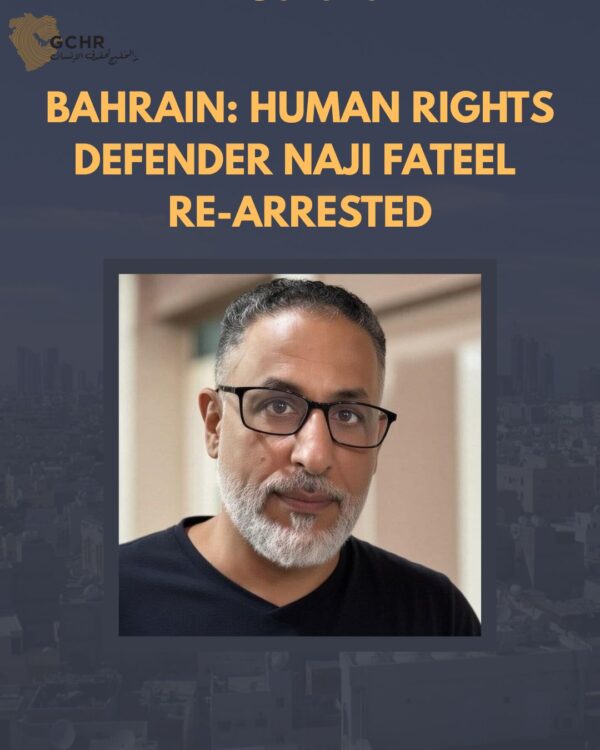
Human rights defender Naji Fateel re-arrested
Defenders Affected